Facing US tariffs, Africa shifts toward new economic paradigm









YAOUNDE/BEIJING - US President Donald Trump recently announced sweeping tariffs on numerous countries, including many in Africa, disrupting the international trade order. While Washington has since granted a 90-day reprieve for most of the affected countries, analysts believe the pause is likely temporary rather than a full reversal.
In this context, the African Growth and Opportunity Act (AGOA) -- a trade pact launched in 2000 and set to expire in September -- faces a bleak renewal outlook. Economists and policy experts argue that Global South countries must bolster self-reliance and enhance South-South cooperation to counter rising US protectionism and unilateralism.
In early April, the US government announced a new wave of tariffs targeting a wide array of countries, with several African economies among the hardest hit. The measures include duties of up to 50 percent on goods from Lesotho, 47 percent from Madagascar, 40 percent from Mauritius, and 37 percent from Botswana.
Robert Kahn, managing director for global macro at political risk consultancy Eurasia Group, acknowledged that the policy has led to "a large number of absurd figures that are meaningless".
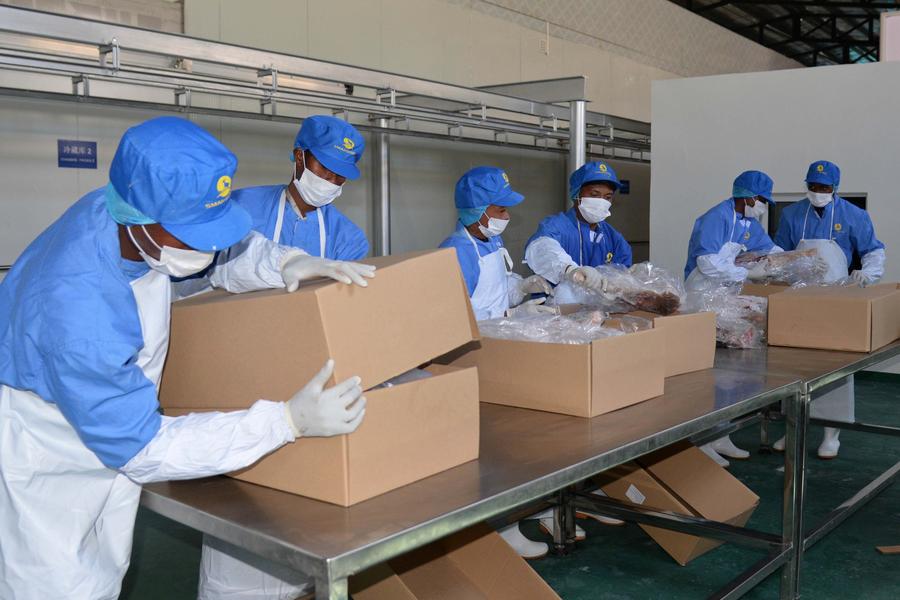
Lesotho, a small mountainous country of about two million people, has reportedly imposed reciprocal tariffs of 99 percent on US products, according to the Trump administration. Consultancy Oxford Economics noted that Lesotho's textile sector, which employs approximately 40,000 people, is especially vulnerable.
"The 50 percent reciprocal tariff introduced by the US government is going to kill the textile and apparel sector in Lesotho," said Thabo Qhesi, an independent analyst based in Maseru, Lesotho's capital. "Then you are having retailers who are selling food. And then you have residential property owners who are renting houses for the workers. So this means if the closure of factories were to happen, the industry is going to die and there will be multiplier effects."
In the long run, the indirect effects of trade disruptions, global trade wars, and the closure of Western markets could pose significant challenges for African economies, which depend heavily on exports as a primary source of income and foreign exchange, said Celestin Monga, a Cameroonian economist and former vice president of the African Development Bank.
"A global economic slowdown means reduced demand for oil and other raw materials, which in turn causes a drop in the prices of crude oil and other unprocessed African products," Monga emphasized.
AGOA, which provides preferential duty-free access to the US market for over 30 African countries, has played a key role in supporting export-led growth across the continent. However, with the imposition of high US tariffs, analysts warn that the renewal of AGOA appears increasingly uncertain, and it may not survive to its 25th anniversary.
Cameroonian economist Michelle Josee Ekila noted that uncertainty surrounding AGOA's future could significantly constrain trade and drive up costs for African exporters.
While African countries are pushing for a 10-year extension, many economists doubt whether the current US administration is committed to continued cooperation. "The US tariffs effectively nullify AGOA," said Daniel Silke, director of South Africa's Political Futures Consultancy.
The director even warned that the program could be terminated before its scheduled expiry unless African countries demonstrate strong strategic value to justify its continuation.
In response to these mounting challenges, African leaders and economists are calling for a shift in strategy.
Monga suggested that African countries establish national development banks and mobilize both public, private and institutional financing to develop industrial parks centered on local production and processing. These would serve emerging markets eager for "Made in Africa" goods that meet international standards.
Ekila emphasized the need to diversify export markets. "Exploring trade agreements with other regions, such as the European Union or Asia, could offset losses from the new tariffs."
Nkolo Foe, a former professor at the University of Yaounde I, echoed the urgency for South-South cooperation. "The measures taken by Donald Trump directly impact the Global South and are destabilizing the international order and peaceful coexistence. The countries of the Global South, and particularly Africa, are waking up."
Humphrey Moshi, director of the Center for Chinese Studies at the University of Dar es Salaam in Tanzania, called for a proactive and strategic approach to the evolving global situation. He said rather than trying to catch up, countries should invest in resilience, regional integration, and smart partnerships.
"The United States may try to create disruptions, but it is cooperation -- not confrontation -- that supports development," he noted. "For the Global South, especially Africa, this is an opportunity to rethink partnerships, strengthen regional ties, and engage on equal footing with emerging powers such as China."