


Still shooting for the stars
More space missions planned, including a manned trip to the moon and one that would bring back samples from Mars










Martian adventure
After the Tianwen 2 mission, China plans to launch the Tianwen 3 robotic craft around 2028. That mission is expected to bring Martian soil back to Earth around 2031.
Chinese researchers are working on essential technologies to be used in the expedition, including sampling and liftoff devices, on the Martian surface, according to the CNSA.
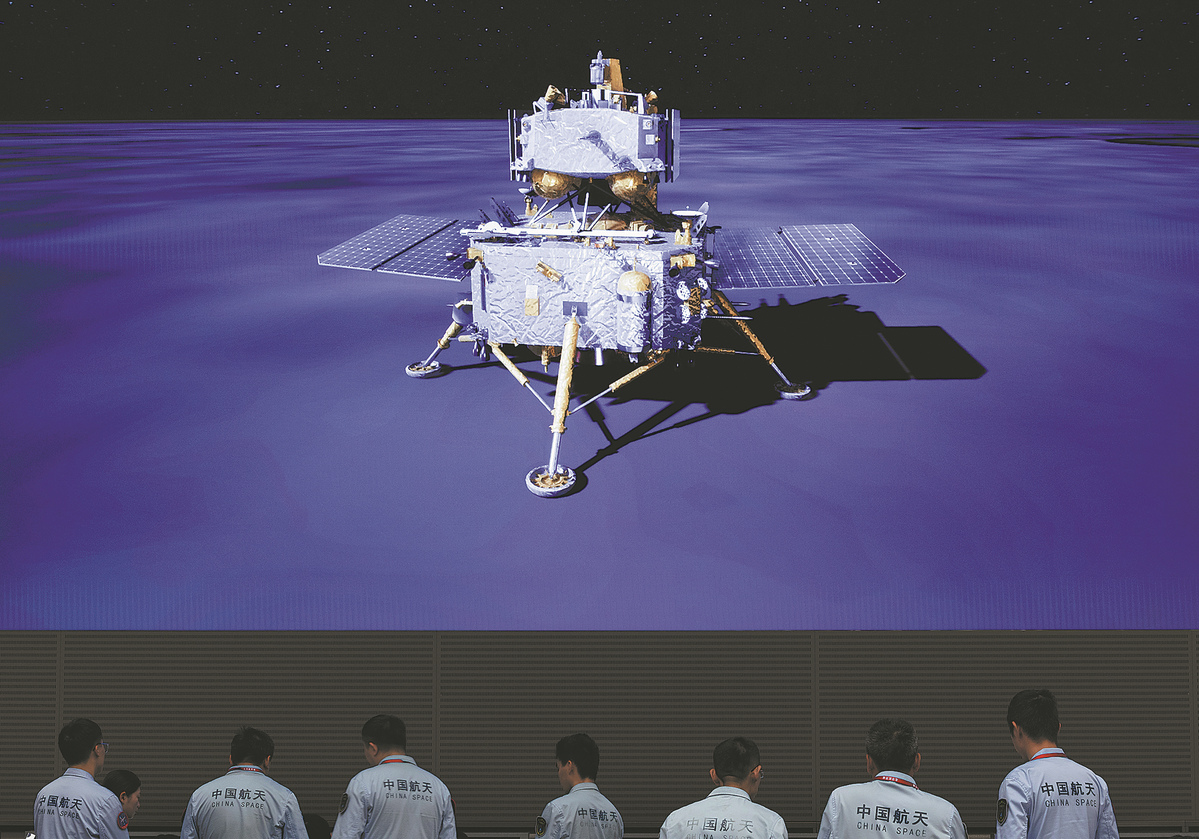
The Tianwen 3 probe will have four components — a lander, an ascender, an orbiter and a reentry module — and will be launched on two Long March 5 heavy-lift carrier rockets from the Wenchang Space Launch Center in Hainan province.
The lander and ascender will take an Earth-Mars transfer trajectory and carry out orbital correction maneuvers before entering Martian orbit, after which they will attempt an engine-assisted soft-landing.
Meanwhile, the orbiting stack — the orbiter and reentry module — will follow the same path to reach Martian orbit, after which they will fly around Mars to relay signals and wait for the samples.
Once the samples are collected and packed into a vacuumed metal container, the ascender's engines will elevate it to orbit to rendezvous and dock with the reentry module, transfer the samples and undock.
The orbiting stack will then leave Martian orbit and return to Earth's orbit, where the pair will break up and the reentry module will conduct a series of complicated maneuvers to return to a preset landing site.
Scientists at the Deep Space Exploration Laboratory in Hefei, Anhui province, a major research and engineering body in China's interplanetary study community, have proposed 86 potential landing sites on the Red Planet, primarily concentrated in the ancient Chryse Planitia and Utopia Planitia regions, which encompass diverse geological environments such as ancient coastlines, deltas, ancient lakes and canyon systems, providing favorable conditions for the origin and preservation of potential ancient life, according to an article published in the November edition of the academic journal National Science Review.
Yang Yuguang, a senior space industry observer and chair of the International Astronautical Federation's Space Transportation Committee, explained that any country wishing to bring samples back from Mars will need to overcome many extremely difficult issues.
For instance, he said, engineers will need to build and launch a massive spacecraft, which will be able to lift off from the Martian surface to send samples to Martian orbit.
Meanwhile, landing such a big vessel safely on the Martian surface would be exceptionally challenging, given that landing on Mars is far more difficult than a lunar landing due to the complex atmosphere surrounding the barren planet, Yang said.
Even if an ascending craft could land on Mars and later lift off, he said there would be a new challenge — how to guide it to carry out an accurate rendezvous and docking with the orbiter flying around the planet to wait for samples.
Designers will have to figure out a solution to lead the sample-loaded ascender to find and connect with the orbiter without any Earth-based telemetry support, according to the expert.
If everything goes according to plan, the samples could become the first to be returned to Earth from Mars. They will help scientists identify traces of life on the Red Planet, learn more about the planet's geology and inner structures and understand its atmospheric cycles.
Space officials said China is open to cooperation with foreign scientists working on the Tianwen 3, encouraging them to take part in payload design, and sample and data analysis.





