Facing the end on their own terms









To Yu Bo, a 41-year-old filmmaker from Beijing, death once felt like a distant concept — something dramatic, even cinematic.
He had spent years documenting life-or-death moments in ICUs, always from behind the camera. But everything shifted when Yu experienced three severe episodes of acute pancreatitis in a single year.
"It was all self-inflicted — alcohol, social events," Yu says. "But it made me realize that death is the one destination we all share. I wanted to understand it, to choose how I face it."
Last month, he signed a living will via an online platform, joining a growing number of people who are formally documenting their end-of-life wishes. He chose to forgo cardiopulmonary resuscitation, mechanical ventilation, and tube feeding should his condition be deemed irreversible.
As China develops, life expectancy has steadily risen — reaching an average of 79 years in 2024, among the highest in the developing world. Many older adults are now living longer, healthier lives, but the rise in chronic illness and end-of-life challenges is prompting deeper reflection on how to age — and die — with dignity.
In this shifting landscape, end-of-life planning is slowly entering public conversations. Once seen as taboo, living wills and advance directives are gaining ground, offering individuals greater control and families a clearer sense of their loved ones' final wishes.
Yu is part of a demographic driving this change: educated, urban, tech-savvy adults aged 30 to 59. This age group accounts for two-thirds of the more than 60,000 people who have signed living wills with the Beijing Living Will Promotion Association — formerly known as the Choice and Dignity platform — since 2010.
"At our age, the most obvious sign is that you get fewer wedding invitations and more funeral notices," he says. "I've seen too many people suffer needlessly in their final days, like my grandfather, who was bedridden for eight years. That wasn't life. That was prolonged pain."
Nearly 70 percent of those who have signed living wills with the association hold a university degree, and most live in first-tier cities like Beijing, Shanghai and Shenzhen of Guangdong province, where exposure and access to new ideas shape their attitudes.
Growth was initially rapid, peaking at about 15,000 a year six years ago, but this has since slowed. According to Wang Bo, secretary-general of the association, this isn't due to waning interest, but rather the emergence of more means for writing wills, such as hospitals, civic groups and notary offices.
"Public awareness has grown," Wang says. "When we first started, no one responded to the information we shared on WeChat. But now, even high school students have joined our volunteer team."
Still, progress clashes with tradition. In China, cultural norms surrounding death remain strong — discussing it is often avoided, as it's seen as inauspicious. Forgoing life-prolonging treatment, no matter how futile, can be seen as unfilial. Families often insist on aggressive intervention for emotional closure or fear of being judged.
Qin Yuan, a doctor at the palliative care center at Beijing Haidian Hospital, often sees this tension. "People believe that as long as their elderly relatives are alive, their family is whole," she explains. "They also worry about being judged for 'giving up' too early."
To navigate this, her team holds family meetings to align patient wishes with family expectations. "It's a daily negotiation," she says.
Now, policy is beginning to reflect shifting attitudes.
In 2023, Shenzhen became the first city in the country to legally recognize living wills, allowing residents to reject invasive treatment at the end of their lives.
The move sparked unexpected interest, with notary offices reporting rising numbers of people seeking to formalize their wishes.
"Young people and childless couples are increasingly seeking notarization," says Liu Suimei, a Shenzhen notary. "They care deeply about preserving dignity in their final moments."
As China's population ages — currently there are more than 310 million people aged 60 and above — the government has been expanding palliative care services as part of a broader strategy to meet the needs of its elderly citizens.
Hospice units in China grew from 510 in 2020 to 4,259 in 2022, with pilot facilities reaching 185 cities and counties. Yet access remains uneven, especially in less-developed western regions. By 2025, the government aims to establish at least one palliative care ward in every pilot area, ensuring coverage across both urban and rural communities.
Momentum is building. In 2024, a national political adviser proposed the expansion of education and policy support. Advocates want advance directives linked to health IDs, ensuring that people's wishes follow them to the hospital.
This shift mirrors a global trend. The United States is moving from static living wills to ongoing advance care planning. China is adapting similar models.
Wang envisions advance care planning, which will be a key focus for her association in the future, as a tool to translate personal preferences into actionable medical plans.
She says the association plans to use big data to inform policy and expand outreach via video-sharing and streaming platforms like Douyin and Bilibili.
Still, cultural resistance lingers.
"Some people just wave us off, as if talking about death will make it come sooner," says Xiang Qiaozhen, a palliative care nurse in Zhejiang province and a volunteer advocate. "But waiting until the very end often means missing the chance to have the conversation at all."
She has not signed a living will herself, but her daughter knows her wishes. "One day, she told me, 'If it ever comes to that, I'll make sure you go into palliative care'," Xiang says. "That kind of quiet understanding is what we hope to build."
Yu, too, faced pushback. After sharing his decision to sign a living will on his WeChat account, friends flooded him with calls, assuming he was terminally ill. "They couldn't believe I'd made such a choice just to be prepared," he says.
"Our discomfort with death is almost in our cultural DNA," Yu reflects. "We fear it, avoid it, and rarely claim ownership of it. But choosing how we leave this world should be our right."
Despite this, he remains hopeful. "I believe more people will choose the same path," he says. "I want to tell their stories through film. Maybe then, we'll learn to talk about death — not to dwell on it, but to live more wisely because of it."
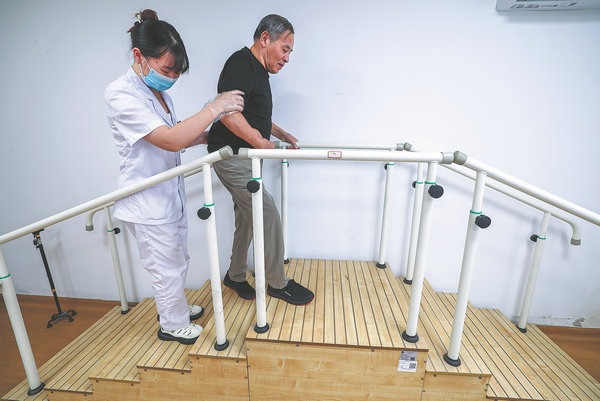
A therapist assists an elderly man in rehabilitation training in Shaoxing, Zhejiang province, on Sept 5. XU YU/XINHUA
To Yu Bo, a 41-year-old filmmaker from Beijing, death once felt like a distant concept — something dramatic, even cinematic.
He had spent years documenting life-or-death moments in ICUs, always from behind the camera. But everything shifted when Yu experienced three severe episodes of acute pancreatitis in a single year.
"It was all self-inflicted — alcohol, social events," Yu says. "But it made me realize that death is the one destination we all share. I wanted to understand it, to choose how I face it."
Last month, he signed a living will via an online platform, joining a growing number of people who are formally documenting their end-of-life wishes. He chose to forgo cardiopulmonary resuscitation, mechanical ventilation, and tube feeding should his condition be deemed irreversible.
As China develops, life expectancy has steadily risen — reaching an average of 79 years in 2024, among the highest in the developing world. Many older adults are now living longer, healthier lives, but the rise in chronic illness and end-of-life challenges is prompting deeper reflection on how to age — and die — with dignity.
In this shifting landscape, end-of-life planning is slowly entering public conversations. Once seen as taboo, living wills and advance directives are gaining ground, offering individuals greater control and families a clearer sense of their loved ones' final wishes.
Yu is part of a demographic driving this change: educated, urban, tech-savvy adults aged 30 to 59. This age group accounts for two-thirds of the more than 60,000 people who have signed living wills with the Beijing Living Will Promotion Association — formerly known as the Choice and Dignity platform — since 2010.
"At our age, the most obvious sign is that you get fewer wedding invitations and more funeral notices," he says. "I've seen too many people suffer needlessly in their final days, like my grandfather, who was bedridden for eight years. That wasn't life. That was prolonged pain."
Nearly 70 percent of those who have signed living wills with the association hold a university degree, and most live in first-tier cities like Beijing, Shanghai and Shenzhen of Guangdong province, where exposure and access to new ideas shape their attitudes.
Growth was initially rapid, peaking at about 15,000 a year six years ago, but this has since slowed. According to Wang Bo, secretary-general of the association, this isn't due to waning interest, but rather the emergence of more means for writing wills, such as hospitals, civic groups and notary offices.
"Public awareness has grown," Wang says. "When we first started, no one responded to the information we shared on WeChat. But now, even high school students have joined our volunteer team."
Still, progress clashes with tradition. In China, cultural norms surrounding death remain strong — discussing it is often avoided, as it's seen as inauspicious. Forgoing life-prolonging treatment, no matter how futile, can be seen as unfilial. Families often insist on aggressive intervention for emotional closure or fear of being judged.
Qin Yuan, a doctor at the palliative care center at Beijing Haidian Hospital, often sees this tension. "People believe that as long as their elderly relatives are alive, their family is whole," she explains. "They also worry about being judged for 'giving up' too early."
To navigate this, her team holds family meetings to align patient wishes with family expectations. "It's a daily negotiation," she says.
Now, policy is beginning to reflect shifting attitudes.
In 2023, Shenzhen became the first city in the country to legally recognize living wills, allowing residents to reject invasive treatment at the end of their lives.
The move sparked unexpected interest, with notary offices reporting rising numbers of people seeking to formalize their wishes.
"Young people and childless couples are increasingly seeking notarization," says Liu Suimei, a Shenzhen notary. "They care deeply about preserving dignity in their final moments."
As China's population ages — currently there are more than 310 million people aged 60 and above — the government has been expanding palliative care services as part of a broader strategy to meet the needs of its elderly citizens.
Hospice units in China grew from 510 in 2020 to 4,259 in 2022, with pilot facilities reaching 185 cities and counties. Yet access remains uneven, especially in less-developed western regions. By 2025, the government aims to establish at least one palliative care ward in every pilot area, ensuring coverage across both urban and rural communities.
Momentum is building. In 2024, a national political adviser proposed the expansion of education and policy support. Advocates want advance directives linked to health IDs, ensuring that people's wishes follow them to the hospital.
This shift mirrors a global trend. The United States is moving from static living wills to ongoing advance care planning. China is adapting similar models.
Wang envisions advance care planning, which will be a key focus for her association in the future, as a tool to translate personal preferences into actionable medical plans.
She says the association plans to use big data to inform policy and expand outreach via video-sharing and streaming platforms like Douyin and Bilibili.
Still, cultural resistance lingers.
"Some people just wave us off, as if talking about death will make it come sooner," says Xiang Qiaozhen, a palliative care nurse in Zhejiang province and a volunteer advocate. "But waiting until the very end often means missing the chance to have the conversation at all."
She has not signed a living will herself, but her daughter knows her wishes. "One day, she told me, 'If it ever comes to that, I'll make sure you go into palliative care'," Xiang says. "That kind of quiet understanding is what we hope to build."
Yu, too, faced pushback. After sharing his decision to sign a living will on his WeChat account, friends flooded him with calls, assuming he was terminally ill. "They couldn't believe I'd made such a choice just to be prepared," he says.
"Our discomfort with death is almost in our cultural DNA," Yu reflects. "We fear it, avoid it, and rarely claim ownership of it. But choosing how we leave this world should be our right."
Despite this, he remains hopeful. "I believe more people will choose the same path," he says. "I want to tell their stories through film. Maybe then, we'll learn to talk about death — not to dwell on it, but to live more wisely because of it."