Finding dignity and peace at the end of life
As nation's population ages, cultural taboo of hospice care slowly lifted









Challenges and promises
The hospice care movement traces its origins to Cicely Saunders, who founded St. Christopher's Hospice in the United Kingdom in 1967. It emerged in response to the limitations of modern medical technology, which, while capable of extending life, often prolonged the suffering of terminally ill patients. Hospice care offered an alternative — prioritizing comfort and dignity over curative treatments.
China began to explore the concept of hospice care in the late 1980s. In 1988, Tianjin Medical College established the country's first hospice care research center. However, progress remained minimal until the last decade. In 2016, hospice care was included in a national health policy document for the first time. The following year, the National Health Commission issued guidelines for its implementation, spurring rapid growth. The number of medical institutions with hospice care departments expanded from 276 in 2018 to 4,259 by the end of 2022.
Despite these strides, the need for palliative care far outweighs its availability. According to a 2024 report by the Ministry of Civil Affairs, China officially entered the "deep aging" stage in 2023, with over 14 percent of its population aged 65 and above. By 2035, the country is projected to become a super-aged society.
China faces further hurdles in medication access. Of the country's 1 million registered medical institutions, only about 36,000 are authorized to prescribe painkillers, and fewer than 18,000 have intravenous pain medications. Fewer than 5,000 institutions nationwide have dedicated palliative care departments. These limitations severely constrain the development of home-based palliative care, which forms the backbone of services in countries like the United States, Japan, and Australia, where over 70 percent of palliative care is delivered at home.
"Palliative care is not about giving up on patients; it's about balancing the length and quality of life," said Chen Yan, a physician in the Palliative Care Department at Fuzhou First Hospital. "It's about focusing on the patient — considering their wishes and addressing their needs."
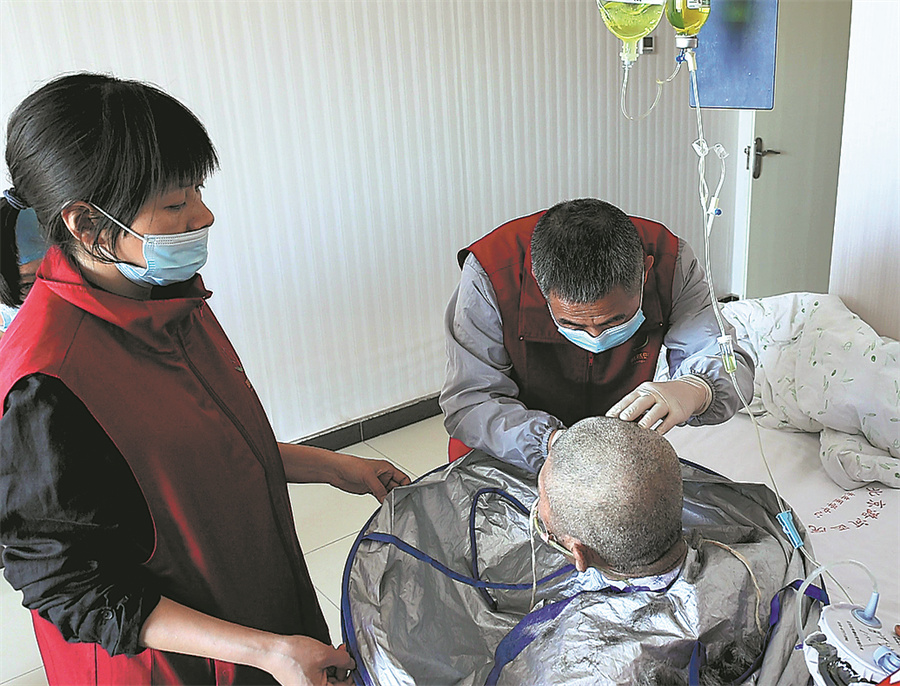
Fuzhou First Hospital's Palliative Care Department is the only one of its kind in a tertiary hospital in Fujian province. The multidisciplinary team includes doctors, nurses, social workers, volunteers and nutritionists. They offer therapies such as aromatherapy, music therapy, and lymphatic care to provide patients with comprehensive support.
Yet even as the number of hospice facilities increases, the gap between need and availability remains vast. According to Lu Guijun of Beijing Tsinghua Changgung Hospital, more than 10 million people die annually in China, with approximately 3 million deaths from cancer. "Two-thirds of these individuals require palliative care services, but the actual coverage rate is extremely low," Lu said.
Although precise statistics are unavailable, industry experts estimate that less than 10 percent of terminally ill patients in China access palliative care each year. Even those fortunate enough to access such services often face significant hurdles, including long waitlists and limited resources.





- Dog weddings — how new industry laps up puppy love
- Efficient medical care draws foreigners
- Arrival of Losar brings joy, good fortune to Tibetans
- Wide view seen as key to full grasp of China
- 10 dead and 84 injured in explosion at steel plant
- China unveils flexible urban planning rules to improve lives, foster new industries