Deep-sea vault built to capture CO2
Carbon storage project beneath South China Sea set to secure millions of tons of greenhouse gas










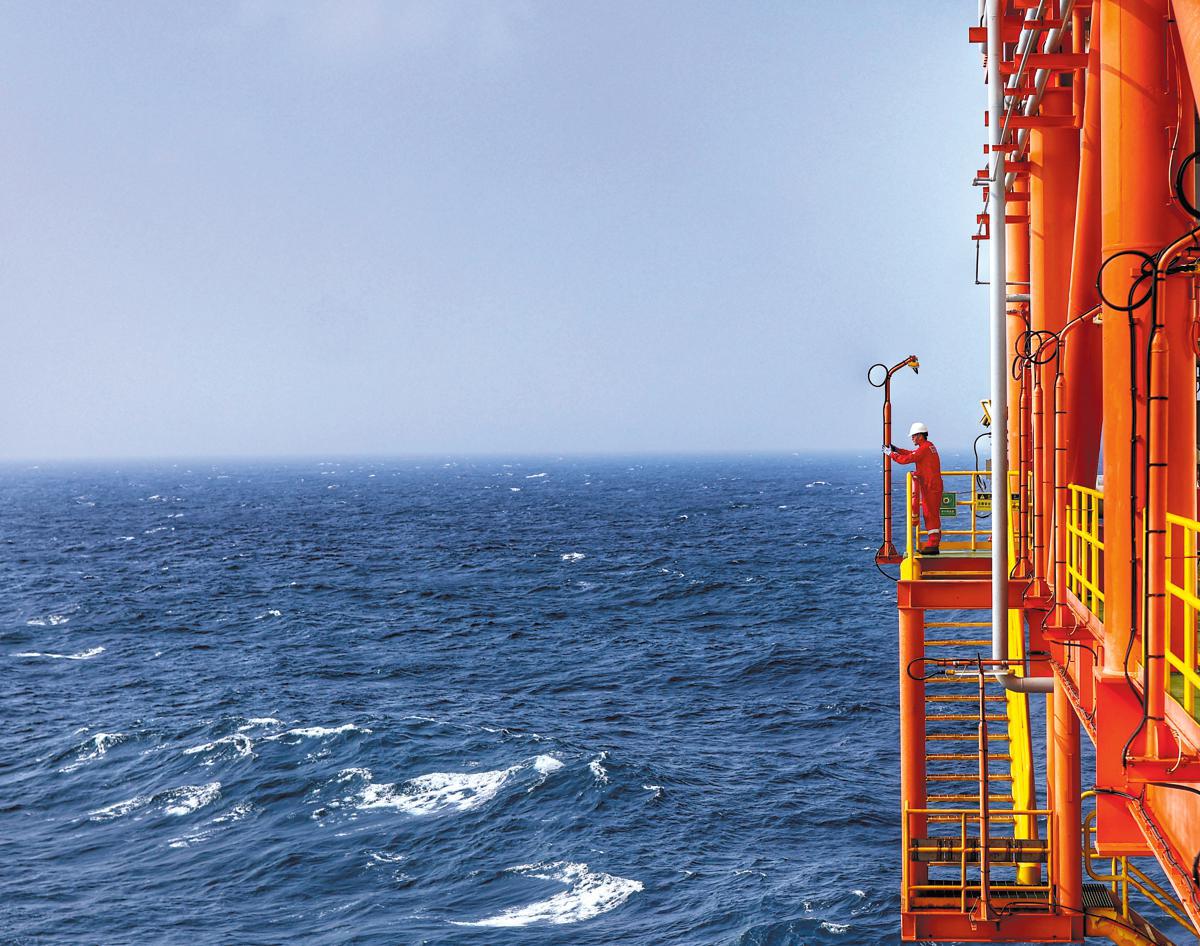
Going big
In its quest for net-zero emissions, China is betting big on the nascent technology.
As of November 2022, the number of CCUS demonstration projects in China in operation, under construction or being planned, was more than 100, according to CCUS Progress in China — a status report released in 2023 by the Global CCS Institute, Tsinghua University, and the Administrative Center for China's Agenda 21.
Nearly half the projects are operational, the report said, with an annual CO2 capture capacity exceeding 4 megatons and injection surpassing 2 megatons — marking increases of roughly 33 percent and 65 percent respectively, since 2021.
In April 2024, China unveiled its first batch of green, low-carbon technology demonstration projects eligible for government grants. Of 47 selected projects, six were CCUS technology related.
As the number of projects grows, they have spread across diverse industries, spanning traditional sectors like oil and gas, chemicals and electricity, to industries including cement, and iron and steel. These are generally considered sectors where it is hard to cut emissions.
In June 2023, the Taizhou Power Plant in Jiangsu province commissioned Asia's largest coal-power CCUS facility, with an annual capacity of 500,000 tons of carbon dioxide — a milestone for the region's energy transition.
Beyond enhanced oil recovery, China is exploring innovative CO2 applications, including microalgae cultivation and high-value product manufacturing.
In December 2022, Zhejiang University and Guangdong Energy Group jointly established the first demonstration project using flue gas for microalgae cultivation and CO2 sequestration at Guangdong Yudean Zhanjiang Biomass Power Generation Co.
In 2024, the Global CCS Institute's Global Status report for the first time devoted a separate section to the development of CCUS in China, as the technology gained wider international traction.
Growing acceptance
As of July 2024, the number of global carbon capture and storage projects in development had surged to 628, marking a 60 percent year-on-year jump, the CCS 2024 report showed.
Another 50 CCS facilities were in operation, with 44 under construction.
The International Energy Agency reports a surge in CCUS development, with 38.4 megatons a year capacity under construction, and 346.8 megatons in planned projects to be achieved by 2030.
By 2030, this growth could help CCUS deliver 8 percent of emissions reductions needed to meet net-zero goals, according to the IEA's 2023 analysis. The agency emphasizes the current decade is critical for scaling investments to meet climate targets.
Recognizing CCUS' decarbonization potential, many countries are taking action to incorporate it in their push to carbon neutrality.
The United Kingdom and Japan have implemented policies to accelerate CCUS deployment, while also developing related regulatory frameworks and technical standards.
In Asia, countries constrained by land such as Singapore, South Korea, and Japan, are making cross-border agreements to export CO2 for storage in nations with abundant geological capacity, including Australia, Malaysia, and Indonesia.
Xie emphasized the need for expanded policy support to drive adoption of CCUS. Citing Singapore's carbon tax as an effective model, she said such measures create financial incentives for emission reductions.
Direct subsidies for CCUS projects, enterprise carbon allowances, and the expansion of carbon trading mechanisms to further stimulate private sector engagement could be introduced, she said.
Sun, from the Panyu Development Office, said: "When key conditions align — including suitable large-scale storage sites, higher carbon credit prices, and robust policy support — the CCUS industry will reach its tipping point."
China's maritime territories have immense CO2 storage capacity, with a total of 2.58 trillion tons of offshore storage potential. The Pearl River Delta is able to store 300 billion tons, according to a report released in January 2023 by the China Geological Survey at the Ministry of Natural Resources.
"The Greater Bay Area presents a unique opportunity," Sun said. "Its vibrant industries demand emission solutions that align perfectly with these massive undersea storage resources."
However, she highlighted key challenges for the Daya Bay CCUS project.
The primary challenge involves identifying and consolidating dispersed onshore carbon sources. A second major difficulty lies in ensuring the safe, efficient transportation of these substantial volumes of gas to precise undersea storage locations. Perhaps most critically, the storage duration presents unique challenges — requiring containment security for potentially thousands of years.
Sun emphasized that unlike typical industrial projects spanning decades, CCUS demands consideration of long-term consequences, including assessing whether stored gases might eventually re-enter marine ecosystems centuries later.
stushadow@chinadailyhk.com