China charging ahead in computing power
Nation's ambition to develop AI underpinned by aggressive investments in infrastructure











At the 8th Digital China Summit held in Fuzhou, Fujian province, from April 29 to 30, the spotlight shone brightly on China's accelerating artificial intelligence revolution.
A robotic dog flawlessly performed backflips on stage, humanoid robots sang emotionally resonant tunes, and an array of AI-powered gadgets — smart toys, glasses, mice and autonomous driving systems — captivated audiences.
Beyond the spectacle, however, lies a profound transformation: AI is no longer confined to laboratories or urban hubs, but is rapidly permeating every corner of the Chinese society, from farmlands to cities.
Behind this AI-driven metamorphosis is an invisible yet indispensable force: computing power.
As the backbone of AI development, computing power has become the battleground for global technological supremacy, and China is charging ahead with unprecedented momentum.
Roughly defined as the ability to process data, computing power includes information infrastructure and technologies to support information computing power, data storage and network capacity in the digital economy era.
China's ambition to develop AI is underpinned by aggressive investments in computing infrastructure.
According to the Ministry of Industry and Information Technology, China's total computing power reached 280 EFLOPS by the end of 2024, with intelligent computing power accounting for 90 EFLOPS, or over 30 percent of the total.
EFLOPS measure the speed of computer systems. It equals 1 quintillion floating-point operations per second.
By 2025, the country aims to boost its aggregate computing capacity to 300 EFLOPS, with AI computing power projected to rise to 35 percent of the total.
This push aligns with a national strategy to position computing power as the "new engine" of the digital economy.
Wu Hequan, an academician at the Chinese Academy of Engineering, emphasized that every yuan ($0.139) invested in computing power drives 3 to 4 yuan in GDP growth. "In the global race for AI leadership, expanding computing power supply is critical," he noted.
Wu also emphasized the pivotal role of cutting-edge digital tools in boosting corporate productivity and reducing operational expenditures.
He projected robust growth for AI-driven software and services in the coming years, forecasting their emergence as a major catalyst for national economic expansion.
At the summit, State-owned telecom carrier China Telecom unveiled its upgraded intelligent cloud ecosystem, cementing its role as a linchpin in China's AI infrastructure.
With its Tianyi Cloud, or China Telecom Cloud, now ranking as the nation's largest cloud service provider by revenue — 113.9 billion yuan in 2024, surpassing Alibaba Cloud — the company is positioning itself as the "National Cloud" to spearhead China's transition from digitization to intelligent transformation.
"Cloud is the cornerstone of AI development," said Ke Ruiwen, chairman of China Telecom, during his keynote speech. "The company is committed to building Tianyi Cloud into a world-class intelligent cloud platform that integrates computing power, data, models and applications."
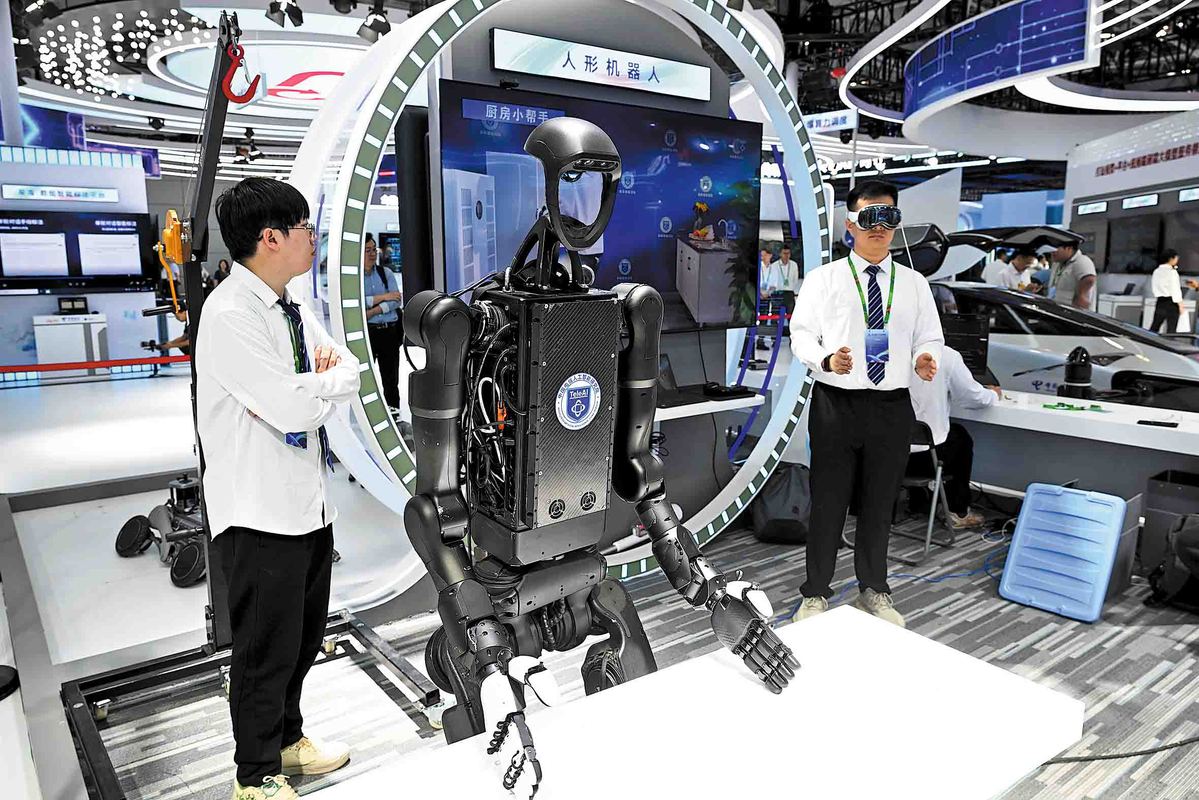
China Telecom's strategy hinges on two pillars, namely core technology innovation and scale. The company has established mega computing clusters in Shanghai and Beijing, and developed a fully self-reliant cloud stack, including the distributed cloud operating system CTyunOS — certified for national security reliability.
Notably, its "Xingchen" (Star-Ocean) large language model — boasting trillions of parameters — has been open-sourced, a rarity among State-owned enterprises.
Paired with the "StarSea" data intelligence platform, which aggregates over 10 trillion tokens of high-quality datasets, China Telecom has deployed more than 50 industry-specific AI applications in sectors like government, manufacturing and education.
China Telecom is aggressively commercializing AI, with smart terminals such as AI phones, cloud computers, and cameras already reaching 87 million users.
Its "five-in-one" intelligent cloud ecosystem — spanning computing power, platforms, data, models and applications — aims to popularize AI access. The newly launched Triless computing architecture, for instance, simplifies cross-domain, heterogeneous computing resource scheduling and AI development, significantly lowering barriers for enterprises, China Telecom said.
The summit also highlighted innovative applications of AI large language models across diverse sectors, showcasing China's push to transform traditional industries through intelligent upgrades.
In Hubei province's Lichuan, a pioneering county-level AI ecosystem is redefining tourism.
Leveraging Huawei's Ascend computing infrastructure and iFlytek's Spark large language model, the Lichuan Intelligent Computing Center has launched the nation's first county-level tourism-focused AI model.
The "AI Travel Lichuan" mini-program offers personalized itinerary planning, such as recommending family-friendly routes, accommodation, and transportation options for visits to local attractions. For merchants, the model generates targeted marketing content and optimizes order management.
AI's industrial footprint is also expanding rapidly.
Over 30,000 basic-level smart factories, 1,200 advanced facilities and 230 "exemplary" intelligent factories now operate across China, covering 80 percent of manufacturing sectors, driving efficiency and innovation, according to data from MIIT.
At the summit, Chinese automaker FAW Group unveiled OpenMind, an enterprise AI agent built on Alibaba's Qwen large language model. Capable of multi-turn dialogue, OpenMind streamlines business processes, policy consultations, and decision-making support, marking a leap in industrial automation.
Meanwhile, Inspur Yunzhou, an industrial internet leader in China, demonstrated how its Zhiye large model empowers sector-specific solutions.
Qi Guangpeng, chairman of Inspur Yunzhou, said the company collaborated with a cable manufacturer to train a specialized model using industry data to optimize processes like optical fiber sintering and equipment maintenance, boosting productivity by 20 percent and maintenance efficiency by 30 percent.
Despite its momentum, China faces hurdles in sustaining AI leadership.
Ke from China Telecom highlighted risks such as data bias, sensitive information leaks and AI-generated disinformation. To address these, China Telecom is building a "dynamic security shield" for AI systems, integrating safeguards across infrastructure, algorithms and content.
China's digital transformation has made great strides in recent years, with the Digital China Development Index climbing to 150.51 in 2024, up 10.65 percent from the previous year, said the National Data Administration.
The index is a benchmark for the assessment of China's digital progress. In 2024, indicators such as digital infrastructure and digital technology rose by 17.55 percent and 13.56 percent, respectively.
Jiang Xiaojuan, a professor at the University of the Chinese Academy of Social Sciences, noted that emerging technologies such as artificial intelligence, big data analytics and internet-based systems have revolutionized the capacity to generate, process and distribute data on an unprecedented scale.
Highlighting China's position as the global leader in data production, Jiang stressed the nation's strategic edge in advancing its digital economy.
She called for intensified efforts to streamline public data sharing mechanisms, foster collaborative data utilization and strengthen governance frameworks to fully harness the transformative potential of data resources.