High-tech solutions transforming medical services









From triage and testing to diagnostics and surgeries, China's healthcare sector is rapidly integrating artificial intelligence technology into medical practices to improve efficiency and upgrade quality.
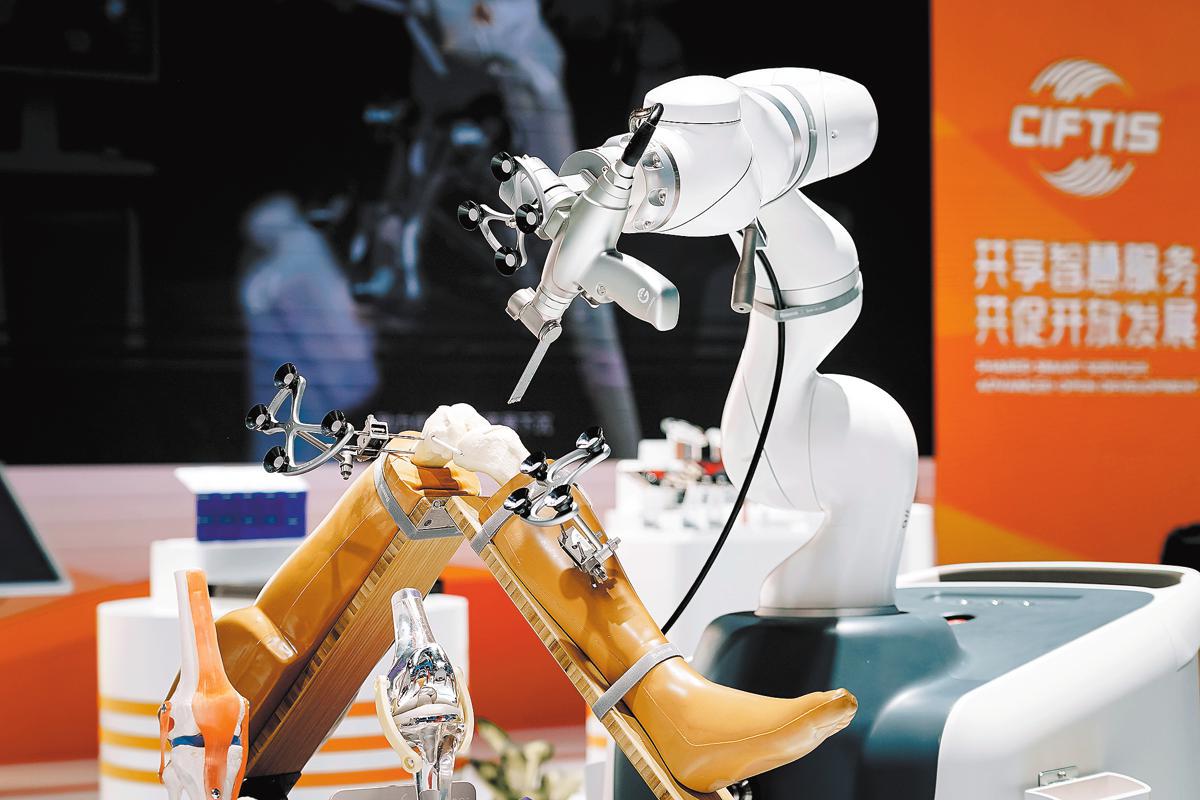
At the 2025 China Medical Equipment Exhibition in mid-March, Longwood Valley MedTech unveiled its ROPA orthopedic smart surgical robot, a groundbreaking device packed with AI deep-learning features. Like a super-smart assistant for doctors, it helps with preoperative decision-making and planning.
The robot can be used in joint replacement and spinal surgeries with its AI system being able to create a 3D model of the human joint based on the patient's CT images, allowing doctors to simulate the surgery in advance and formulate preoperative plans, said Chen Peng, vice-president of the company.
"Manual modeling usually takes a technician a whole day, while our AI system can complete it in just one to three minutes," Chen added.
He explained that the company's AI system has already been applied in surgical practices in many hospitals across the country, significantly improving surgery efficiency, safety and accuracy.
Using AI-powered robots can cut the average surgical time by 30 percent, resulting in less anesthesia, lower intraoperative exposure risks and a lower probability of complications, Chen said.
Beijing Children's Hospital's first AI pediatrician, that joined the medical team in February, also offers a helping hand.
During a joint consultation at the hospital, 10 children from across the country, each battling complex tumors or undiagnosed conditions, received diagnoses from both the AI pediatrician and a panel of medical experts. The AI pediatrician's treatment recommendations aligned closely with the expert panel's.
"I trust doctors' judgments, and I also think the opinion of the AI pediatrician can be a valuable reference," said a father from Tianjin who brought his child for the consultation.
The medical knowledge of the AI pediatrician matches that of experts at top Chinese hospitals. In recent consultations on tough cases, its conclusions were highly consistent with human experts, according to Wang Xiaochuan, founder and CEO of Baichuan AI, the developer of the AI pediatrician.
"With AI colleagues, we can better protect the health and lives of children," said Ni Xin, president of Beijing Children's Hospital, where some 8,000 to 10,000 outpatient and emergency cases are handled daily.
This AI program is expected to expand to primary-level hospitals, communities and households. It will offer on-site training for local doctors and guide home-based medical care to ease the shortage of top-notch pediatric medical resources.
So far, Chinese domestic enterprises have released over 50 AI healthcare vertical large models, according to a recent report by CITIC Securities. These models can alleviate the problem of insufficient grassroots medical resources and improve the efficiency of diagnosis and treatment at a lower cost.
Triage and medical image interpretation are currently the primary scenarios among these large models. For instance, the AI-powered cognitive function analysis system used in Peking Union Medical College Hospital in Beijing is designed for the early screening of patients and high-risk groups with brain cognitive impairments caused by stroke, Alzheimer's disease and Parkinson's disease.
The large model RuiPath at Ruijin Hospital, affiliated with the Shanghai Jiao Tong University School of Medicine, is applied to assist in analyzing pathology. Developed by Huawei, this model integrates multimodal data and incorporates the disease characteristics of the Chinese population, providing pathologists with accurate and efficient support.
Some 6,000 pathological slides are generated daily in Ruijin Hospital, with each doctor examining an average of 200 to 300 slides. Through traditional methods, doctors have to diagnose each slide under a microscope.
However, using RuiPath's interactive pathological diagnostics, the model can identify lesion areas, reducing the diagnosis time for a single slide to mere seconds.
The application of AI will effectively ease the lack of pathologists in China, improve slide examination efficiency and diagnostic accuracy, and provide more precise support for clinical treatment decisions, said Ning Guang, president of Ruijin Hospital.
However, the ultimate goal of AI technology in healthcare is not to replace doctors, said Liu Zhongjun, director of the spinal surgery institute at Peking University Third Hospital.
Instead, it should aim to relieve doctors of their repetitive tasks, allowing them to focus more on in-depth communication with patients and provide humanistic care, Liu said.
Every technological iteration should be measured by its clinical value and underpinned by patient safety. Only in this way can this AI revolution truly safeguard human health and support the future of human well-being, he said.
Xinhua