



Built on solid foundations
Hong Kong's collateral offering at the 19th Venice Biennale of Architecture is a celebration of the design intelligence and capabilities that turned the city's postwar public infrastructures into eco-friendly, community-oriented spaces. Chitralekha Basu reports.









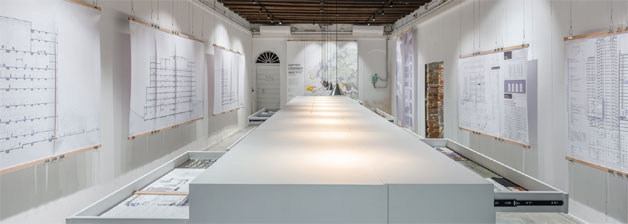
While Hong Kong's collateral event at the Biennale Architettura 2025 is meant to be a showcase for its "unsung postwar public infrastructures", the curators have opted to frame that story in the city's folk heritage and folk tradition. For instance, one of the most visible elements of the Projecting Future Heritage: A Hong Kong Archive exhibition at Campo della Tana in Castello, Venice is the bamboo scaffolding referencing a Hong Kong tradition that could have originated during the Sui Dynasty (581-618).
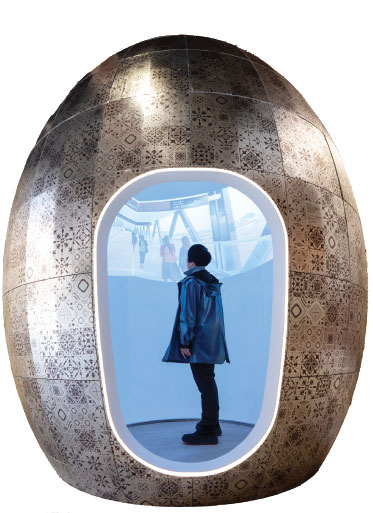
One of the exhibits, called Memory Eggency, involves an egg-shaped pod inside which visitors can embark on an immersive audiovisual journey across Hong Kong's past and present. And as eggs tend to do, the installation contains a few surprises on the inside. These include an artwork called Lasting Play, in the shape of vinyl discs with snapshots of life in Cha Kwo Ling village - the site of one of Hong Kong's earliest Hakka settlements, predating the city's colonization in 1841. Playing on a loop, the audio is a recording of the sounds of celebration around a historical figure - the naval admiral of Guangdong, Li Zhun (1871-1936) - on Chinese New Year's Day.
Projecting Future Heritage co-curator Sunnie Lau Sing-yeung, who created Lasting Play with Annie Lye, says that there are historical records to suggest that around the end of the 19th century, the naval leader would visit Hong Kong in order to make sure that the Hakka people who had traveled south to eventually settle in Kowloon were safe from pirate attacks.
On the face of it, the connection between Cha Kwo Ling and the main idea behind the show - which is to celebrate the design intelligence and capabilities that went into realizing Hong Kong's postwar public infrastructures - seems tangential. But the reference to Cha Kwo Ling is relevant on at least two counts.
First, the village was one of four Hakka settlements in Kowloon - collectively referred to as the Four Hills community whose members earned their livelihoods mainly from quarrying. The granite they unearthed was exported, leading to the beginnings of the regularization of the city's trading systems and construction industry.
Second, Cha Kwo Ling has been earmarked as a site for building a public housing project and will soon cease to exist in its present form. Hence Lasting Play is meant to be a last hurrah for the village and its inhabitants - memories of a community and a way of life linked to the city's construction history, preserved in the form of a sonic experience.
Mixed-use property pioneers
The curatorial statement of Projecting Future Heritage states that its aim is to highlight how "the city's often overlooked architectural and urban achievements have for decades fulfilled the pressing mandates that cities around the world now face, like combatting climate change; managing extreme density and maintaining a cultural life for citizens in shared public spaces".
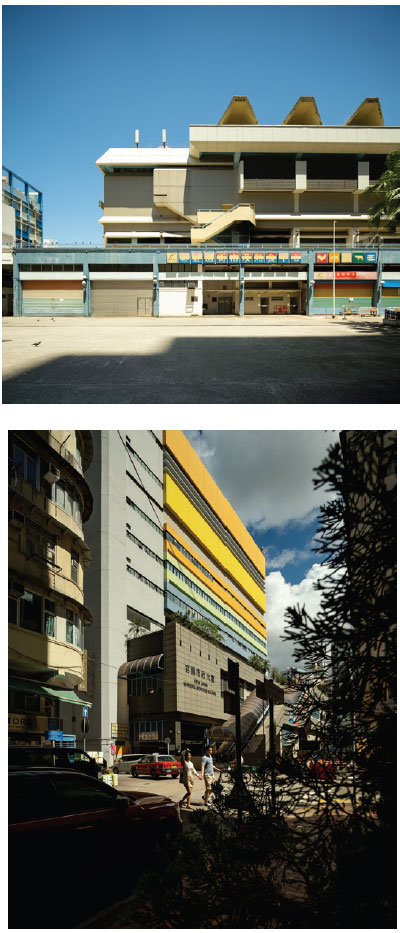
Such achievements are manifest in both composite structures, combining residential and commercial spaces, that began coming up in the late '50s as well as mixed-use municipal services buildings, the first of which was opened in Aberdeen, on southern Hong Kong Island, in 1983.
"These buildings optimized natural ventilation inside, and became 'social condensers' for sports, culture, and commerce under one roof," says exhibition co-curator Au Fai. "Sadly, these are now being sealed and air-conditioned, resulting in more energy consumption and worsened air quality."
For the Social Condenser Extraordinaire exhibit put together by Au, exhibition co-curator Zhou Ying and Guo Hongshan, the team has used archival material sourced from both Hong Kong's Public Works Department and Public Records Office as well as from private architectural practices to highlight the unique features of the mixed-use municipal services buildings that have served the city's public well for decades together.
Zhou says that the urban design archetype "is representative of the era of civic aspirations of a rapidly transforming and densifying Hong Kong". Her contention is that by redeveloping such structures the city risks the "loss of this civic-ness".
"We hope that institutional reforms can once again lead to a type as innovative as these."
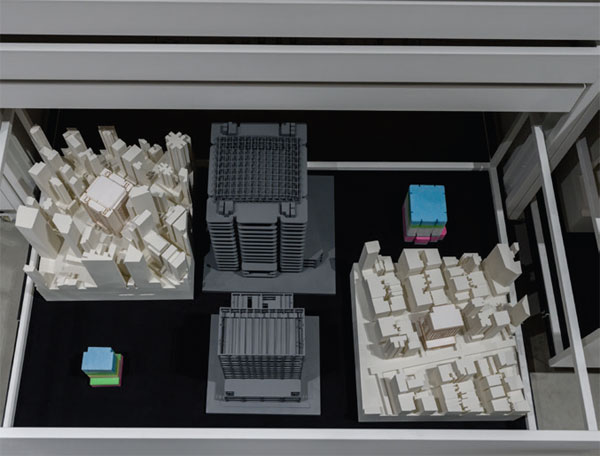
The Multiple Mansions exhibit by Eunice Seng is based on a close study of six of Hong Kong's more than 1,000 composite buildings built between the late '50s and mid-'70s. Au says that Chungking Mansions, built in 1961, is "a classic example" of typical Hong Kong "mixed-use, strata-owned architecture" that "combine domestic and commercial programming emerging out of the need to manage extreme density in the city's postwar era".
He adds that the buildings included in Multiple Mansions "were selected for their significance in terms of typological, technological, programmatic, and developmental innovation as well as their cultural meanings - such as those serving as sites of major events in the city's history". For example, before the 1037 flats and a three-story department store of the massive Metropole Building in North Point became functional in 1972, it had been a hotel and a theater in its previous incarnations and also served as a hideout for anti-colonial demonstrators in 1967.
Playfully serious
Though Projecting Future Heritage is about highlighting serious architectural concerns - the phasing out of eco-friendly and community-oriented urban designs being one - these are communicated in a playful way. The maps and architectural drawings on display in the main indoor exhibition area serve as the proverbial tip of the iceberg. For those interested in a deeper engagement with the subject, texts, images and models providing the context to each exhibit can be accessed by pulling out drawers stacked under a sprawling white table created by joining of chests - bringing to mind the ways in which space-strapped Hong Kong residents try to make optimum, and sometimes creative, use of the spaces available to them.
Au says, "We opted for a refreshing means of archival discovery, choosing stacked drawers to hold drawings and models instead of conventional wall hangings and pedestal objects. The idea is to encourage visitors to slow down and engage with the exhibition contents more closely."
A heritage on its last legs
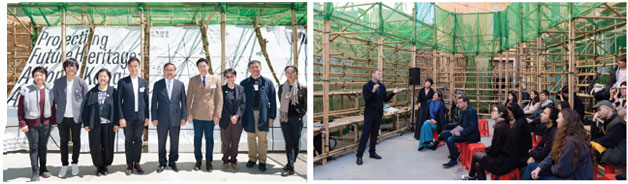
The bamboo scaffolding erected in the courtyard, which doubles as seating for visitors attending public forums, is meant as homage to a Hong Kong intangible cultural heritage that could be on its way out. In March, Hong Kong's Development Bureau announced that it will "drive a wider adoption of metal scaffolds in public building works", the logic provided being that compared to metal bamboo is more accident-prone.
Named Staging the Archive, the bamboo installation was built on site by master craftsmen flown in from Hong Kong. It illustrates some of the ideas contained inside the drawers.

Examples include photos showing the evolution of bamboo scaffolding in Hong Kong from the '30s to 2020, compiled by Zhou with Yin Law, and Bamboo City by Xiang Ji, which Au says, "captures the sense of ubiquitousness of bamboo scaffoldings in Hong Kong". He adds that the installation in the courtyard reiterates the same idea - "that the city is a product of unsung public infrastructures and the bamboo scaffolding is an integral part of that".
Guillaume Othenin-Girard, a co-founder of Architecture Land Initiative - the team behind Staging the Archive - says that situating the piece in the open-air courtyard of Campo della Tana, where it can be gazed on by residents living on the first and second floors of the surrounding buildings, creates a sense of intimate connection with viewers.
He reveals that "the neighbors had a crucial impact" on deciding on the piece's height.
"Yet the lowering of the outer ring has allowed neighboring life to enter our scene in unexpected ways, creating poetry of the ordinary - examples being the washing line and laundry drying in the sun, moving alongside the green fabric of our structure. Everyday objects and practices have suddenly been summoned as characters reinforcing the intimacy of this new urban interior."




- Xinjiang reports highest foreign trade growth in China
- Harbin authorities demand return of pensions paid out to deceased
- Global research project on AI guardrails launched in Beijing
- Partnering with China, embracing opportunities
- China's cyberspace regulators announce measures for protection of minors
- Beijing's 'Rocket Street' promoted at aerospace conference













