



Tariffs hurt global trade: Experts
Protectionism 'addictive', undermines US' own economic health, panelists say









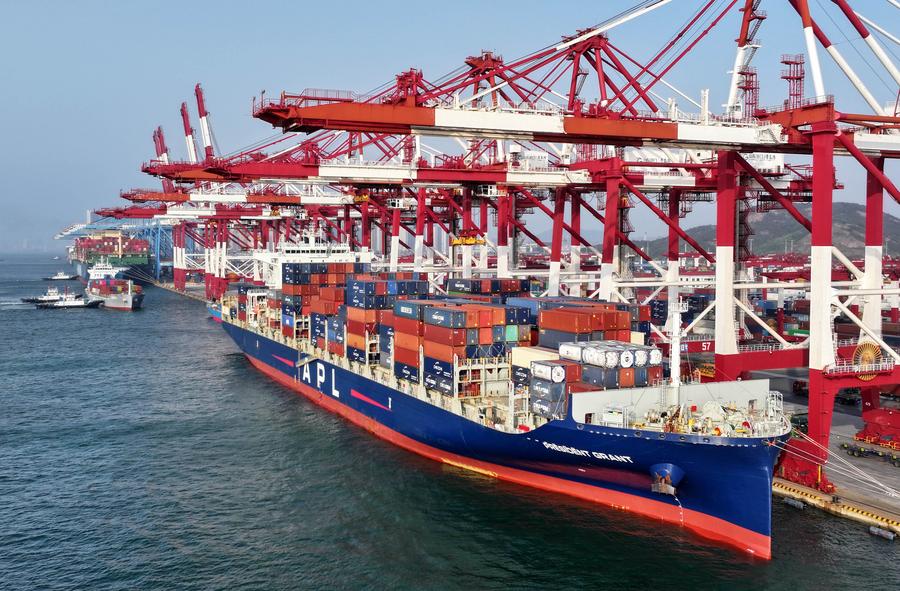
The tariff policies of the United States are like an "addictive drug" that could destabilize the global trade system and undermine its own economic health, according to experts at a World Salon and Institute for China-America Studies event earlier this month.
Randall Morck, Stephen A. Jarislowsky Distinguished Chair at the University of Alberta and a research associate at the National Bureau of Economic Research, said at the event titled "The Ripple Effect of Trump's Reciprocal Tariffs" that the US tariffs are creating a "nation of corporate fentanyl addicts" in the US. He argued that companies, once hooked on lobbying for protection, abandon innovation for political favors."Trade protectionism is like fentanyl. It's addictive to corporations because once they get into it, they just can't get out of it," Morck said.
He mentioned Argentina's economic decline under high tariffs, predicting that the US could face lower productivity, reduced living standards and a loss of global competitiveness if the policy persists.
The discussion explored how these measures are fracturing international commerce, hurting the US economy and posing challenges worldwide. With the rules-based trading order at risk, panelists said there would be broad negative consequences for both the US and the global community. The US and China recently reached a 90-day trade truce in Switzerland, but significant uncertainty remains about its long-term impact on global trade dynamics.
Patrick Leblond, a professor at the University of Ottawa, highlighted the erosion of global trade norms, noting the widespread disruption caused by the Trump administration's approach. "As the world has discovered, this new administration has gone much further than anyone anticipated a few months ago as to how far the tariffs would be imposed at large," Leblond said. He also said that the uncertainty is stifling investment and jobs globally, with ripple effects beyond the US, including in Canada.
Breakdown of trust
Leblond pointed to the breakdown of trust in international agreements, saying that the global economy could suffer as countries retreat from cooperation. He noted that the policy's impact extends to partnerships with nations adhering to trade rules, including those engaging with China, which could affect Canada's trade strategy.
Enrique Dussel Peters, a professor at the National Autonomous University of Mexico, framed the issue as part of a "new triangular relationship" involving the US, China and other nations like Mexico. He argued that the US tariffs, framed as national security measures, are dismantling the post-1944 multilateral system.
"The United States is retracting as the founder and saying, I will not participate under the rules that I established several decades ago," Dussel Peters said, noting that this shift harms global supply chains, with the US itself facing higher costs as companies adjust to disrupted flows.
Georgy Egorov, a professor at Northwestern University's Kellogg School of Management, tied Trump's tariffs to political motivations, particularly among voters blaming free trade for job losses."Certainly, people who have lost manufacturing jobs might be right, in a sense, to blame free trade for that," Egorov said. However, he doubted significant job recovery, given automation's dominance, and said that the policy's uncertainty could fragment global markets for decades. For the US, this could mean higher consumer prices and a loss of export competitiveness, while the world faces a more divided trade landscape.
James Harrigan, a professor of economics at the University of Virginia, talked about both short-term chaos and long-term damage to the US economy. "Trump's policies make no sense," Harrigan said."There's no economic rationality behind him, there's no political rationality behind him." He said businesses are delaying investments due to uncertainty, potentially triggering a US economic slowdown. Globally, he predicted, reduced trade openness would lower efficiency, with the US becoming "somewhat poorer" and other nations facing intensified pressure. The policy's instability, Harrigan added, undermines the US' leadership role in the world economy.
The panel agreed that the Trump administration's actions have ended the World Trade Organization-led rules-based system that has been in place since 1995. Harrigan called the policy "illegal under international law, under US treaties," while Morck questioned the US' ability to honor future agreements.
Dussel Peters quoted US former trade representative Robert Lighthizer's view that the US might limit itself to a small group of allies, excluding broader multilateral frameworks — which could isolate the US and weaken global economic stability. Leblond said the US' credibility crisis could deter international investment, further damaging its economy.
The tariffs' impact extends beyond borders, the experts said. Morck's research showed that US steel tariffs in the 1980s increased CEO pay but killed jobs as well as research and development, a pattern that could repeat nationwide.
Egorov said a fragmented world trade system would raise costs for US consumers and reduce its geopolitical influence. Harrigan highlighted that automation, not trade, drives job losses, suggesting Trump's policies are not aligned with economic realities, potentially leading to domestic discontent. Globally, Dussel Peters pointed out that China's resilience and growing trade presence could reshape supply chains.










