



Solid-state battery advancements set to propel eVTOLs









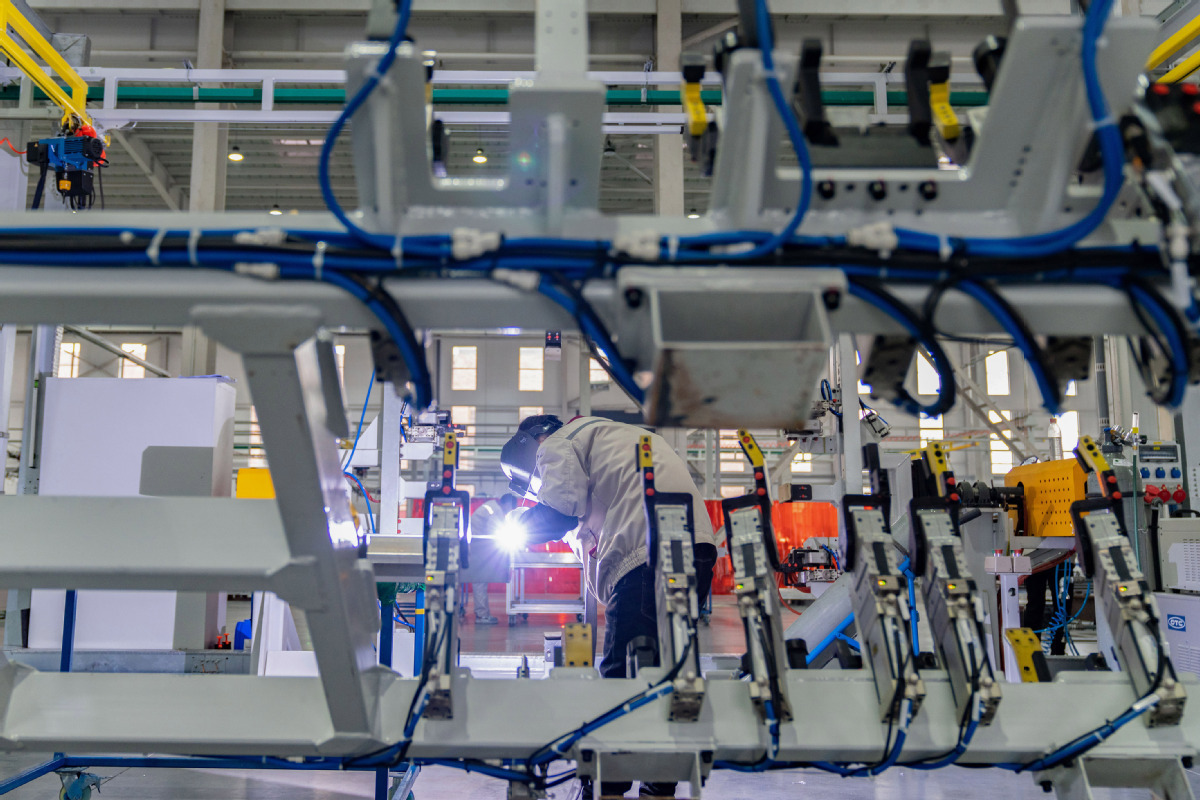
Chinese major battery manufacturers are making progress in solid-state battery development, which promises higher energy density and safety while reducing costs compared to lithium-ion batteries. The cutting-edge technology is critical for the advancement of flying cars, according to industry experts.
Earlier in May, battery maker Gotion High-Tech launched the first road tests for its next-generation all-solid-state batteries, after completing China's first fully localized 0.2 gigawatt-hour pilot line.
It also launched the G-Yuan battery, which can deliver a 300-watt-hours-per-kilogram energy density with main application scenarios in electric Vertical Take-Off and Landing aircraft, EVs and humanoid robots, according to Gotion's chief scientist Zhu Xingbao.
Ganfeng Lithium announced on Wednesday that the company has established a full-chain layout for solid-state batteries, possessing research and production capabilities in key areas.
The company has achieved 420 Wh/kg energy density in current products and developed samples reaching 500 Wh/kg.
CATL reported in mid-May that its solid-state batteries can achieve a maximum energy density of 500 Wh/kg. The company is advancing a civilian electric passenger aircraft project, adhering to aviation safety and quality standards through testing.
These manufacturers are expected to achieve small-scale demonstration installations of all-solid-state batteries in vehicles by 2027, and mass production by 2030.
Such batteries have a wide range of applications, including but not limited to EVs.
Analysts said that the progress of development of solid-state batteries essentially determines the timing of the launch of low-altitude aircraft represented by eVTOLs.
EHang, an autonomous aerial vehicle company, launched a flight test of an eVTOL featuring solid-state battery in November. It achieved a single flight time of 48 minutes and 10 seconds, representing a 60 to 90 percent increase in operating time compared to previous tests.
Professor Huang Liang from Hunan University noted that the development of eVTOLs and other low-altitude aircraft places higher demands on batteries in terms of energy density, power output, fast charging and long life span. Solid-state batteries need to gradually break through energy densities of 400 to 600 Wh/kg to meet these requirements.
Statistics show that eVTOLs consume 65 kilowatt-hours per 100 kilometers, which is three to five times more than EVs, and they require 10 to 15 times higher instantaneous power during takeoff and landing.
Currently, leading eVTOL companies require batteries to have an energy density of 300 Wh/kg and a life of 500 cycles.
In addition to energy density, reducing costs and achieving lightweight designs are focuses of battery manufacturers. Presently, eVTOL batteries are three to five times more expensive than EV batteries, making scaled production essential for cost reduction.
EHang data indicates that a 1 percent decrease in battery cost or a 1 percent increase in life span can boost operators' profits by 3 percent and 2 percent respectively. Advanced technologies like dry electrode processes and high-nickel ternary materials offer cost reduction possibilities.
The Civil Aviation Administration of China predicts that by 2025, the low-altitude economy in China will reach 1.5 trillion yuan ($208.18 billion), and it is expected to reach 3.5 trillion yuan by 2035.




















