



Incentive offer to find endangered turtle raises concern









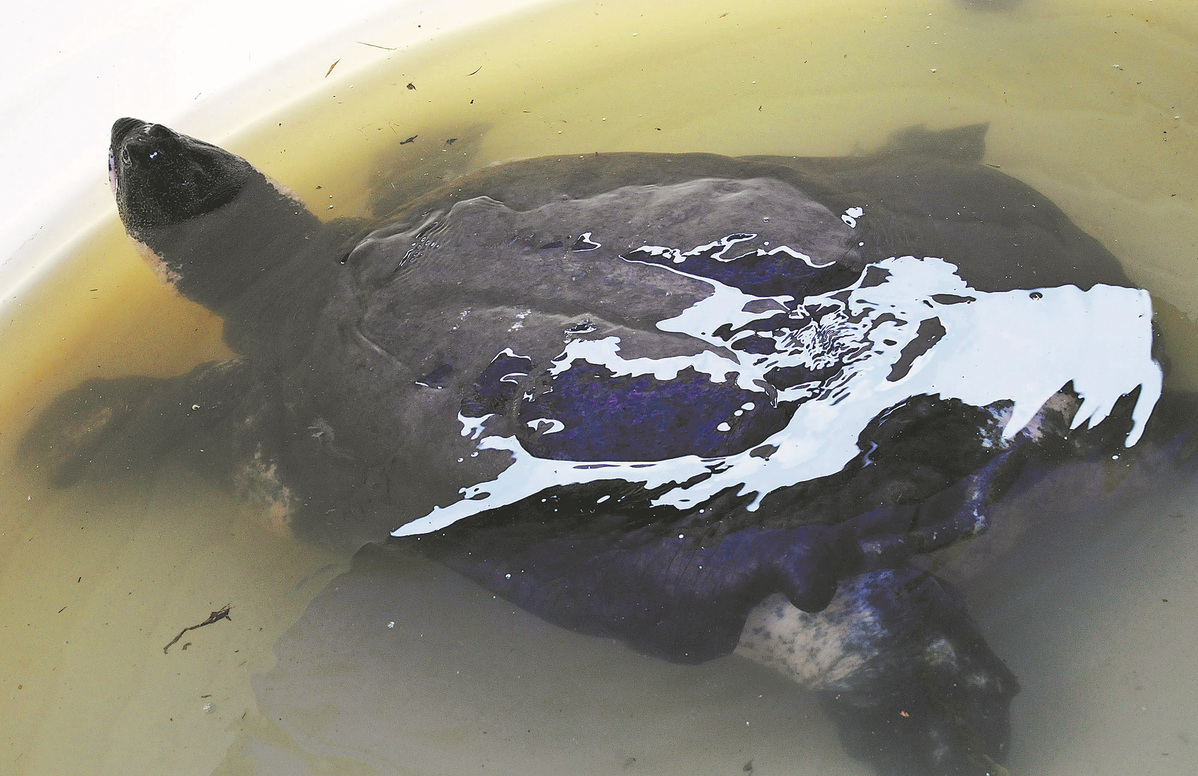
A Chinese animal protection group is offering a reward of 100,000 yuan ($13,902) to those who can help it locate one of the world's rarest turtles — the Yangtze giant softshell turtle — in a bid to save the species from extinction.
Only two known males of the species, Rafetus swinhoei, remain in the world — one in Suzhou Shangfangshan Forest Zoo, formerly known as Suzhou Zoo, in Jiangsu province, and the other in Dong Mo Lake in Vietnam.
The Endangered Species Fund, or ESF, a nongovernmental organization, said the species once inhabited areas including the middle and lower reaches of the Yangtze River, the Qiantang River basin, the Taihu Lake region and the Honghe River basin. It believes that some may still exist in the wild, possibly even in release ponds at some temples.
The group said it would offer the reward to anyone who finds a suspected Yangtze giant softshell turtle in those areas and receives professional confirmation of its identity. The reward will be issued within 15 working days.
The incentive is not without controversy.
Lyu Shunqing, a professor at Huangshan University in Anhui province who has studied the turtle for nearly two decades, said he personally does not support the use of reward-based searches.
"Such high rewards might drive untrained people into the wild, where they may use illegal or harmful methods," Lyu said. "The capture process itself could injure the animal."
Still, he acknowledged the benefit of raising public awareness.
"The ESF efforts can at least draw attention to the species and promote broader conservation of wildlife and the ecological environment," he said.
Lyu has been involved in turtle conservation since January 2007, when he joined efforts to protect the species. That month, he saw photos from then Changsha Zoo, now known as Changsha Ecological Zoo, in Hunan province that led to the identification of a female Yangtze giant softshell turtle — a major breakthrough at the time.
"It gave us new hope for the survival of the species," he said.
Later that year, experts gathered in Harbin, Heilongjiang province, and initially planned artificial insemination but ultimately decided to move the female turtle to the Suzhou zoo to attempt natural mating.
In May 2008, the pair mated underwater, but the eggs were not fertilized. Several later attempts at natural reproduction also failed.
In 2015, the focus returned to artificial insemination, but efforts were unsuccessful. In 2019, the female died while under anesthesia during another insemination attempt.
"I still feel sad about it," Lyu said. "But I don't regret trying. If scientists don't try, the species will inevitably disappear."
The Yangtze giant softshell turtle was first named in 1873 and once had a range stretching from East Asia to the Euphrates basin in Iraq. In China, it was primarily found in the Yangtze and Honghe River basins.
But its habitat has suffered major changes, especially in the Yangtze River and Taihu Lake areas. The last confirmed sighting in China was in 1998, when an illegally captured turtle appeared in a rural market in the Honghe Hani and Yi autonomous prefecture in Yunnan province. It was seized and released by authorities, but no tracking measures were taken and its fate is unknown.
Lyu said the Honghe River basin is still capable of supporting the species despite environmental degradation, and years of surveys suggest there are pockets where the turtles could still survive.
According to Lyu, two possible methods remain to save the species. One is cloning the existing males, and the other is locating wild individuals for either natural mating or artificial insemination.
But prospects are slim. The male turtle in the Suzhou zoo has a damaged reproductive organ and produces sperm with very low activity.
If a wild turtle is found in the future, the priority will be local protection and monitoring before considering breeding plans.
"If it turns out to be female, we may bring the male from Vietnam to her location," Lyu said. "Or we could let her move downstream to Vietnam to see if natural reproduction is possible."





