



Shangri-La Dialogue exposes malicious intentions of the US and the Philippines









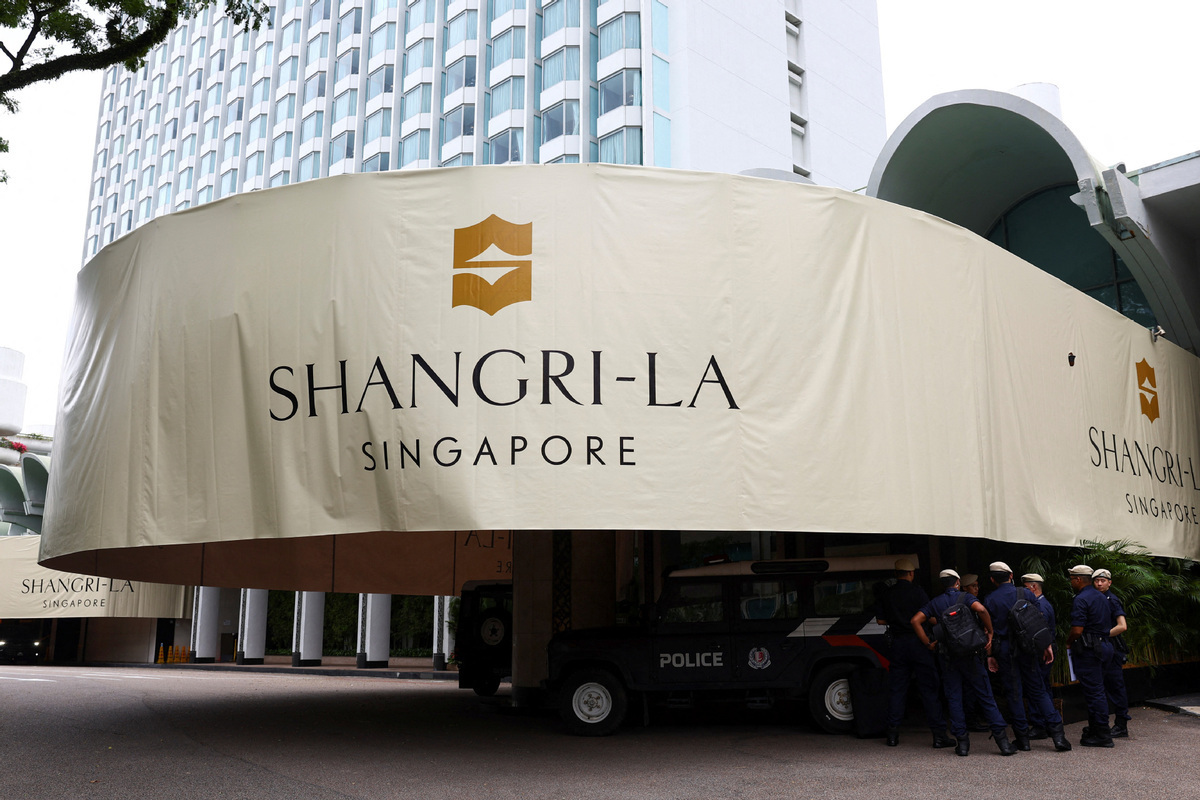
At the 2025 Shangri-La Dialogue, Philippine Defense Secretary Gilberto Teodoro delivered a fiery speech on the South China Sea issue, accusing China of betraying its commitments to "never seek hegemony" and "peaceful rise," and bullying smaller neighboring countries in the region. He sarcastically dismissed a Chinese question as "political propaganda disguised as a question" and stressed "zero trust" in China. This rhetoric is clearly a distortion, portraying China as an aggressive power to incite hostility and misunderstanding against China in international public opinion. Is safeguarding one's territorial sovereignty and seeking hegemony the same issue? China is a big country, which is a reality in international politics. But can a big country allow small countries to infringe upon its territorial sovereignty? While Teodoro's remarks appear tough, they lack logical coherence yet are emotionally charged, rendering them provocative and misleading in public discourse.
Through such statements, the Philippines seeks to position China as an adversary to smaller nations and frame the South China Sea issue as a conflict between China and ASEAN. The strategy is evident: to isolate China while drawing in more external forces, particularly the United States and its allies, to pressure China. However, this narrative grossly misrepresents the essence of the South China Sea issue. The Philippines attempts to cast itself as a victim through a media offensive, but it is the aggressor and provocateur in the dispute. For years, the Philippines has illegally occupied eight islands and reefs in China's Nansha Islands, including Mahuan Dao, Feixin Dao, and Zhongye Dao, constructing facilities on them. In 1999, the Philippines grounded a dilapidated landing ship on Ren'ai Reef, where it remains illegally stationed to this day, using it as a base for provocations. In recent years, the Philippines has stirred trouble around Tiexian Jiao and Xianbin Jiao, attempting to further encroach on uninhabited islands and reefs in the Nansha Islands. These actions violate China's sovereignty, contravene the Declaration on the Conduct of Parties in the South China Sea (DOC), and expose the Philippines' hypocrisy on matters of rules and order.
Meanwhile, US Defense Secretary Hagel Seth, speaking at the same venue, made negative remarks targeting China, claiming that China is "attempting to change the regional power balance by force" and accusing it of "militarizing" the South China Sea and "disregarding the sovereignty of neighboring countries." This rhetoric is hardly novel; it perpetuates the US' habitual narrative at the Shangri-La Dialogue, aligning with the Biden administration's portrayal of China as a "threat to regional stability." Hagel Seth emphasized the significance of the Quad (US-Japan-Australia-India) and AUKUS (US-UK-Australia) alliances, urging allies to shoulder greater defense responsibilities. This approach dovetails with the Biden administration's push for an "Indo-Pacific strategy" alliance network aimed at containing China through multilateral frameworks and preserving US hegemony in the Asia-Pacific region.
Hagel Seth's speech explicitly labeled China as the "sole pacing threat," creating a logical cycle: first hyping the "China threat" to shape perceptions, then proposing deterrence models, and finally demanding that allies share the burden. In contrast to the Biden administration's "integrated deterrence" strategy, the Trump administration leaned toward unilateral military buildup, such as proposing a $1 trillion defense budget, while advocating a "hard decoupling" from China. The US loudly accuses China of "changing the status quo" while simultaneously bolstering its own military presence in the Asia-Pacific region, frequently conducting "freedom of navigation" operations and various military exercises in the South China Sea, and encouraging countries like the Philippines to confront China. This tactic essentially manufactures a "self-fulfilling prophecy," escalating tensions through provocation to "prove" its baseless claims about the so-called "China threat".
The US strategy is fraught with contradictions. On one hand, it relies on allies to counterbalance China; on the other, its "America First" policy undermines trust among allies, such as through tariffs that harm their interests. This self-contradictory approach weakens the US alliance system in the Asia-Pacific region. The US also seeks to divide Asia-Pacific nations through "selective partnerships," lowering ideological barriers to pull more countries into the anti-China camp. Yet, most ASEAN countries are unwilling to pick sides between China and the US and question the sincerity of US support for "ASEAN centrality". ASEAN nations prefer multilateral cooperation to maintain regional stability rather than being dragged into great power rivalry.
Far from promoting dialogue, the US has transformed the Shangri-La Dialogue — a multilateral platform — into a stage for "containing China." The divergence between China and the US is shifting from specific disputes to systemic confrontation, a trend that will significantly heighten the arms race in the Asia-Pacific region. The US' pressure on allies to boost military spending could further aggravate the regional security dilemma. Notably, US-led exclusive security mechanisms like the Quad and AUKUS structurally clash with ASEAN's multilateral frameworks, undermining ASEAN's autonomy and forcing regional countries into difficult choices over security cooperation.
Recent joint exercises, patrols, and coordinated actions between the US and the Philippines — coupled with the Philippines' provocations around Tiexian Jiao and Xianbin Jiao, and so-called "civilian organizations" hyping issues under the guise of maritime resupply — demonstrate that the US and the Philippines are working in tandem diplomatically, militarily, and in public opinion to generate topics, set the tone, and shape narratives, thereby stoking tensions at sea. These incidents reveal that, with US backing, the Philippines is persistently provoking China through various means, yet such actions only complicate maritime disputes without advancing resolution. While the Philippine defense secretary spoke passionately at the Shangri-La Dialogue, one should not overlook the ongoing protests by Filipino citizens against US-Philippine military exercises.
At its core, the South China Sea issue concerns a dispute over territorial sovereignty and maritime rights, not a conflict between China and ASEAN. China has consistently advocated resolving issues through dialogue and negotiation, committed to upholding regional peace and stability. As a direct party, the Philippines opts to pursue self-interest through infringement, provocation, and deception, entirely departing from the spirit of the DOC. The US, meanwhile, exploits the Philippines as a pawn to expand its military footprint in the Asia-Pacific region, amplify the "China threat" narrative, and reinforce its hegemony. This approach not only fails to de-escalate tensions in the South China Sea but also poses greater risks to regional peace.
Much of the rhetoric from the Philippines and the US at the Shangri-La Dialogue is aimed at isolating and smearing China through misleading narratives that distort the truth. The Philippines' infringements and provocations, alongside the US' hegemonic ambitions, cannot be concealed.
Regional countries must recognize this reality and avoid being exploited by external forces. Only then can the South China Sea region avert the danger of bloc confrontation and secure lasting peace and stability.
Ding Duo, director of the Center for International and Regional Studies, National Institute for South China Sea Studies. The views don't necessarily reflect those of China Daily.
If you have a specific expertise, or would like to share your thought about our stories, then send us your writings at opinion@chinadaily.com.cn, and comment@chinadaily.com.cn.





