A delicate bronze vessel unearthed from the Zhuo'erkut ancient city site in Northwest China's Xinjiang Uygur autonomous region features a square socket once fitted with a wooden or bone handle and a rare cross-shaped pattern embossed on its base.
This first-of-its-kind discovery is on display at the Museum of the Western Regions Frontier Command, which opened to the public in May in Luntai county, in Xinjiang's Bayingolin Mongol autonomous prefecture.
In 60 BC, the Western Regions Frontier Command was set up, Xinjiang was formally incorporated into the territory of China, becoming an integral part of this unified multiethnic country.
The museum, with a 5,120-square-meter exhibition area, showcases 463 artifacts from the Han (206 BC-AD 220) to the Qing (1644-1911) dynasties. Displays include pottery, bronze ware, silk fragments and official documents. These artifacts illustrate how governance, economic integration and cultural exchange helped shape the identity of China's western frontiers.
Among the standout exhibits are oracle bones used for divination, a bronze vessel, pottery lids, eave-tile ends, a copy of painted brick depicting mounted courier, a copy of commander's credential from Zhangye in Gansu province and Tang Dynasty (618-907) bronze mirrors, featuring dragon motifs.
"The museum explains why the Western Regions Frontier Command was established and how it operated," says Chen Ling, the lead archaeologist at the Zhuo'erkut ancient city site and a professor at Peking University's School of Archaeology and Museology.
"It marked the beginning of long-term effective central governance in Xinjiang and affirmed the region's significance within the Chinese nation."
Exhibits reveal the deployment of garrisons for land reclamation, the construction of water conservation systems and the promotion of agricultural irrigation. They economically and politically tie the region to the Central Plains.
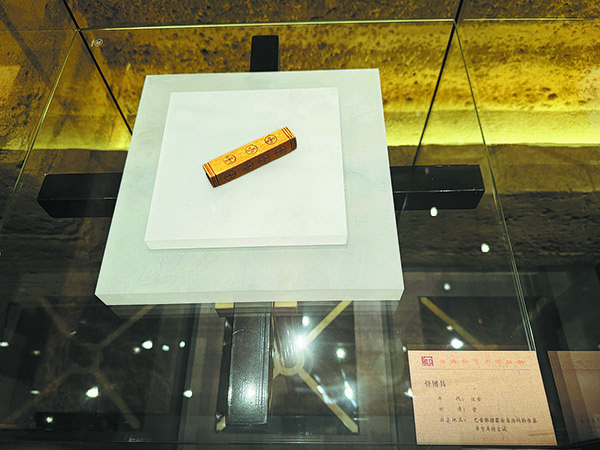
Cultural integration is vividly illustrated. A carved bone piece, used for games, common in the Central Plains but discovered at Zhuo'erkut, shows how certain forms of leisure culture spread.
Chinese script is the earliest written language officially used in Xinjiang, as evidenced by its presence on Han dynasty and Jin dynasty (265-420) textiles, Confucian classics, and decorative items from the region, underscoring the influence of Central Plains culture.
"Many artifacts closely resemble those from the Central Plains. They provide strong evidence of historical integration," says Chen Ying, director of Bayingolin's cultural heritage bureau. "They highlight the lasting bonds among ethnic groups and the unity embedded within Chinese civilization."
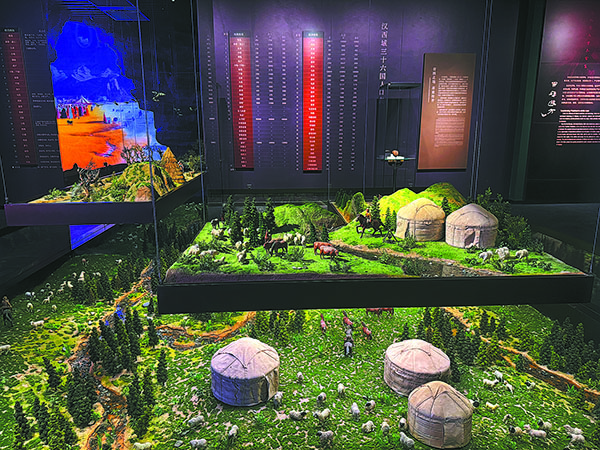
In addition to physical exhibits, the museum has developed dioramas, and virtual reality and multimedia presentations to bring to life the historical contexts of the relics.
Plans are underway to host educational study tours and online exhibitions, extending the reach of the collection to broader audiences, Chen Ying adds.
Xinjiang was formally brought under central governance during the Western Han Dynasty (206 BC-AD 24) through the establishment of the Western Regions Frontier Command. The Han court established the command in Wulei city, following sustained military campaigns that defeated the Xiongnu people to the north. As the highest military and political institution governing the area, it marked the beginning of an effective state presence in China's far west.
Archaeological studies suggest that Wulei was located at what is now known as the Zhuo'erkut ancient city site, a major hub in the Tarim Basin during the Han Dynasty and Jin Dynasty. Later records indicate that the seat of administration was moved westward to Qiuci's (or Kucha's) Taqian city in AD 16.