Major reforms rolled out ahead of gaokao
Universities expand enrollment, add AI, tech programs to align with shifts









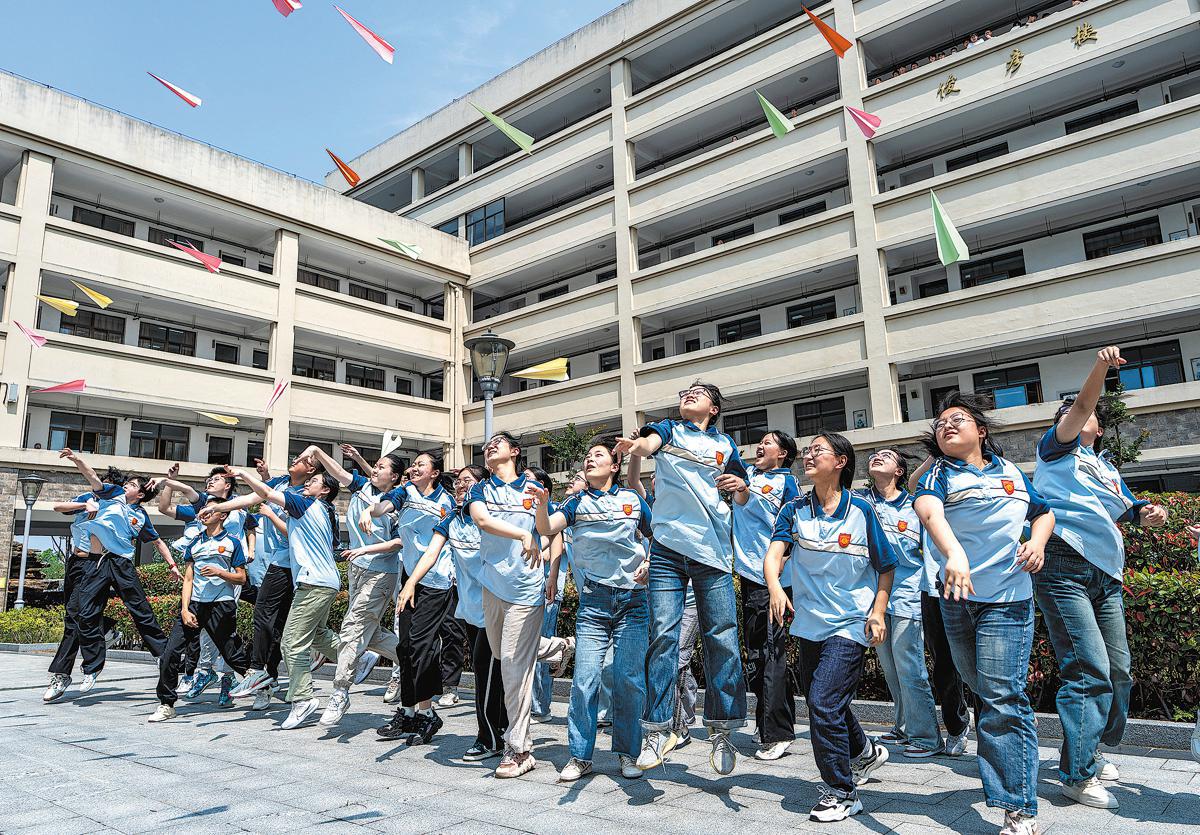
China's national college entrance exam, known as the gaokao, will take place from Saturday to Tuesday and feature several new developments, including the rollout of exam reforms in eight additional provinces, expanded university enrollment and the launch of new academic majors.
This year, eight more provincial-level regions will implement the gaokao reform: Sichuan, Henan, Shanxi, Yunnan, Shaanxi, Qinghai and the Ningxia Hui and Inner Mongolia autonomous regions. So far, 29 provinces have adopted the new gaokao mechanism.
Under the reform, candidates must take three nationally standardized subjects — Chinese, mathematics and a foreign language — along with one primary elective subject, either physics or history, and two additional electives selected from chemistry, geography, political science and biology.
Xiong Bingqi, director of the 21st Century Education Research Institute, said the reform, launched in 2014, has provided students with greater flexibility in subject selection and aims to place more emphasis on students' individuality and personal interests while establishing a more comprehensive and multi-dimensional evaluation system.
"However, the issue of solely relying on test scores persists. It is necessary to strengthen the reform of comprehensive quality evaluation," Xiong said.
Many universities have expanded enrollment plans this year, including Tsinghua University, Peking University and Shanghai Jiao Tong University. The additional spots, ranging from dozens to several hundred, are primarily concentrated in fundamental disciplines such as mathematics, physics and chemistry, as well as in strategic and cutting-edge fields.
Xi'an Jiaotong University in Shaanxi province has been expanding its enrollment over the past decade and plans to add 200 more spots this year, according to Cao Liangzhi, director of the university's admissions office.
"The focus is primarily on emerging technology industries and fields geared toward the future," Cao said. "In response to technological and industrial transformation and upgrading, we aim to cultivate more high-quality talent."
This year, China's college admissions introduced 29 new undergraduate majors across fields such as artificial intelligence, carbon neutrality and digital governance.
According to the Ministry of Education, these new programs are designed to align with national strategic priorities, market demands and technological advancements.
Beijing Jiaotong University has added five undergraduate majors in fields of national strategic demand, including data science and big data technology, robotics engineering, intelligent manufacturing engineering, intelligent vehicle engineering, and international journalism and communication.
The Beijing Institute of Technology has introduced a low-altitude technology and engineering major, focusing on cultivating top-tier talent to meet the strategic needs of low-altitude economic development.
Universities are adjusting their programs to align with social development and meet societal needs, according to Xiong.
Around 13.35 million students have registered for this year's gaokao, a decrease of 70,000 compared to last year and marking the first decline in a decade, according to data released by the ministry.
The decline in exam candidates is primarily due to a decrease in vocational college entrance exam participants, who are no longer required to take the gaokao, Xiong explained. However, the number of candidates for the regular gaokao has increased, he said.
"It is hoped that universities will expand enrollment based on their unique conditions and strengths, focusing not only on increasing numbers but also on improving quality," Xiong said.




- Viral app bares 'safety anxiety' among solo dwellers
- Research suggests causes of moon's two different 'faces'
- AI software under lens for facilitating porn talk
- Commercial recoverable spacecraft completes test flight in China
- Test launch marks push in reusable space vehicles
- Smart tech to unify healthcare and insurance data