


Weight of early poetry felt through the ages










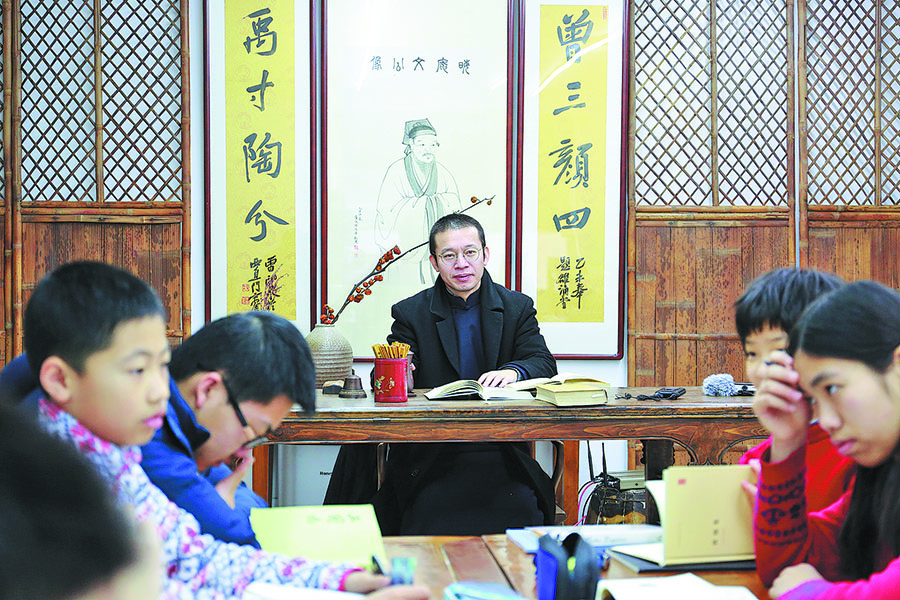
"The 160 poems in Guo Feng (The Airs of the States), the first and largest section of the book, were traditionally regarded as folk song lyrics. However, their literary sophistication suggests they were at least partly composed by educated members of society, who drew on everyday scenes and narratives to express personal reflections and political sentiments," Tan says. "The rhetorical techniques employed in this process, most notably the use of metaphor, analogy, and evocative imagery such as natural landscapes, were later woven into the fabric of the Chinese poetic tradition."
One example features the image of a "fat rat" as a symbol of greedy exploiters, offering a sharp critique of social injustice. In another, the lines "The reeds and rushes grow lush and green, the white dew turns to frost" open a poem with a misty, ethereal atmosphere, setting the tone for a poignant expression of longing.
"Longing for what? Many modern readers interpret it as yearning for the beloved," Tan says, referring to the term yi ren, meaning "that person".
"What they often overlook is that, to the poem's contemporaries, it did not signify a romantic lover, but a junzi, a noble gentleman who embodies the moral ideals. It is from this that its political connotation arises."
One such figure was Qu Yuan (c.340-278 BC), a poet and aristocrat for whom the Shi Jing had almost certainly served as a foundational text. Remembered as a tragic patriot, Qu Yuan took his own life in despair, drowning himself 55 years before the fall of his homeland, the State of Chu. His poems, marked by their distinctive rhythm and political overtone, overflow with vivid imagination and a deep, brooding sense of escapism.
Through his work, now known collectively as Chu Ci (The Songs of Chu), Qu Yuan established new traditions in Chinese poetry, notably the articulation of profound political disillusionment and the use of nature-bound escapism as a form of emotional refuge. While others contributed to the Chu Ci tradition, the majority of surviving works in this genre are attributed to Qu Yuan himself.
Banished to remote and desolate regions, he transformed long-distance travel into a metaphor for exile: both imposed and self-chosen. Over the two millennia following his death, countless poets, especially scholar-officials, echoed this theme. Their travel poems, rich with allusions to political marginalization, gave rise to a uniquely enduring motif in the history of Chinese literature.
"From the Book of Songs to The Songs of Chu, a crucial transition occurred from the collective expression of emotion to a more individualistic one," Tan says. "This shift brought Chinese poetry closer to what poetry ultimately aspires to be: a vehicle for conveying inner experience."
He notes that, as a Confucian classic, Shi Jing inevitably carried a public and communal character.
Occasionally, that inner experience is not meant to be shared, at least not publicly. This, Tan explains, gives rise to a fifth function of poetry, beyond the four outlined by Confucius. "Poetry can conceal, or more precisely, it allows one to conceal oneself, to become a spiritual hermit within the lines, seeking refuge in verse just as a recluse finds sanctuary in nature."





