Findings of first autumn Antarctic expedition released









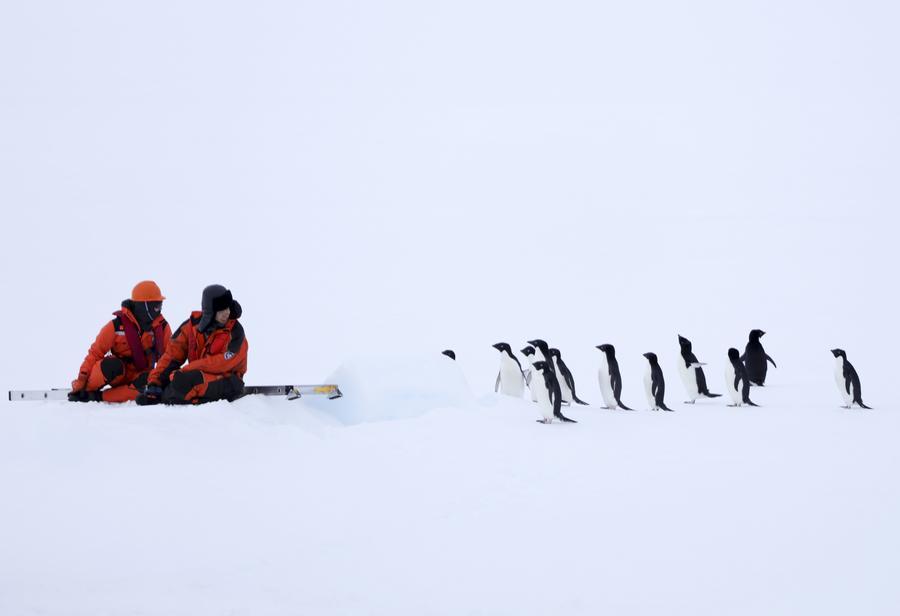
In an unprecedented autumn expedition to Antarctica, scientists observed a significant surge in small planktonic organisms in the deep and bottom layers of the ocean, a stark contrast to their typical presence in the upper ocean during spring and summer.
Researchers said the rich, balanced distribution of water properties and planktonic life in the vertical layers of the ocean was especially striking in the polynya area — the "ice-making factory" of Antarctica — located in the Ross Sea.
The findings underscore the profound impact of intense deep convection activities driven by strong ice formation processes in the polynya, an area of unfrozen sea within a large patch of ice, during the cold season. These activities shape the physical properties of seawater and influence biological distribution and overwintering processes, scientists said.
The observations came from the first-ever human expedition to Antarctica in its autumn season, during which researchers collected more than 3,000 chemical analysis samples and 2,500 biological analysis samples. The results were presented by scientists from Shanghai Jiao Tong University at a news briefing on Friday.
During the transition from March to April, when Antarctic productivity sharply declined, about 50 researchers from nine countries — China, the United States, the United Kingdom, Australia, New Zealand, Norway, South Korea, Malaysia and Thailand — braved extreme temperatures from -20 C to -28 C in the autumnal Ross Sea. They conducted continuous observations for 20 days.
Their work was part of China's 41st Antarctic expedition and marked the first multinational collaborative research focused on the autumnal ecosystem of the Antarctic marginal seas. The initiative was led by the School of Oceanography at Shanghai Jiao Tong University and the Polar Research Institute of China.
Zhou Meng, dean of the school and a veteran of 14 Antarctic and 10 Arctic expeditions, highlighted the rarity of Antarctic research beyond the summer season, citing challenges posed by extreme climate and complex marine conditions. The lack of observational data available during autumn and winter meant that there was limited human understanding of natural processes around those seasons, scientists said.
"When we reached Antarctica in early spring during previous expeditions, we saw that 99 percent of the biomass had disappeared, so there always existed this curiosity about what happened in autumn and winter," Zhou said.
The Ross Sea plays a pivotal role in Antarctic studies, serving as a crucial site for the generation of the densest water mass in the Southern Ocean, known as Antarctic Bottom Water.
This region significantly influences global heat and salt circulation and climate patterns, scientists said.
"Moreover, the Ross Sea stands out as one of the most biologically productive areas in the Southern Ocean, boasting abundant marine resources vital for ecosystem functioning," Zhou said. "The high productivity and deep water formation processes make the Ross Sea a hotspot for the burial of organic carbon in the deep sea."
Zhang Zhaoru, assistant chief scientist of the research and a professor at the school, said the deep convection processes in the polynya during the windy autumn period can effectively transport surface ocean particles to deeper layers. This process may play a crucial role in carbon burial, she said.
The team's research also identified warm signals of deep water intrusion and cold signals of ice shelf meltwater in the polynya, processes instrumental in the generation of Antarctic Bottom Water driven by deep ocean convection.
Furthermore, the team observed significant differences in nutrient concentrations in the polynya compared with other marine regions, indicating active biological processes before their expedition.
"These unique ecological processes in the polynya area of the Ross Sea provide essential observations for a comprehensive understanding of the biogeochemical cycles in the Antarctic marginal sea," Zhou said.
Scientists said an active "dark ecosystem" exists in the Antarctic marginal sea during the autumn and winter seasons, lasting as long as eight to nine months. This ecosystem encompasses various organisms, including krill, fish, birds and mammals.
"Our discoveries and ongoing explorations will help answer scientific questions: Where do the organic matter and energy driving the marine biosphere in the dark ecosystem of the Antarctic autumn and winter seasons come from? How do processes such as ice formation, deep convection and mixing impact the transport of marine organisms and vertical carbon flux? Which processes in winter determine the population structure of planktonic organisms, influencing productivity in the following spring season?" Zhou said.
The research team said its work enhances the international community's understanding of the adaptation and survival strategies of key biological groups and ecosystems in the challenging dark environment of the Southern Ocean during autumn. The team's efforts also offer valuable experience for future Antarctic expeditions in winter.




- Xinjiang reports highest foreign trade growth in China
- Harbin authorities demand return of pensions paid out to deceased
- Global research project on AI guardrails launched in Beijing
- Partnering with China, embracing opportunities
- China's cyberspace regulators announce measures for protection of minors
- Beijing's 'Rocket Street' promoted at aerospace conference