America's 'Golden Dome': A cause for vigilance









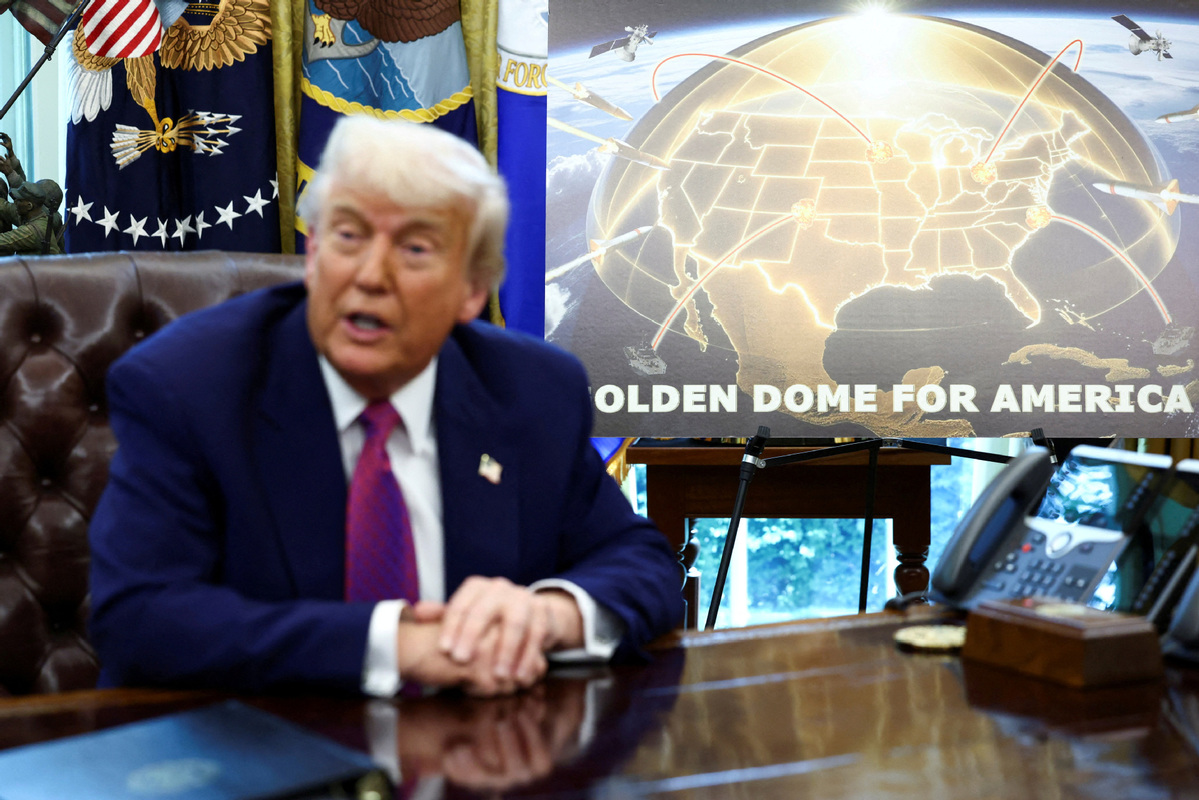
The US government launched the "American Golden Dome" project, which it plans to complete within three years with a total budget of $175 billion, on May 20, 2025. It formally puts on the agenda the goal develop the next-generation missile defense system that Trump first mandated via a presidential order ("American Iron Dome") shortly after assuming office in his second term on January 27. The project's explicit focus on "defending against peer adversaries" and its intention to "develop and deploy proliferated space-based interceptors" represent its two most contentious aspects.
Missile defense systems generally refer to strategic defenses designed to counter intercontinental nuclear missiles. It is part of the strategic defense system and is intrinsically linked to strategic offensive system, forming two sides of the same coin. By "defending" against an adversary's strategic offensive capabilities, a missile defense system effectively bolsters one's own strategic offensive power. Consequently, during the Cold War US-Soviet nuclear arms control negotiations, missile defense was always considered alongside strategic offensive systems. This is precisely why the 1972 Interim Agreement between the United States of America and the Union of Soviet Socialist Republics on Certain Measures with Respect to the Limitation of Strategic Offensive Arms (SALT I) and the Anti-Ballistic Missile (ABM) Treaty were negotiated and concluded simultaneously.
Although the US withdrew from the ABM Treaty in 2002, its subsequent Missile Defense Review reports consistently included statements that "China and Russia are not the focus of US missile defense" and "the US will continue to rely on strategic deterrence to address threats to the homeland from China and Russia", maintaining at least a facade of rationality.
The "Golden Dome" project explicitly aims to "defend against attacks by peer adversaries". This marks the first time the US has formally designated nuclear weapon states as the operational targets of its missile defense system in an official national document--a significant shift never made by any US administration, either during or after the Cold War. During the Cold War, when the Reagan administration merely mentioned "intercepting and destroying Soviet ICBMs" in a televised address, then Soviet ambassador retorted that this would open a new phase of the arms race.
Explicitly targeting the strategic offensive capabilities of nuclear powers is sufficient to trigger a nuclear arms race. One side's "absolute security" becomes the other's "absolute insecurity". As stated in the Concept Paper of the Global Security Initiative by Chinese Government, "Humanity is an indivisible security community, and security of one country should not come at the expenses of that of others."
It is true that deploying conventional weapons in outer space is not explicitly prohibited by current international law. This is why the UN General Assembly First Committee resolution "Prevention of an arms race in outer space" (adopted by consensus annually) consistently notes that "the legal regime applicable to outer space by itself does not guarantee the prevention of an arms race in outer space."
To tackle this governance deficit in outer space security, China and Russia have, since 2008 and 2014 respectively, proposed the draft Treaty on the Prevention of the Placement of Weapons in Outer Space, the Threat or Use of Force against Outer Space Objects (PPWT) and the resolution on "No First Placement of Weapons in Outer Space". The US opposed both proposed documents under various high-sounding pretexts, including the claim that the draft did not sufficiently define what constitutes a weapon in space.
Now that the US has brazenly announced plans to deploy "space-based interceptors", one wonders how it will attempt the self-deception of excluding these from the category of weapons? The hypocrisy of America's carefully cultivated image of promoting "responsible behavior in space" is laid bare. Alarmingly, operational requirements dictate that these space-based interceptors would be deployed in Low Earth Orbit (LEO) - the primary operational orbit for most nations' satellites.
According to a US think tank assessments, maintaining at least 10 interceptors over a nuclear power at any given time would require deploying over 2,000 interceptors, effectively creating a weaponized "mega-constellation" in LEO. As critical combat assets, these space-based interceptors would inevitably become priority targets for adversaries. The risk of the orbital region occupied by this "mega-weapon constellation" becoming a battlefield would dramatically increase. This arguably violates Article I of the Outer Space Treaty, which states that the exploration and use of outer space shall be carried out for the benefit and in the interests of all countries. It selfishly places the pursuit of one nation's "absolute security" above the interests of all humanity.
As some attempts to gild their ambitions with "gold", the people all around the world must see it through and remain vigilant: Under the shared sky of humanity's common destiny, no one can secure safety for themselves alone.
The author is a commentator on international affairs, writing regularly for Xinhua News, Global Times, CGTN etc. The views don't necessarily represent those of China Daily.
If you have a specific expertise, or would like to share your thought about our stories, then send us your writings at opinion@chinadaily.com.cn, and comment@chinadaily.com.cn.