



Green switch
China leads in clean energy trade in region, eyes ASEAN market amid US scale-back









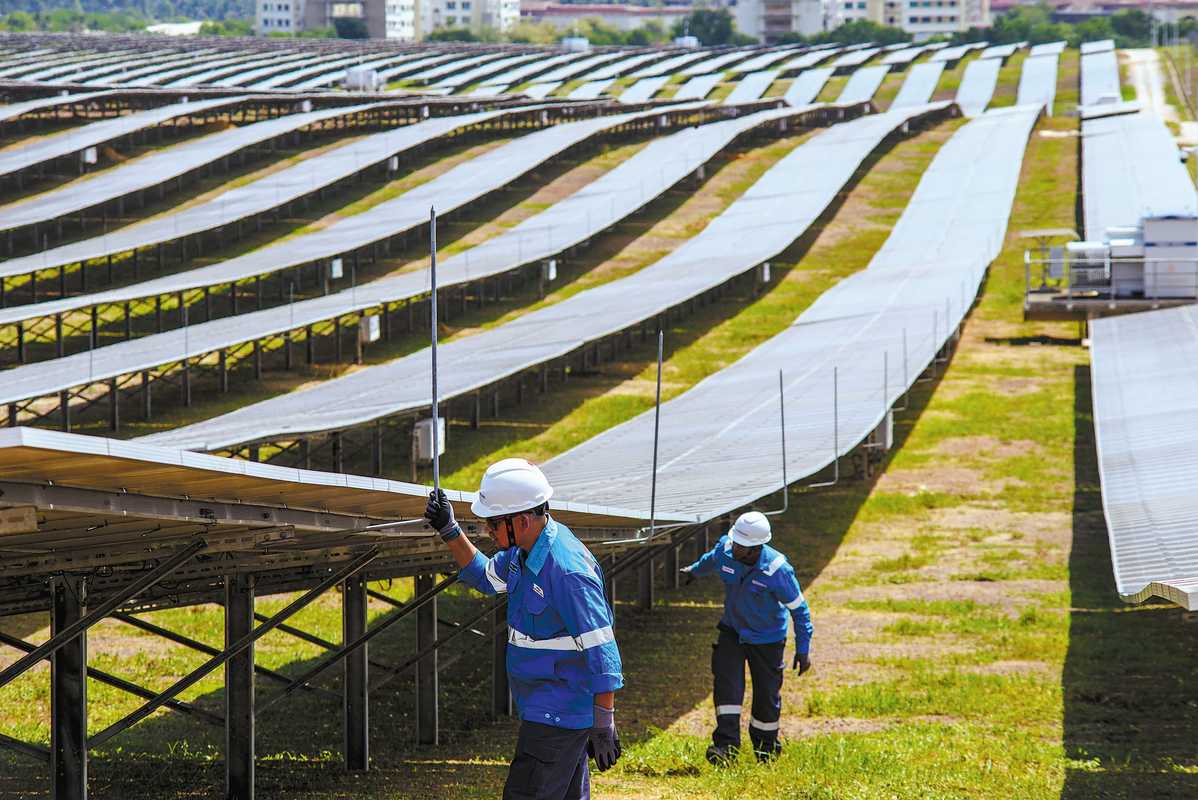
Editor's note: In this weekly feature China Daily gives voice to Asia and its people. The stories presented come mainly from the Asia News Network(ANN), of which China Daily is among its 20 leading titles.
Southeast Asia is a developing region with a huge appetite for energy, and investors in China, South Korea and Japan are now finding promise in investing in renewable energy projects in Association of Southeast Asian Nations, or ASEAN.
A new report released on May 20 found that the number of international investment projects for renewable energy in ASEAN has increased by an average of about 15 percent per year since 2020, with investments reaching $43 billion in 2022.
This growth rate is higher than the global average of 11 percent, according to the report by climate and energy research group Zero Carbon Analytics.
In terms of public financing, China was the largest investor in ASEAN clean energy with over $2.7 billion between 2013 and 2023, followed by Japan with $2.45 billion.
Meanwhile, South Korea invested $583 million and Australia put in $51 million.
The four countries are some of ASEAN's largest clean energy investors, according to the report, adding they are the major external powers shaping Southeast Asia's energy transition.
The five ASEAN recipient countries in the report are Indonesia, Malaysia, the Philippines, Thailand and Vietnam.
ASEAN's electricity demand is expected to grow 41 percent by the end of the decade, and renewable energy capacity is expected to increase by 300 to 500 percent by 2035, said the report.
However, the developing region — which is still heavily reliant on coal for its energy needs — needs foreign investment for the energy transition, with major financing gaps in renewables and grid development.
The report comes amid the scale-back in climate initiatives and spending by the United States, such as laying out plans to phase out clean energy tax credits and slash spending on electric vehicles and renewable energy.
The US — one of the world's largest emitters — also said in January that it would pull out of the Paris Agreement, a pact signed by nearly 200 countries in 2015 to limit global warming to 1.5 degrees above preindustrial levels to avoid the worst impacts of climate change.
Sharon Seah, coordinator at the ASEAN Studies Centre and Climate Change in Southeast Asia Programme at the ISEAS-Yusof Ishak Institute in Singapore and one of the experts speaking at a webinar for the report on May 20, said the global climate vacuum is "very concerning".
"There's been a lack of leadership… and the concern within the region really is about the normative effect that this can have on the other countries," she said.
Rising to occasion
But the report showed some economies in Asia seem to be rising to the occasion.
For example, China leads in investments for wind and hydropower among the four countries, and provided $1.83 billion for clean energy financing in Southeast Asia in 2024 under its Belt and Road Initiative.
It also led in clean energy trade with the five Southeast Asian countries, driven by strong exports of electric vehicle batteries, solar modules and wind components.
Meanwhile, Japan is the region's bigger investor in geothermal and solar energy, with investments of $1.3 billion and $142 million, respectively.
South Korea was the largest exporter of battery components to Indonesia and Malaysia between 2017 and 2024. It also has a hand in financing mechanisms to support climate projects in ASEAN, albeit on a smaller scale.
The report also found that intentional and transparent policy by ASEAN countries can increase investor confidence in the energy transition.
The ASEAN power grid, for instance, finally made headway after Singapore said in 2021 that it plans to import around 30 percent of its electricity from low-carbon sources, such as renewable energy plants, by 2035.
Power grid integration was first mooted in 1997 to enhance cross-border electricity trade in Southeast Asia to ensure energy security.
However, it was the Laos-Thailand-Malaysia-Singapore, or LTMS, electricity import pilot launched in 2022 that finally saw the region's first multilateral electricity trade take place.
That same year, Singapore started importing up to 100 megawatts of hydropower from Laos via existing interconnectors — cross-border electricity transmission lines — between the four countries.
An ASEAN grid will allow Singapore, which lacks access to most renewable energy options other than solar, to tap sources such as wind energy and hydropower in other countries.
Exploring opportunities
Such a grid also allows countries in Southeast Asia, where renewable resources are unevenly distributed, to trade electricity freely to meet rising demand. It would hedge against the intermittency of renewables by distributing energy more efficiently.
Eighteen key interconnection projects have been identified under the ASEAN power grid, of which half have been completed.
Seah noted: "What (other) countries are interested in right now is to just explore what opportunities there are in the ASEAN power grid… and assess whether (ASEAN) countries are serious about completing those other nine interconnections."
On the heels of the LTMS project, the Brunei-Indonesia-Malaysia-Philippines power integration project was announced in August 2023. It aims to create multiple interconnections across the grids of the four countries, drawing on key lessons from the LTMS project.
Feasibility studies on the interconnections must be done before financing support can be sought for the subsea cables, said Seah, who added that she expects to see more progress on the project in 2025 with Malaysia chairing ASEAN.
Dinita Setyawati, a senior energy analyst at energy think tank Ember who also spoke at the webinar, said that while the ASEAN power grid has attracted "a lot of interest" from development partners who are interested in selling their technologies, the project has to first materialize before investors crowd in.
She added that energy transition is not only about replacing fossil fuels with renewables or financing renewable energy projects, but also about looking into investment in infrastructure like power grids and upskilling of workers in the industry.
The ASEAN power grid would have many benefits for countries in the region other than providing green electricity, including the creation of new jobs, reduced air pollution, and significant investments generated for the energy sector.
According to a study on regional energy connectivity, the regional grid can generate$2 billion annually in research and development, and create as many as 9,000 jobs a year.
Seah said: "It's a good thing that the region has actually decided that physical interconnectivity will be a manifestation of what they really want to do, which is to integrate economically."
She added:"But the ASEAN power grid has been discussed for the last three decades, so it really needs a few countries to be a champion of the ASEAN power grid and to bring it to fruition."
The Straits Times, Singapore










