



Tagore spirit continues to enlighten China-India friendship and exchanges









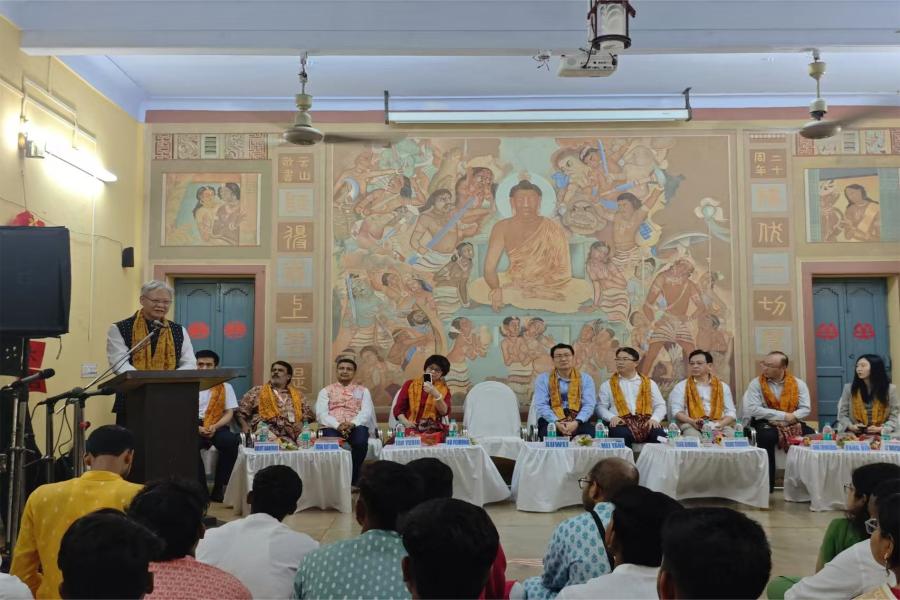
Recalling renowned Indian poet, educationist and philosopher Rabindranath Tagore's significant contribution to promoting Sino-Indian exchanges and friendship in the past, China's top diplomat in India on June 9 called for upholding the spirit and legacy of Tagore to bolster bonds between the two large Asian neighbors.
Xu Feihong, the Chinese ambassador to New Delhi, made the comment during a trip to Visva-Bharati University at Santiniketan in India's eastern state of West Bengal, visiting an institution that was founded by Tagore in the previous century and which houses India's oldest department of Chinese studies.
During a two-day visit to the university starting June 9, Xu visited Rabindra-Bhavana which contains a major portion of Tagore's manuscripts, paintings, correspondence, and sketches, along with thousands of photographs of the late Indian scholar and Nobel laureate.
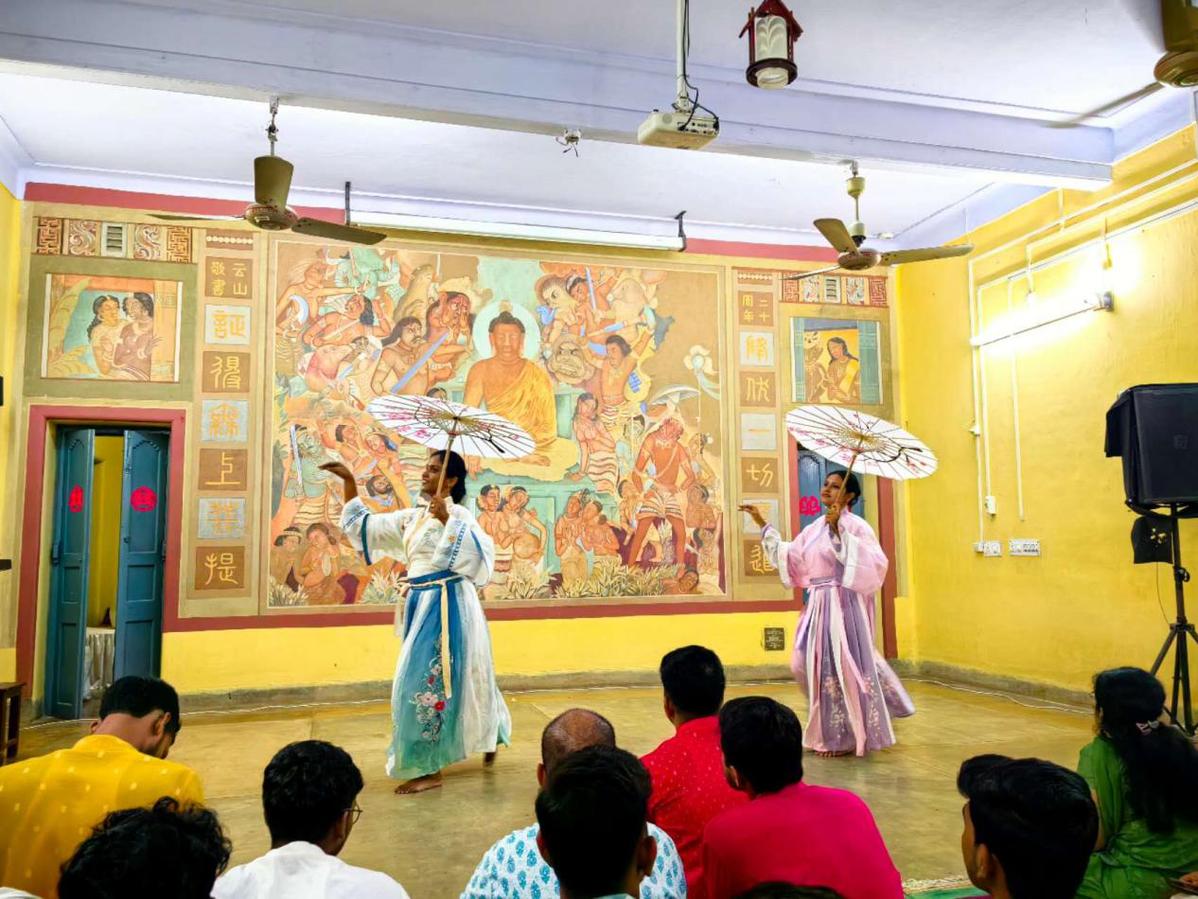
The envoy praised the standard of Chinese language education at Cheena Bhavana, or the Department of Chinese Language and Culture, at Visva-Bharati, and encouraged students of the university to become goodwill envoys for Sino-Indian exchanges. Xu was impressed by calligraphic skill, superb craftsmanship and remarkable creativity of Indian students of the university.
Later, in a post on the social media platform X, Xu wrote: "Delighted to visit #CheenaBhavana, where I enjoyed friendly exchanges with students and admired their wonderful performance."
The precious moments, alongside the historical treasures like the thread-bound books gifted by Premier Zhou Enlai in 1957, old photographs, and yearbooks, symbolize the enduring China-India friendship, he said, adding: "Such bonds deserve to be cherished and passed on."
Xu stated that Cheena Bhavana, founded through the visionary efforts of luminaries like Tagore and Chinese scholar Tan Yunshan, is a living testament to the enduring Sino-Indian friendship.
On June 10, Xu met the vice-chancellor of the university, Probir Kumar Ghosh, and held a discussion focusing on the importance of promoting people-to-people exchanges and bolstering educational collaboration between China and India.
The university, which houses Cheena Bhavana, India's oldest and premier Chinese studies center, was founded by Tagore in the 1920s.
In another post on X, Xu wrote that over a century ago, driven by his "selfless love for humanity", Tagore revitalized the ancient path of cultural exchanges between China and India. "Hope that more friendly envoys can inherit Tagore's spirit and illuminate the future path of friendship," he said.
On April 12, 1924, at the invitation of the Chinese Cultural and Literary Society, Tagore embarked on his first trip to China. Shanghai was the first stop of his China trip. From Shanghai, Tagore visited other Chinese cities, including Hangzhou, Nanjing, Jinan, Peking (now Beijing), Taiyuan, Hankou and other places.
Tagore was received by Liang Qichao, one of China's foremost intellectuals of the time. During his nearly 50-day stay from April 12 to May 30, Tagore delivered numerous speeches and talks and came in contact with numerous Chinese scholars, poets and leading Chinese litterateurs.
One of the remarkable encounters during Tagore's visit was with Tan, a Chinese scholar and a leading authority on the history of Sino-Indian relations. Later Tan visited Santiniketan, and in 1937, helped Tagore in founding the Cheena Bhavana.
Through the establishment of the Chinese studies center, Tagore laid the foundations for a new dialogue and intellectual exchanges between the two ancient civilizations.
In 2024, India and China celebrated the centenary of Tagore's visit to China with various celebrations and grand events. This year India and China celebrated Tagore's 164th birth anniversary with great fervor.
Throughout last month, Indian schools, universities, cultural institutions, local communities and government bodies organized events, including seminars, workshops, dance performances, theatrical productions and musical recitals, to mark the Tagore May 7 birth anniversary.
The Indian consulate in Shanghai in association with Shanghai Adda (an association of Bengali people in Shanghai) commemorated Tagore's birth anniversary at Vivekananda Culture Centre, Shanghai, on June 1 with a grand cultural celebration.
The celebration witnessed enthusiastic participation from scholars, cultural enthusiasts and children, along with delegates from various Chinese cultural and academic organizations, reinforcing cultural ties between India and China through Tagore's legacy.
Participants at the cultural event underscored that Tagore's literary work has more relevance today among the young Chinese generations, and that Tagore's legacy can bring deeper engagements between India and China.
"We are deeply inspired by Tagore's legacy and are committed to spread Tagore's message of universal humanism, philosophy, and ideals through cross-cultural activities," Xiao Hui, a student of Buddhist studies and a resident of Shanghai, said in an email to this reporter. Xiao was among the attendees at the event.
Tagore's literary work has profound impact among the young Chinese generation and it covers many emotions such as love, friendship, family affection, love for nature, and perception of life, which continues to resonate with readers beyond any geographical border, Xiao said.
Xin Dong, a resident of Shanghai and a Tagore follower who also attended the event, said he has gone through Tagore's Gitanjali and Stray Birds in school, and also noted that Tagore's poetry collection The Crescent Moon is well-known in its Chinese translated version.
Even today Tagore's words are relevant in the context of China-India relations, Xin said.
Speaking at the Shanghai event, India's consul-general in the city, Pratik Mathur, underlined the abiding impact of Tagore's rich cultural legacy in India and abroad.
"Tagore's spirit continues to inspire cross-cultural harmony. By embracing Tagore's legacy, India and China can certainly strengthen their ties," Chandrachur Paul, president of Shanghai Adda said. Paul hails from West Bengal and has been living in Shanghai for more than a decade.
Tagore's visit to China was a sensational event in China's literary circles The Orient Magazine, Novel Monthly, and Buddhist New Youth had special issues dedicated to Tagore. Other influential newspapers and magazines of that time also dedicated numerous reports and coverage to the event.
Most of Tagore's works were sooner or later published in the Chinese language, according to the China Gallery archive, housed in Jorasanko Thakur Bari (Tagore's birthplace) located in north Kolkata, state capital of West Bengal.
Tagore made three visits to China — during April to May 1924, March 1929, and June 1929, creating "Tagore fever" in modern China and injecting eastern wisdom into a country which was undergoing dramatic social transformation, according to the archive.
Indian diaspora, Chinese students and followers of Tagore have pledged at the event to organize more cultural festivals, academic exchanges, and joint literary festivals inspired by Tagore's legacy to nurture mutual understanding between India and China.
Tagore's visit to China a century ago was an important episode in the cultural interaction between India and China, and his discourse and ideas on pan-Asianism and nationalism attracted the attention of many Chinese intellectuals at that time, said Zhang Xing, professor and head of the South Asian Culture section in the Department of South Asian Studies at Peking University. Zhang was not present at the recent Shanghai event.
"Tagore believed that through people-to-people dialogues and the sharing of art, literature and philosophy, Asian nations could strengthen ties and learn from each other's experiences. This may also apply to our bilateral relations today. We need to think about how the cultural exchanges and mutual learning that Tagore emphasized in his time can be better utilized in current Sino-Indian interactions," Zhang said in an email to this reporter.
"100 years ago, Rabindranath Tagore gave a number of talks in Beijing on the theme of "civilization", and his confidence in Eastern culture and his efforts in preserving and promoting it are still inspirational to us today," Zhang said.
She believes that the friendship between the people of China and India will continue to develop through the mutual understanding of civilizations and the exchange of cultures.
Last year, a two-day international conference and a year-long exhibition organized by Peking University on Tagore was part of the centenary commemoration of Tagore's visit to China.
The writer is a freelance journalist for China Daily.










