Development zones to drive growth
State Council plan aims to further open up domestic market to foreign investment










To mitigate the headwinds of a volatile external environment, China is capitalizing on the strengths of its State-level economic and technological development zones to maintain steady growth in foreign trade and investment, which are critical to the country's overall economic development, officials and analysts said.
These development zones are at the forefront of China's push to further open up its economy and align with international best practices, they said, adding that new models and mechanisms deemed replicable will be scaled up nationwide, to ensure China remains responsive to the evolving global landscape.
As part of China's ongoing efforts to open its door even wider despite rising protectionism, the State Council, China's Cabinet, has adopted a work plan aimed at deepening reform and innovation in the development zones.
"The international economic and trade order is facing a serious shock," said Ling Ji, vice-minister of commerce. "The role of these development zones in stabilizing foreign trade and investment is becoming increasingly prominent."
As of last year, China had established 232 State-level economic and technological development zones spanning 31 provincial regions, which collectively generated 16.9 trillion yuan ($2.35 trillion) in regional GDP, data from the ministry showed.
They facilitated 10.7 trillion yuan in exports and imports last year, making up 24.5 percent of China's total foreign trade volume, and attracted $27.2 billion in actual foreign direct investment, accounting for 23.4 percent of the national total.
The work plan calls for prioritizing foreign-funded projects in sectors such as integrated circuits, biomedicine and advanced equipment manufacturing within the zones, for inclusion in the list of major foreign investment projects.
It also encourages the development zones to deepen engagement with leading global investors and financial institutions by leveraging trade promotion platforms while vowing support for the zones in organizing delegations to go overseas to attract foreign capital.
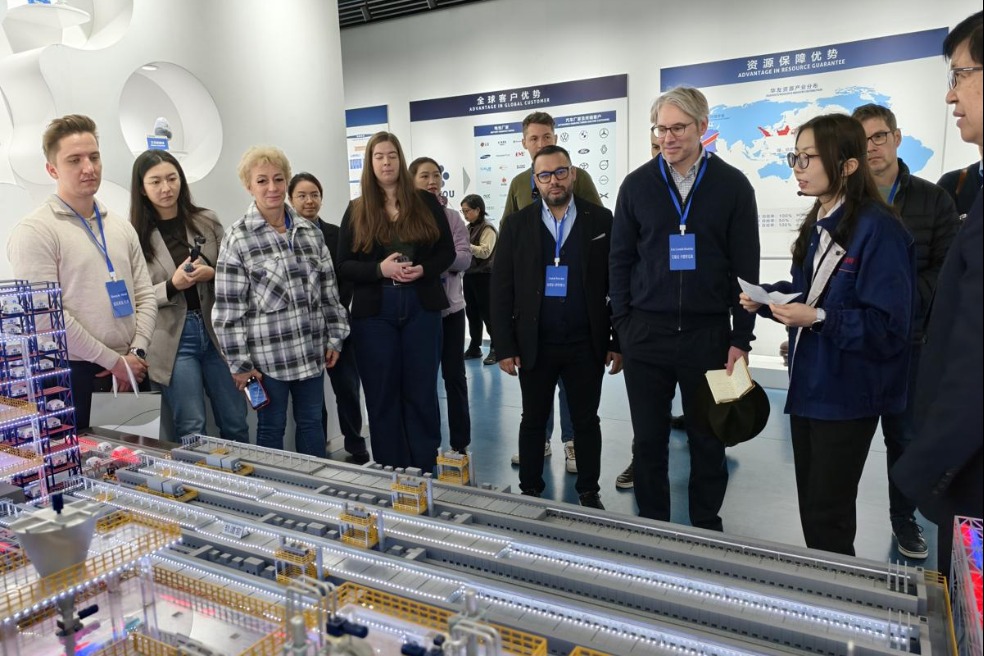
TUV Rheinland Greater China, a testing, inspection and certification company, plans to further expand its laboratory space in the Beijing Economic and Technological Development Zone this year, said Xie Qin, the company's senior government affairs manager.
The company will focus on enhancing its service capabilities in the medical device and electronics sectors to support the steady growth of its business, Xie said.
As the sole national-level development zone in Beijing, the Beijing Economic and Technological Development Zone recorded nearly $1.4 billion in actual utilized foreign capital last year, a historical high and a nearly 26 percent increase year-on-year, according to local government data.
Song Xiangqing, deputy head of the Commerce Economy Association of China, said localities should further optimize their policy and services, and increase support for foreign-invested enterprises, to ensure foreign companies feel at home and have greater confidence in their development in the economic development zone.
In terms of underpinning the country's foreign trade sector, the work plan calls for collaboration between these development zones and the China Export & Credit Insurance Corporation, the country's only policy-oriented insurer specializing in export credit insurance.
The plan encourages the development zones to establish commodity trading centers, global distribution hubs and international logistics centers if conditions permit. Eligible development zones can also establish overseas logistics facilities, according to the plan.
At a development zone in Hefei, Anhui province, a bonded logistics center has provided a new engine for the zone's foreign trade growth.
"Thanks to the efficient services at the bonded logistics center, our company's customer orders have continued to increase, and we have doubled our warehouse space, equipment investment and staffing," said Wu Mansong, a manager at Hefei Shunzhuo Supply Chain Management Co.
In the first quarter of this year, the company's import and export volume surpassed $30 million, a near 50 percent increase year-over-year, Wu said.
With the Hefei Economic and Technological Development Zone in Anhui province as one of 13 national-level development zones, the region has seen a significant boost to its foreign trade.
Data from the local customs showed that in the first four months of this year, Anhui's total goods trade import and export value grew 14.1 percent year-on-year. In April alone, the province's import and export volume reached 77.09 billion yuan, up 16.7 percent and accelerating 3.6 percentage points from the first quarter.
To further bring out the vitality of the development zones in driving the country's opening-up, regional coordinated development and high-quality industrial growth, the work plan calls for dedicated efforts to resolve longstanding pain points facing enterprises.
It also emphasizes strengthening the guarantee of key elements like land, talent and capital, and formulating supporting policies to create a more favorable environment for the zones.
Peng Xinmin, an official at the State Administration for Market Regulation, said that authorities will optimize government services in areas that deeply impact enterprises, such as market regulation, and make concerted efforts to reduce the time, procedures, documents and physical visits required.
By strictly regulating administrative inspections and refining the credit-based supervision approach, the administration aims to minimize unnecessary interference with well-performing companies and create a more efficient and enterprise-friendly regulatory environment, Peng said.
Zhou Mi, a researcher at the Chinese Academy of International Trade and Economic Cooperation, said that as China's national-level economic and technological development zones have reached a certain scale, they now possess advantages in terms of economies of scale and brand effects.
"Deepening the reform and innovation of these development zones, including strengthening their internal competition mechanisms, can help maintain their long-term growth momentum and better unlock their potential," Zhou said.
Looking ahead, Zhu Bing, director of the Ministry of Commerce's department of foreign investment administration, said that these development zones will actively foster industry-led consortia uniting enterprises, universities and research institutions.
Qualified zones will be supported in establishing offshore innovation bases. This facilitates "overseas R&D, domestic commercialization" — utilizing global talent pools while anchoring production within China, Zhu said.
China's national-level economic and technological development zones are home to over 700 national-level incubators and maker spaces, with more than 4.9 million operating entities, including 85,000 high-tech firms, which account for 18.3 percent of the country's total, according to the Commerce Ministry.
Zhang Xiaotao, dean of the School of International Trade and Economics at the Central University of Finance and Economics in Beijing, said that exploring new pathways for high-level opening-up is a key mission of these development zones.
"We need to reform existing mechanisms and systems that constrain productivity development and hinder innovation, with a focus on delivering tangible benefits to enterprises, and strive to build a world-class, market-oriented, law-based and internationalized business environment," Zhang said.
wangkeju@chinadaily.com.cn



- Xinjiang's Tacheng secures 10bn yuan boost for modern industrial projects
- Tianjin leads nation in geothermal energy use
- Golden Melody Awards celebrate rich cultural heritage of Hokkien music
- Jiangmen terminates Level III Chikungunya emergency response
- Civil aviation sector shows growth with release of upcoming flight season
- China honors first Commemoration Day of Taiwan's Restoration