



Aggressive regression
The US is becoming a revisionist state increasing political turbulence and uncertainty worldwide









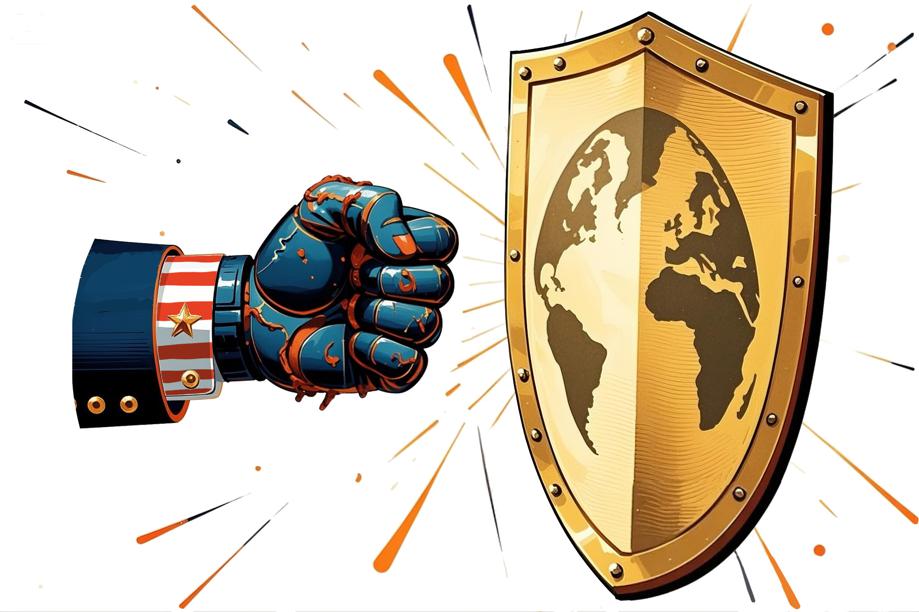
The United States, leveraging its overwhelming strength, became a key architect of the postwar international order and a leader in global governance following the end of World War II. After the Cold War, the world entered a unipolar era dominated by the US. Under this unipolar hegemony, the US pursued a policy of "liberal internationalism", which promotes a world order characterized by open markets, free trade and the free flow of production factors worldwide. This has facilitated the deepening of globalization.
However, under the leadership of Donald Trump, the US is seeking to counter the globalization trend, advocating its "America First" doctrine, populism and trade protectionism, even at the cost of overturning the existing international order.
Thus, the principal contradiction of the world is that the dominant power is undermining the world order, while emerging nations strive to uphold it.
Under the leadership of Trump, the US is evolving into a revisionist state within the international order. "Revisionism" refers to a state's unilateral pursuit of its own interests at the expense of shared norms, responsibilities and obligations, thereby causing disorder in the international system. Currently, US revisionism is primarily manifested through its unilateralist actions.
To start with, the US has shirked its responsibilities in global governance.
The Trump administration is ignoring global efforts to address climate change and instead taking regressive actions, such as announcing the US' withdrawal from the Paris Agreement, revoking the clean energy transition plan proposed by the Joe Biden administration, and restarting oil and gas exploration.
Additionally, the Trump administration has withdrawn from global governance platforms that offer no immediate economic benefits to the US, such as the World Health Organization, and criticized the 2030 Agenda for Sustainable Development and its Sustainable Development Goals.
Second, the US has ignored liberal trade principles. This is evident in the increased use of tariffs. At the beginning of his second term, Trump launched a large-scale tariff war against major world economies with the implementation of so-called reciprocal tariffs.
Since the end of the Cold War, successive US administrations extended free market rules worldwide by granting preferential trade terms to developing countries, applying differential tariffs based on each country's level of economic development. However, after Trump took office, he announced large tariff hikes on products from countries such as Mexico, Canada and China, aiming to use these tariffs as a source of revenue for the US federal government.
Third, the US has openly challenged the principle of sovereignty. The US has embarked on a new round of geopolitical expansion in the Americas. In his inaugural address, Trump announced plans to rename the Gulf of Mexico as the "Gulf of America", and later claimed that the US should reclaim ownership and control over the Panama Canal, annex Greenland, and even make Canada the 51st US state.
On the Ukraine issue, Trump advocates compromising with Russia, urging Ukraine to accept the current territorial status quo and make concessions to Russia in exchange for reconciliation, and demanding $500 billion worth of mineral resources from Ukraine in exchange for US diplomatic mediation and security guarantees.
The sharp confrontation between the US and Europe over Ukraine is not only testing the US-European alliance but also heightening European countries' sense of insecurity, fueling right-wing extremism within European nations, triggering an arms race in the region, and increasing the hostility of European countries toward Russia, leaving a hidden danger for regional security in Europe.
The root of the Trump administration's revisionist security and foreign policies lies in the populist revolution driven by extreme conservative forces within the US. The US now uses populist values and standards to define national interests and principles of international engagement.
In the economic realm, the US has abandoned the principle of free trade, employing tariff wars, trade wars and technology wars to ensure its dominance in the new wave of technological revolution. It aggressively promotes the return of basic manufacturing industries, the strengthening of its global leadership in science and technology innovation, as well as in the critical mineral and strategic resource industries, and significantly reduces its trade deficits and the outflows of US dollars.
In terms of security, the US approaches alliances from a cost-benefit calculation perspective, pressuring European allies to increase defense spending to 5 percent of GDP and forcing them to pay for US security guarantees through military procurement.
In international engagement, the US has abandoned the principles of liberal internationalism. On the Israeli-Palestinian issue, it openly supports Israel's position, proposes taking control of Gaza, advocates the expulsion of Palestinians living in Gaza and the West Bank, and completely rejects the two-state solution.
The core objective of the Trump administration's revisionist security and foreign policies is to maintain the US' hegemonic position — most of all, maintaining and reinforcing the country's absolute dominance in technology, industry and finance. The administration's new wave of tariff and trade wars is, in essence industrial, technological and market warfare, which aims to form a comprehensive campaign to encircle, suppress and contain China's industrial advancement, particularly innovation and entrepreneurship in science and technology.
On the one hand, during his second term, Trump has comprehensively tightened restrictions on high-tech capital flows between China and the US through the "America First Investment Policy".
On the other hand, Trump is seeking to gain an advantage in critical minerals. As global politics moves beyond a century of "oil politics", it is entering an era of "metal politics", in which critical minerals have become strategic resources indispensable to the new wave of technological and industrial revolution centered on artificial intelligence.
The US relies heavily on imports for many of its critical minerals. Specifically, the US imports over 50 percent of its supply for 41 out of the 50 critical minerals, including some the US is fully dependent on foreign sources.
Trump's threats to control up to 50 percent of Ukraine's rare earth and other critical minerals, and remarks about turning Canada into the 51st US state, competing for Greenland, and compromising with Russia, reveal the nation's political intention to make competing for mineral resources a core foreign policy goal.
Since Trump's return to power, his attempt to "Make America Great Again" through revisionism has increased political turbulence and uncertainty worldwide, triggered conflicts and confrontations, and exacerbated the failure of global governance, significantly undermining the liberal international order.
The escalating tariff wars will heighten global inflation risks — including in the US — raise living costs for citizens, especially low-income groups, and cause significant harm to the global economy.
If the Trump administration continues to act unilaterally driven by a hegemonic mindset, the world's main contradiction will gradually turn into a political and economic struggle between the majority of countries advocating global governance and a minority opposing it.

The author is dean of the School of International Studies at Nanjing University. The author contributed this article to China Watch, a think tank powered by China Daily. The views do not necessarily reflect those of China Daily.
Contact the editor at editor@chinawatch.cn.





