Support for sci-tech, research institutions reaping dividends









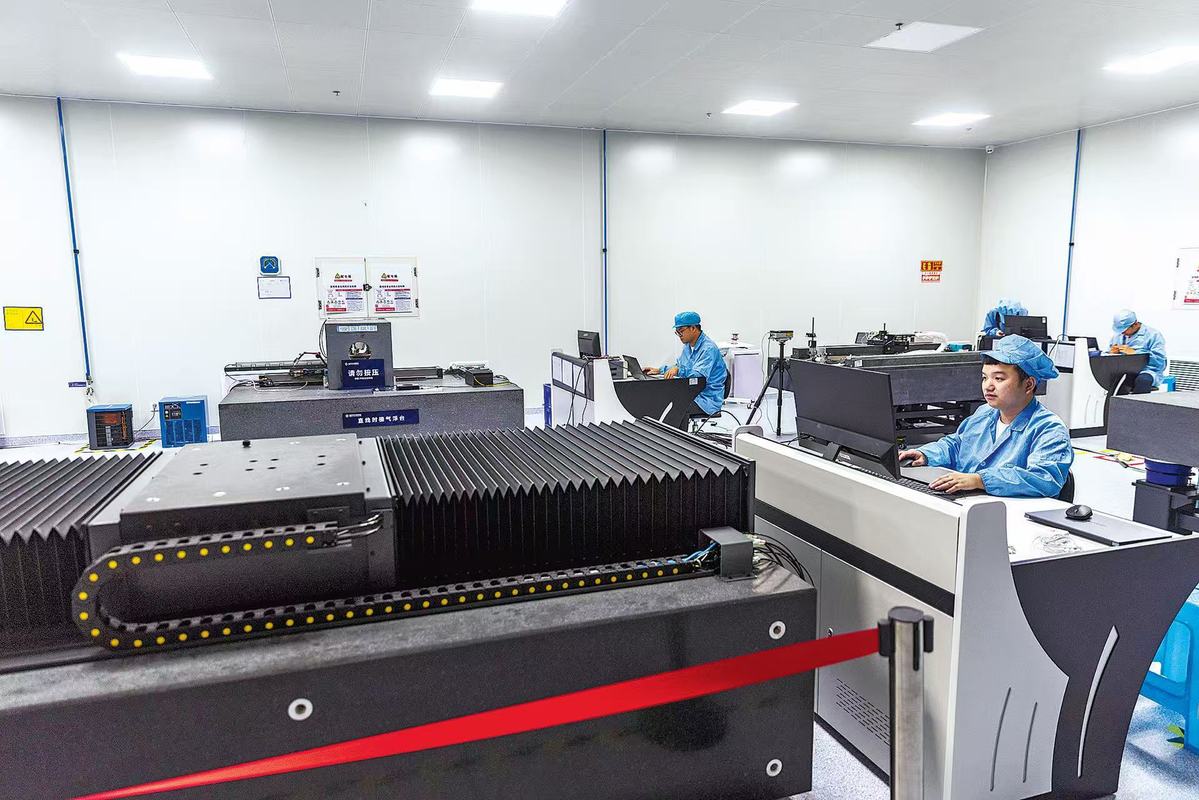
Genertec Guoce Time Grating Technology Co Ltd, a Chongqing-based innovation-driven enterprise, is intensifying efforts to address growing demand for ultra-precise displacement measurement in high-end equipment.
Since its establishment a few years ago, the company has benefited from a range of tax incentives, including 5.67 million yuan ($790,000) in value-added tax refunds, 51.67 million yuan in additional deductions on research and development expenses, preferential policies such as pre-tax deductions for hiring people with disabilities and a 50 percent reduction in stamp duties in 2022.
The company's story exemplifies China's broader fiscal push to support science and technology enterprises and research institutions, with the aim of advancing both fundamental research and industrial applications to foster high-quality economic development.
The Ministry of Finance said China's fiscal expenditure on science and technology totaled 295.3 billion yuan in the first four months, up 3.9 percent year-on-year. Local governments are also optimizing fund allocation mechanisms to further enhance the efficiency of sci-tech innovation support.
In Chongqing, the local government has aligned fiscal strategy with its innovation blueprint, optimizing spending structures, refining policy systems and deepening reform measures to better integrate innovation, industrial, capital and talent resources in order to turn sci-tech innovation into a key driver of the city's high-quality growth.
From 2018 to 2024, the city's fiscal spending on sci-tech reached 63 billion yuan, with an average annual growth rate of 11.5 percent — 7.9 percentage points higher than the average increase in general public expenditure.
One of Chongqing's hallmark reform measures lies in reinforcing the role of enterprises as the principal drivers of innovation, gradually shaping what is known as the "three 70 percent mechanism".
Under this model, over 70 percent of technological innovation demands originate from businesses, more than 70 percent of application-oriented fiscal subsidies are allocated to enterprise-led R&D projects, and enterprises contribute over 70 percent of funding for industry-related scientific research programs.
The city also grants scientists greater autonomy in choosing research pathways and using funds, while establishing a closed-loop performance management mechanism to ensure efficient use of resources.
High-end research platforms such as an ultra-transient experimentation facility and Jinfeng Laboratory have been completed and put into operation.
Over the past three years, Chongqing has launched more than 610 major sci-tech projects, allocating over 1 billion yuan from fiscal funds. They have attracted over 5 billion yuan from enterprise investment, resulting in breakthroughs in 304 core technologies and further integration between innovation and industrial chains.
"At Jinfeng lab, we've benefited from both national and municipal fiscal policies tailored for us to gather key strategic resources and platforms, and develop research programs," said an executive at the laboratory. "These targeted policies allow us to focus fully on research."
The lab is designed to drive innovation in biomedicine and intelligent science sectors in western China by integrating frontier research resources, accelerating research applications and strengthening basic research.
To further bolster innovation-driven growth, Chongqing has established a full-cycle financial support system that spans seed funds, angel investments, venture capital and IPO cultivation.
By the end of 2024, outstanding loans to tech-oriented enterprises in Chongqing had reached 707.5 billion yuan, marking a year-on-year increase of 44 percent. The number of tech-oriented firms reached 69,000, while the city had become home to more than 8,800 high-tech enterprises.
In Shandong province, Jinan Jingzheng Electronics Co Ltd, founded in 2010, has made a technological breakthrough by developing nanoscale lithium niobate single-crystal thin films, primarily applied in fields such as 5G smartphone filters, detectors and fiber-optic communications.
"There was financial backing for establishing laboratories for our company as a startup, and when we began to scale up, we received funding for factory construction," said Hu Wen, company founder and CEO.
Hu said that at a critical moment in the company's development, the Shandong new growth drivers fund program injected 50 million yuan as equity investment into the firm.
"The program doesn't just invest for financial returns — it connects our company with resources along the industrial chain. It's professional, strategic and long-term, so this kind of support is much more valuable than pure capital investment," Hu said.
The Shandong Provincial Department of Finance said the province has continued to build an integrated fiscal support system based on the characteristics of different stages and types of innovation.
These include competitive selection, diversified inputs and tailored guidance — all aimed at cultivating world-class strategic scientific capabilities and generating more high-quality outcomes.
In key sectors — such as integrated circuits, machine tools and biopharmaceuticals — Shandong encourages enterprise-led innovation through collaboration with universities and research institutes.
The province has also deepened fiscal-financial coordination, making full use of the Shandong New Growth Drivers Fund Management Co Ltd as a vital tool to support innovation.
By the end of April, the firm had set up a total of 151 funds, investing in 1,759 projects with a total investment of 224 billion yuan. These investments have drawn in 558 billion yuan from society, significantly bolstering Shandong's innovation-driven development.