



Lai's 'ten talks' a perilous push toward division









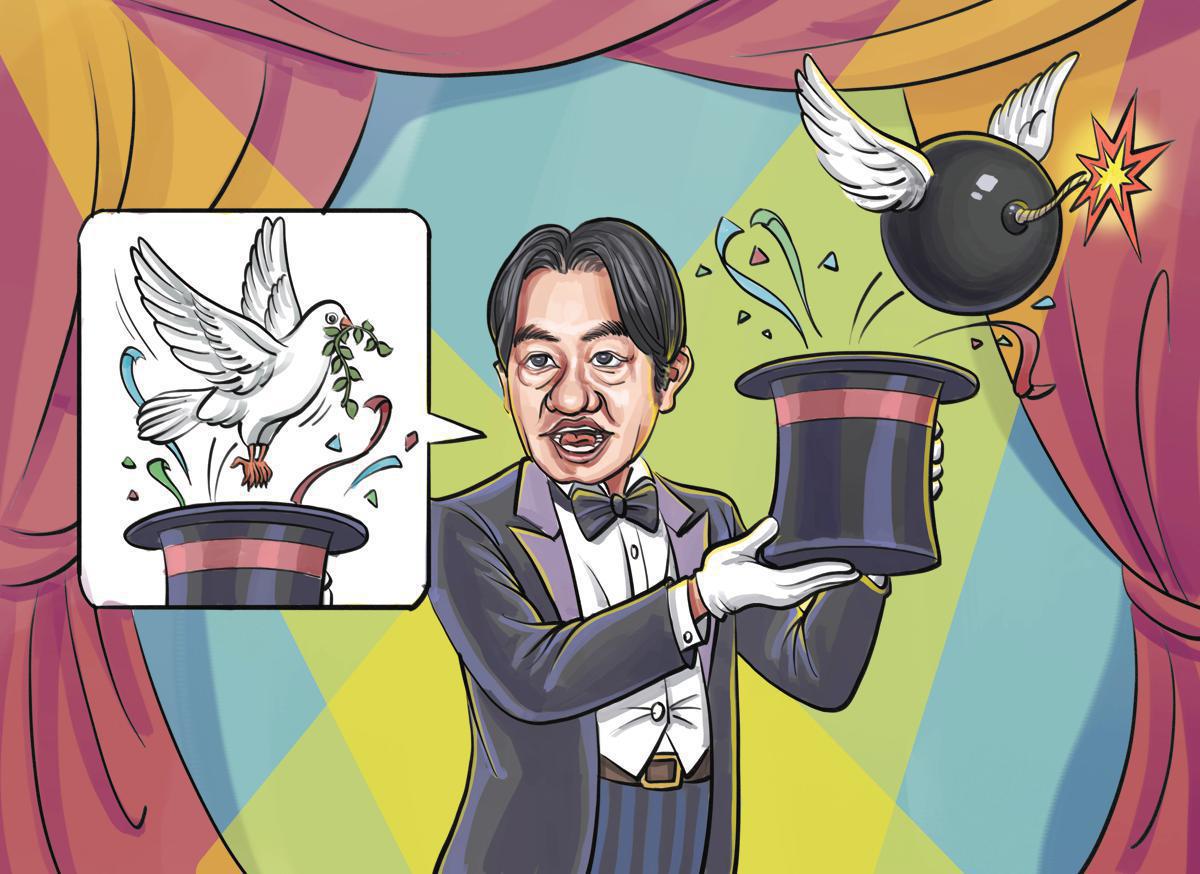
Along with the Taiwan authorities' campaign to hold a recall election for 24 opposition lawmakers in late July, island leader Lai Ching-te has rolled out his so-called "ten lectures on unity". But in a society marked by intense political polarization, escalating confrontation between the ruling and opposition parties, and deepening divisions, Lai's "ten talks" are not about unity but more about advancing his "Taiwan independence" agenda.
Behind his polished rhetoric are only lies and distortions.
First, Lai claims "Taiwan has always had its own independent ecosystem". This is a blatant lie, an attempt to rewrite history. Taiwan has been an integral part of China since ancient times. Chinese people settled and began developing Taiwan centuries ago, and formal governance structures were formed as early as the Song (960-1279) and Yuan (1271-1368) dynasties. In 1684, the central government of the Qing Dynasty (1644-1911) established the Taiwan prefecture, which it elevated to a full province in 1885. These are historical facts that refute Lai's fabricated "independence narrative".
Second, Lai says "Taiwan is a country, with sovereignty and governance over Taiwan, Penghu, Kinmen and Matsu" based on the 1999 "resolution on Taiwan's future" passed by the Democratic Progressive Party — a document not recognized by even all the parties on the island. In fact, some of them deem it illegal.
Lai's position contradicts international law, too. Taiwan was restored to China in 1945 after 50 years of Japanese occupation. Since then, Taiwan being part of China has been integral to the post-World War II world order. Countries including the United States, Japan, and European Union member states all uphold the one-China principle, and do not recognize "two Chinas" or "one China, one Taiwan". This makes Lai's rhetoric mere political theater with no basis in fact or law.
Third, Lai claims that "UN General Assembly Resolution 2758 does not concern Taiwan". This is a deliberate misreading of the resolution, because it once and for all settled the issue of China's representation in the United Nations and affirmed the one-China principle that there is only one China and Taiwan is an integral part of China. As a result, Taiwan has no right to join the UN or any of its affiliated bodies. Lai's attempt to twist this reality is nothing more than a dirty political gimmick to reject the 1992 Consensus that there is only one China.
The DPP has long relied on a fervent base that is deeply influenced by "anti-Chinese mainland" and "pro-independence" sentiments. Lai's "ten talks" are crafted to inflame this base — not with facts, but with emotion-driven narratives — and prompt Taiwan residents to take part in the recall election campaign targeting opposition Kuomintang lawmakers.
More worryingly, Lai recently made a shocking remark: calling for the removal of "impurities" that hinder "Taiwan independence". This remark has drawn widespread condemnation. Many interpret it as labeling anyone who opposes his agenda as disposable. In Lai's worldview, Taiwan society is divided into "pro-independence" and "anti-independence" camps, with only the former considered legitimate. Such thinking reveals a deeply authoritarian mindset, intolerant of dissent and disdainful of democratic values.
Within the DPP, despite internal factionalism, no one dares challenge Lai. Power preservation trumps principles in the party, which is hell-bent on tearing apart Taiwan's social fabric. The DPP is cultivating division — turning the "pro-independence" and "anti-independence" forces into oppositional forces — further intensifying the already volatile recall election atmosphere.
Over the past year, the Lai administration has been repeatedly blocked in the island's "legislature" by the combined efforts of Kuomintang and the Taiwan People's Party, stalling key personnel appointments, budget bills and major legislative measures.
That's why Lai's "ten talks" are aimed at shifting the blame for the political deadlock onto the opposition, portraying himself as a victim while seeking to regain control of the legislature. The July 26 recall vote, which will be vital for membership of at least 24 Kuomintang "lawmakers", will determine whether the DPP can reclaim dominance in the legislature, with the result largely hinging on voter turnout from both camps and "independents".
Lai has recently ramped up his rhetoric, pushing "anti-communism", "Taiwan independence" and "defend Taiwan" themes more aggressively. His political motive is clearly aimed at swaying the public opinion ahead of the recall vote.
At its core, Lai's "new two-state theory" defines his stance on cross-Strait relations. But no amount of rhetoric can change the legal and historical fact that Taiwan and the mainland are parts of one China. Beijing is well aware of Lai's tactics and will not tolerate moves that endanger peace across the Strait and divide the Chinese nation.
It's time Taiwan residents reflected on whether Lai, since assuming office, has consolidated unity or exacerbated the division in Taiwan society. Has he advanced public welfare or political vendetta? His moves to spread hatred, target dissent and polarize society speak for themselves. As one popular slogan in Taiwan goes: "Taiwan won't thrive until the DPP falls."
The author is deputy head at the Institute of Taiwan Studies, Chinese Academy of Social Sciences.
The views don't necessarily represent those of China Daily.
If you have a specific expertise, or would like to share your thought about our stories, then send us your writings at opinion@chinadaily.com.cn, and comment@chinadaily.com.cn.





