


Tracing the origins of civilization
Hongshan relics and artifacts reveal ritualistic systems, an integration of cultures, and the formation of China's united identity, Zhang Kun reports.









About 6,000 years ago, ancient people in North China's Liaohe River Basin developed advanced ritualistic sacrificial systems that reflected the path and characteristics of Chinese civilization.
They created Hongshan culture through a continuous collision and integration of cultures, yet it was distinctive from the civilizations found in the lower reaches of the Yellow and Yangtze rivers.
Legends of Dragon: The Ancient Civilization of Hongshan Culture, a new exhibition at Shanghai Museum East that opened on June 26 and runs until Oct 8, marks the largest, most comprehensive showcase featuring Hongshan culture.
The exhibition is the fourth of the museum's series of archaeological exhibitions called "The Essence of China" that focuses on the origins of the Chinese civilization and the formation of the country's united identity.
Shanghai Museum joins more than 20 museums and archaeological institutions in Liaoning province, the Inner Mongolia autonomous region, Hebei province, Beijing and others to present Legends of Dragon, which gathers more than 300 Hongshan culture artifacts from archaeological findings over the past century, including findings from the latest expeditions.
More than a quarter of the exhibits are making their public debut, according to Chu Xiaobo, director of the Shanghai Museum.
The exhibition interprets Hongshan culture's unique path in developing a civilization characterized by unified beliefs, and the initial formation of rites and ceremonies, says Chu.
"Through the most important achievements and latest discoveries of Hongshan archaeology, the show provides solid evidence of Chinese civilization's over 5,000-year history, and eloquently answers the ultimate question — What is the essence of China?"
Hongshan culture is a significant Neolithic culture in northern China dating back 6,500 to 5,000 years. Named after the archaeological site of Hongshan, or red mountains, in Chifeng of the Inner Mongolia autonomous region, it covers 200,000 square kilometers in the western part of Liaoning province, the southeastern part of Inner Mongolia, and the northern part of Hebei province.
Roughly 5,000 years ago, Hongshan culture entered its late phase with accelerated social development and distinct settlement classes and functions. Ritual sites of various scales emerged away from residential areas.
A sacrificial system comprising temples, altars and stone burial mounds was established, reflecting a ritual culture primarily focused on ancestor and heaven worship and signifying that Hongshan society had entered a civilized stage.
As China's first representative archaeological culture to enter the phase of ancient states, Hongshan is recognized as a significant research source of Chinese civilization, according to Jia Xiaobing, a researcher at the Institute of Archaeology at the Chinese Academy of Social Sciences.
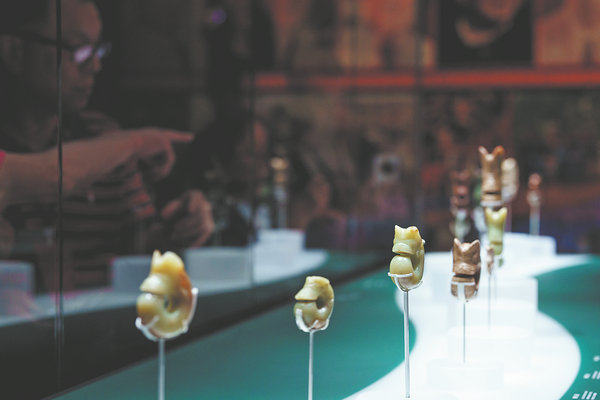
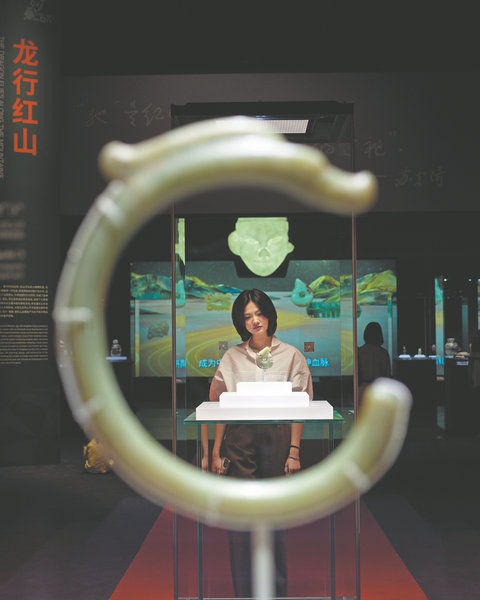
Hongshan people created beautiful artifacts by carving jade. One of the most iconic objects among the exhibits is the C-shaped Jade Dragon from the Palace Museum's collection in Beijing. It stands 25.7 centimeters tall and its widest point is 21.8 cm. Many jade dragons were excavated from the Hongshan culture sites. Used as a worshipping object by prehistoric people, the C-shaped dragon stands out for its simple, light form, which draws wide interest from the public.
C-shaped dragons are among the earliest dragon forms found in jade artifacts and they closely resemble the image of dragons in people's imaginations, according to Feng Yucheng from the archaeological research department at Shanghai Museum.
There are various theories regarding the design's origin. Some scholars believe the primary form was rooted in a pig's head, while others think the form is a fusion of multiple animals. However, they unanimously refer to it as a dragon, marking it as one of the earliest recognized dragons, and subsequently as the national totem by the Chinese people.
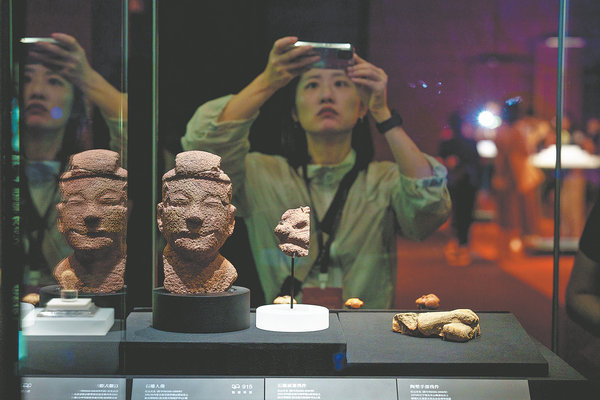
Ancestor worship was a vital component of the Hongshan culture's belief system. Hongshan people idolized their ancestors and made human figures in various sizes from different materials, such as clay, stone and jade. These figures were found in the residential areas and venerated at ritual sites such as temples and altars.
Archaeologists excavated the Goddess of Hongshan in 1983 at the Niuheliang site in Liaoning province, which was built on a grand man-made platform. The statue's head, made of clay, has jade eyeballs and shells for teeth. It is recognized as the earliest goddess statue found in China thus far.
The original artifact is so fragile that the Liaoning Provincial Institute of Cultural Relics and Archaeology, where it is stored, decided against shipping the original piece to Shanghai. Instead, the institute presented a replica.
"The reproduction is nearly the same as the original," says Bai Baoyu, head of the Liaoning Provincial Institute of Cultural Relics and Archaeology.
By observing the exhibit carefully, visitors will find that the goddess has a pierced left ear, which indicates that the Hongshan people wore earrings. The goddess also wears a headband on its forehead, which is quite different from the wild-haired primitive image that people often imagine.
Contact the writer at zhangkun@chinadaily.com.cn
If you go
Legends of Dragon: The Ancient Civilization of Hongshan Culture Shanghai Museum East, Bright Dairy & Food Exhibition Gallery 1,1952 Century Avenue, Pudong, Shanghai.
Jun 26-Oct 8, 10 am-6 pm (last entry at 5 pm), Wednesday-Monday, closed on Tuesdays (except national holidays).
Visitors can enter the museum with a valid ID through the B1 East Gate after security check.
021-2072-9999.