



Xi Story: Under Xi, China's first 15-year city plan resonates far









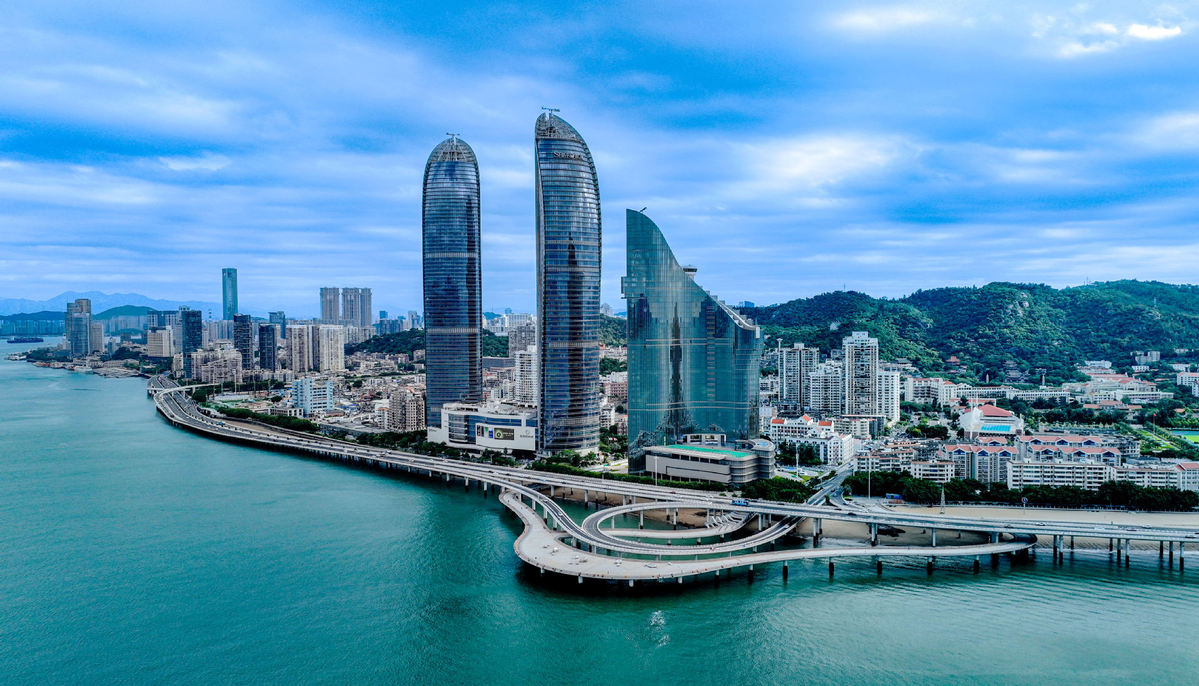
XIAMEN -- In a quiet corner of an exhibition hall in the coastal city of Xiamen in East China's Fujian province rests a faded blue binder, its 300 yellowed pages meticulously preserved, containing the city's economic and social development strategy from 1985 to 2000.
During a 2024 inspection, President Xi Jinping paused here, his fingers tracing the pages he helped draft four decades ago. "We planted seeds here," he said. "Today's harvest surpasses our expectations."
In the summer of 1985, when 32-year-old Xi assumed the office of Xiamen's vice mayor, the city was grappling with uncertainties.
The central government had just expanded the Xiamen Special Economic Zone from 2.5 to 131 square kilometers, raising a pivotal question: how could a modest port city morph into a global harbor while preserving its unique features?
With no domestic precedents to follow, officials here were divided. Some were overly optimistic about replicating Singapore or Hong Kong, while others remained skeptical that major breakthroughs could be achieved given Xiamen's weak economic fundamentals.
Xi took a different view. He argued that modern economic development demanded long-term thinking and a comprehensive approach.
"We must think far ahead and see the bigger picture. Acting only for short-term goals leads to inefficiency and strategic drift," he said in a 1986 meeting. It was under his direct leadership that Xiamen established an office to draft a development strategy for the next 15 years.
"Xi's contribution wasn't merely in the construction of a building, a road or a bridge, but in establishing a long-term, forward-looking, and systemic approach to development," recalled Zheng Jinmu, then deputy head of the city's planning commission and one of the plan's lead authors.
At the time, it was common at both national and local levels to create annual or five-year development plans, but never a 15-year plan for a city.
"Facing such a monumental research task, we had limited experience," Xi acknowledged. "That's why the team must study hard and explore boldly."
He led delegations to Beijing to seek guidance from top economists. He also met with researchers from the Chinese Academy of Social Sciences and Xiamen University. Ultimately, over 100 experts and government staff contributed to 21 thematic reports covering industry, trade, port logistics, tourism, education, and more.
Beyond expert consultation, Xi emphasized the importance of public participation. In 1986, a city-wide essay campaign themed "Xiamen in the Year 2000" was launched, inviting members of the public to give advice. Contributions poured in from scholars, engineers, civil servants and ordinary workers.
The final blueprint positioned Xiamen as a strategic economic center in southern Fujian, a key gateway in China's southeast coastline, a bridge for cross-Strait relations and a hub for China's connections with Asia-Pacific economies. It set ambitious goals for port development, industrial modernization, and infrastructure, including turning the port of Xiamen into a major hub. Today, that vision is a reality.
In reform policy, Xi pushed for bold steps, insisting that Xiamen should "dare to break through" and "explore a uniquely Chinese path" to free port development.
He led study trips to Singapore and other ports, convened international conferences in Xiamen, and proposed a "three-step" approach: first, create bonded zones; then expand to a free trade zone; and eventually, a quasi-free port. This framework laid early conceptual groundwork for China's national free trade zones decades later.
Ecological governance was another key theme of the plan, years before "green development" became a national strategy. Yundang Lake, once heavily polluted, was Xi's priority. In 1988, he introduced a clear-cut guideline for lake management focused on legal enforcement, sewage treatment, dredging, water flow improvement, and environmental beautification. This set in motion a decades-long transformation of the lake area into one of Xiamen's most iconic scenic spots.
"Destructive development isn't always done by the ignorant," Xi warned in a 1986 government address. "Sometimes it reflects a lack of responsibility or vision."
The plan also emphasized livelihoods. Of the six core goals set for 2000, three were directly related to people's livelihoods: income growth, improved social services, and a healthy environment. It also proposed early solutions to urban-rural integration.
"In building the city of Xiamen, we have carried on the approach adopted by Xi and our focus must be on creating places where citizens feel a sense of gain and belonging," said Li Decai, chief of the city's housing and development department.
The same spirit of forward-thinking, grounded in evidence and public input, has sustained Xi's later political career, while the experiences that began in one city continue to resonate far beyond it.
As the general secretary of the Communist Party of China Central Committee, Xi has repeatedly stressed the importance of strategic thinking and planning for a political party and a nation.
In 2020, to formulate the 14th Five-Year Plan, public opinions and suggestions were solicited online. That same year, Xi chaired seven symposiums over three months that engaged representatives from various sectors.
As China prepares to draft its 15th Five-Year Plan this year, Xi has stressed the importance of sound, democratic and law-based decision-making, emphasizing the need to integrate top-level design with public consultation, enhance research and dialogue, and build broad consensus.
"When Xi led the formulation of Xiamen's development strategy, he upheld an open and forward-looking vision that embraces historical trends," said Zhang Xingxiang, a professor at the School of Economics, Xiamen University. "This approach offers invaluable insights for current national and local planners in formulating socio-economic development plans for the next five years."


- China's rail network sets new Spring Festival travel records
- Yunnan trains offer stools for standing passengers without seats
- China releases full text of government work report
- China advances biotech innovation: Expert
- Call to expedite visas for ASEAN patients
- School spring breaks set to spur tourism





