


From digitized Buddhist caves to neutron-scanned relics, innovators are merging tradition and cutting-edge science to revive ancient treasures.
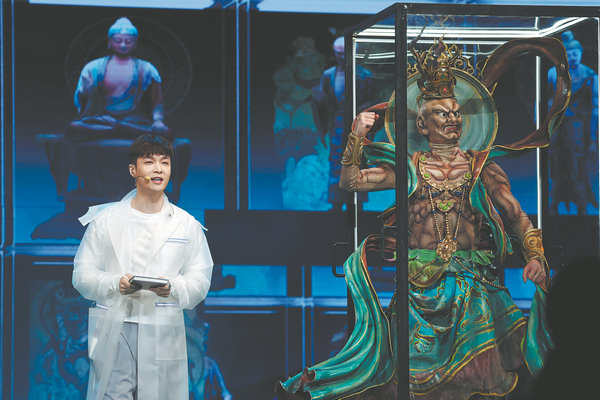
A towering projection of a 1,600-year-old Buddha from the Mogao Caves — a Silk Road treasure trove of Buddhist art — fills the screen as Tian Qinxin taps her tablet.
The audience gasps as the fresco's fading pigments are restored to their original brilliance from the scenes of The Summoning of Dunhuang that were presented by Tian, president of the National Theatre of China. The images on the screen created a vivid, time-traveling connection between the Dunhuang Academy's digital research center in 2035 and a painter from 1935, vividly bringing the past to life at the 2025 Cultural and Natural Heritage Day's theme forum in mid-June that showcased the powerful fusion of culture, history and technology.
The annual day celebration has served as a vital platform to highlight the achievements in the protection and utilization of cultural relics and the preservation and inheritance of cultural heritage in China.
"The entire performance uses singing as the narrative medium, with dramatic acting and dance driving the plot. It brings the static images of Dunhuang to life through the actors' performances and digital technology, effectively reviving the cultural relics," Tian explains.
The debut of The Summoning of Dunhuang in December 2024 was a huge success, drawing 9 billion views across the internet and climbing to the trending lists of platforms such as Weibo, Douyin, Xiaohongshu, and Kuaishou more than 300 times.
Tian emphasizes that the production didn't just strike a chord in China but resonated strongly with overseas Chinese communities, reaching an audience of over 100 million globally.
She believes the show perfectly demonstrates how art can breathe contemporary life into the cultural relics.
"It allows us to continually recognize the essence of our nation," Tian says.
She points out that art, as "the horn of the times", reflects and leads the cultural trends of an era. Through its integration with cultural relics, it breathes new life and vitality into these ancient treasures and allows modern people to reconnect with and pass on these cultural treasures.
Tian was among dozens of experts and officials at the forum that explored a range of key topics in cultural relic protection and utilization. The discussions offered perspectives for bridging cultural heritage with the public and advancing its protection as a shared responsibility.
While art breathes emotion into relics, science provides the tools to decode and preserve them. Bridging the gap between ancient craftsmanship and modern innovation, Wei Cunfeng, a researcher at the Institute of High Energy Physics, Chinese Academy of Sciences, shares how nuclear technologies are revolutionizing the study and protection of cultural artifacts.
Large scientific devices such as synchrotron radiation sources and neutron scattering facilities, along with techniques like X-ray testing and X-ray CT scanning, have enabled comprehensive research on the materials, structure, and craftsmanship of cultural relics, which helps better understand the degradation of cultural relic materials, assess the effectiveness of preservation materials through environmental simulation, he says.
"By combining historical information — such as the history of pigments or architecture — we can analyze the elemental composition and crystal structure of relics, which enables us to deduce their creation dates and restoration history. This helps us in establishing chronological studies of relics and understanding their internal structure and material distribution, shedding light on their craftsmanship," he explains.








