



Digital initiative turns city into innovation hub
Govt support for startups credited with nurturing technological transformation









When Canadian entrepreneur Nikk Mitchell first landed in Hangzhou, the capital city of Zhejiang province, more than a decade ago, he expected to stay for just a year — long enough to enjoy the misty lake views and ancient pagodas before moving on.
Today, as co-founder and CEO of FXG — a virtual-reality startup — he remains firmly rooted in a metropolis that has become a bellwether for China's technological leap.
"China captured me," he said while sitting in his studio in Dream Town, a government-backed tech park that has become a haven for startups.
He credited the city's success to a strong research ecosystem, a robust industrial supply chain that helps convert concepts into commercial products, and a policy environment that actively supports innovation.
"For Hangzhou, it's the government support that makes this a really friendly place to do business," he said.
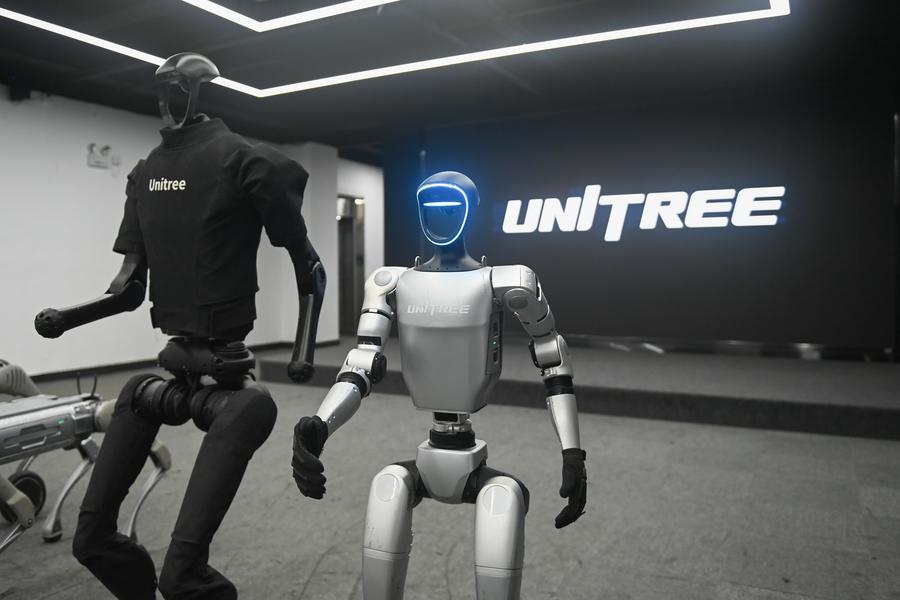
That support has helped nurture companies like artificial intelligence startup DeepSeek, as well as Game Science, the developer behind the hit title Black Myth: Wukong, and Unitree Robotics, which dominates the global market for quadruped robots — a phenomenal rise that Mitchell believes is no coincidence.
In the eyes of analysts and business leaders, Hangzhou over the past two decades has become a powerful symbol of China's technological transformation.
They believe that today's boom traces its roots to 2003, when Xi Jinping, then secretary of the Communist Party of China Zhejiang Provincial Committee, launched the "Digital Zhejiang" initiative.
Backed by a total investment of 62.5 billion yuan ($8.7 billion) in information infrastructure, the initiative overhauled the region's internet infrastructure, setting a foundation for data-driven industries.
"Faster networks, higher reliability and expanded digital services did more than boost businesses," said Gong Sen, director of Zhejiang University's Centre for International Studies on Development and Governance. "They enabled a more responsive government and paved the way for a smarter city."
Gong said that development of sound digital infrastructure enabled Zhejiang to lead the way for China in pushing forward the development of one-stop government services.
Meanwhile, Xi also showed foresight in pointing out that Zhejiang, as one of China's major economic powerhouses, needed to play a greater role in the nation's sci-tech innovation drive.
In March 2006, he presided over a provincial conference on independent innovation, proposing targets to develop Zhejiang into a region with strong innovation and sci-tech capacities.
Xi's early push for digital connectivity helped Hangzhou leap ahead of its peers and establish a durable edge in China's fast-growing digital economy, Gong said.
Over the past two decades, companies like Alibaba have played a defining role in shaping China's digital economy, from e-commerce and cloud computing to digital payments. Others, including NetEase, have driven advancements in hard tech and gaming.
Hangzhou is a place where entrepreneurs are not only building products, but also laying the groundwork for a future driven by AI, blockchain and smart technologies, said Cai Guoxiang, vice-president of Rokid, a Hangzhou-based producer of AI-powered smart eyewear.
The continuity of government efforts to develop the city into a digital hub is one of the key reasons for the emergence of leading tech startups, Cai said.
"This continuity — spanning from the e-commerce revolution to the current AI surge — has cemented Hangzhou's reputation not just as a home for tech giants, but as a breeding ground for the next generation of innovation," Cai said.
That foundation has evolved into a full-fledged industrial cluster — an entire ecosystem — centered around AI, he added.
These companies collectively represent Hangzhou's early wave of technological strength. Now, with the rise of a new generation of innovation driven by artificial intelligence, a second wave is taking shape, Cai said.
While Xi's policies created the groundwork for Hangzhou's tech boom, the region's officials have driven the vision forward through a host of initiatives to cut red tape and offer key incentives to startups.
"Officials often told us: 'We won't bother you if you don't need us — but if you do, we'll be there.' It's more than a slogan — it reflects a real commitment," Cai said.
In other words, the government stays out of the way when things are running smoothly, but steps in immediately when businesses need help, he added.
"After meeting the criteria for a municipal subsidy program, we submitted our application online. Eight minutes later, we received the funds — 3 million yuan. That level of speed shocked even us," Cai said.
"When you combine that with Hangzhou's investment in research, funding and infrastructure, it's no wonder the city has emerged as a leading hub for innovation. It's not a miracle. It's a product of intention — and execution."
Targeted support
Lou Hangjie, deputy head of the bureau of science and technology in Hangzhou's Yuhang district, said that offering practical, targeted support for tech companies has always been a policy priority for local authorities.
In Yuhang, where many startups are based, high-tech enterprises can secure up to 600,000 yuan in subsidies, while graduates launching new ventures receive three years of rent relief and additional grants of up to 500,000 yuan. Administrative requests are funneled through a single online platform that sends inquiries to the appropriate department — often generating responses in mere hours.
At the same time, businesses can lodge complaints or request administrative assistance through a unified online platform that routes their queries directly to relevant government departments.
"The playing field is level for all businesses, whether domestic or foreign," he said.
Huang Kaisheng, dean of the Yangtze Delta Region Institute of Tsinghua University, Zhejiang, said the strategic blueprints once envisioned by Xi have since laid the groundwork for Hangzhou's emergence as China's leading digital economy hub and a global center of innovation.
"Hangzhou's transformation — from a follower to a front-runner in the innovation race — offers a vivid example of how systematic top-level design, bold reform and an inclusive innovation ecosystem can reshape a city's future," he said.
Huang said the experience of Hangzhou, and Zhejiang in general, offers a key playbook for other cities to boost their innovation drive.
"For cities, success in innovation hinges on building a dynamic innovation network that links technology, capital, industry and policy," he said.
Meanwhile, long-term thinking is essential, he added. "Rather than chasing short-lived trends, cities must invest consistently in basic research and talent development."
Forging connections
Another reason that Mitchell, the Canadian entrepreneur, has stayed in Hangzhou is the personal connection he's forged with local officials — a relationship that, over time, has come to feel more like friendship.
"I have more than 30 government officials on my WeChat," he said. "When we hit a rough patch and needed serious help, they weren't just worried about losing an investment — they were worried about me, Nikk Mitchell, as their friend."
"And when things turned around and we were back on our feet, they were genuinely happy for me — like friends would be."
"To me, that is why I don't think my company's headquarters will ever leave Hangzhou," Mitchell said.


- Inside the nation's collective power to drive action
- Over 70 stranded Taiwan compatriots return home from Middle East via Chinese mainland transit
- New strategy to revitalize Chinese cities
- Xiangxi marches ahead on road to prosperity
- Presidium of China's annual legislative session holds 2nd meeting
- Elevating exchanges to forge cross-Strait ties





