Diversification, innovation key to energy security
Possible shutdown of key Middle East waterway spurring contingency action









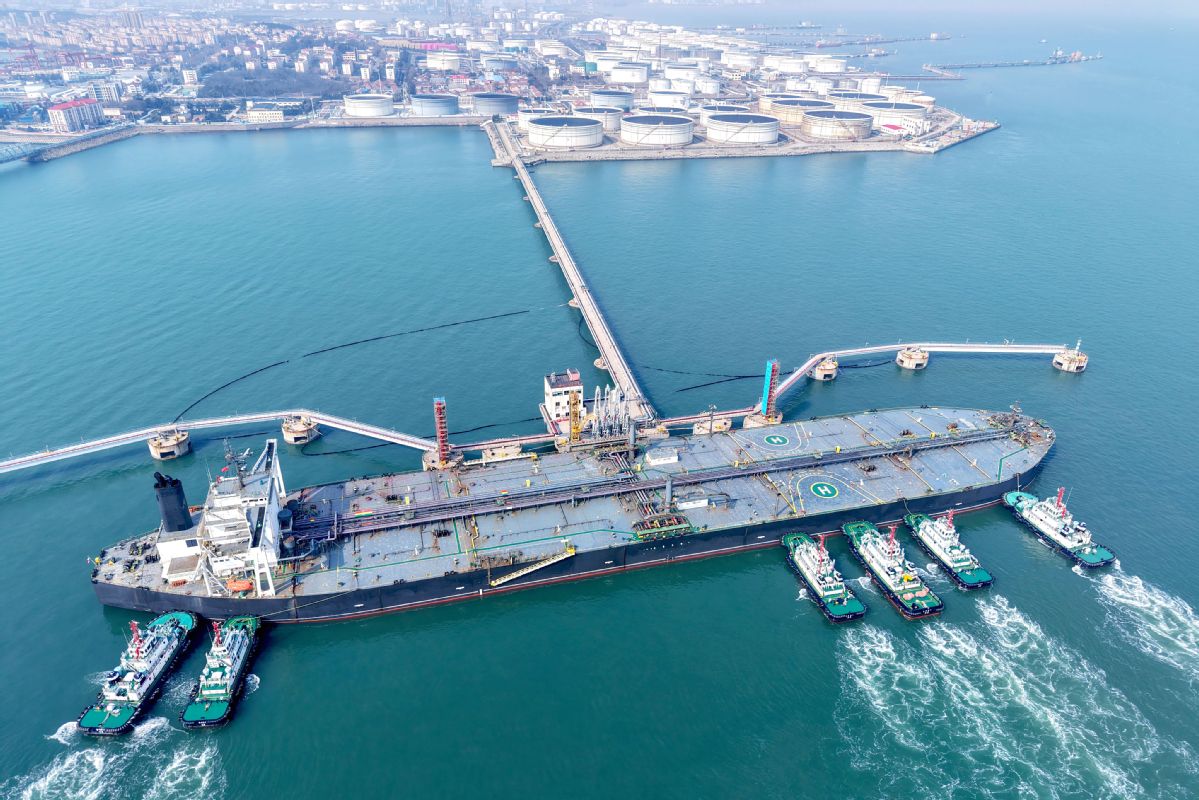
China's long-term energy security strategy is robust enough to withstand even extreme scenarios, such as the potential shutdown of the vital Strait of Hormuz, said industry experts and company executives.
Disruptions caused by geopolitical uncertainties are unlikely to fundamentally impact energy shipments to China, the world's largest energy consumer, which has been diversifying its energy import channels while developing clean energy on a large scale, said Lu Ruquan, president of the China National Petroleum Corp Economics and Technology Research Institute.
This confidence stems from a multipronged approach, including strategic reserves and diversified supply routes, said Lu during the Shanghai Cooperation Organization Energy Ministers Meeting held in Ningbo, Zhejiang province, in June.
"China maintains a certain level of crude oil and natural gas storage to buffer against short-term shocks, while the world's largest energy consumer has also been stepping up domestic oil and gas development in recent years as part of a broader push to buffer against potential disruptions in global markets and ensure stable supplies for its vast economy," he said.
"Crucially, alternative overland pipeline networks, such as those connecting China with Russia, Myanmar and Central Asian nations, also provide vital non-maritime import channels that bypass potential bottlenecks like the Strait of Hormuz."
His comments came after Iran's parliament last month announced its consideration of a plan to close the strait, which is globally recognized as among the most critical chokepoint for oil transport.
Around 20 percent of the world's oil passes through the Strait of Hormuz, with major oil and gas producers in the Middle East using the waterway to transport energy from the region. A substantial portion of China's total oil and gas imports also passes through the strait.
Commodities data firm Kpler said the Strait of Hormuz is also essential for global liquefied natural gas exports. Around 80 percent of LNG shipments through the strait are bound for Asia.
Mark Cunningham, CEO of Kpler, said China has been leading one of the most ambitious transformations in global trade, with the energy, optimism and scale of technological adoption unlike anywhere else in the world.
Lu added that China's energy security resilience would be tested and ultimately enhanced, with the primary challenge being effective short-term risk management while the country seizes the opportunity for fundamental energy transformation.
Domestically, China has been actively working to enhance its oil and natural gas production, including intensifying exploration and development of unconventional resources like shale oil and gas.
China's crude oil and natural gas output exceeded 400 million metric tons of oil equivalent for the first time last year, with crude oil and natural gas output sustaining a robust annual growth streak of over 10 million tons for the eighth consecutive year, said the National Energy Administration.
Crude oil production reached 213 million tons in 2024, an increase of 24 million tons from 2018, while natural gas production reached 246.4 billion cubic meters, with an average annual growth of over 13 billion cubic meters in the past six years, it said.
Offshore and unconventional reserves have become the primary contributors to production growth, while China's shale gas production remained strong, exceeding 25 billion cubic meters, said the administration.
Despite its position as the world's leading energy consumer, which requires significant oil and gas imports, China possesses considerable advantages in energy security, said Lin Boqiang, head of the China Institute for Studies in Energy Policy at Xiamen University.
These strengths include the swift build-out of renewable energy capacity to decrease reliance on fossil fuels, alongside its global dominance in producing critical minerals essential for its energy independence, Lin said.
China's significant spending on its energy infrastructure is also preparing the nation for a future powered by renewable sources. At the same time, the country's large reserves of coal provide policymakers with a fallback option should other energy supplies experience major interruptions, he added.
The China Electricity Council said China has significantly upgraded its grid infrastructure and capacity in recent years, with interprovincial transmission capability now exceeding 300 million kilowatts.
Yang Kun, the council's executive vice-chairman, stated that accelerating the creation of a unified national power market is expected to further enhance the efficient distribution of power resources across the country.
Lu said China's aggressive push into developing new energy sources and energy storage technologies is also seen as a key pillar for bolstering long-term energy resilience.
"In this extreme scenario, the strategic importance of new energy sources — solar, wind and nuclear power — would be profoundly elevated," he said.
"While unable to directly replace fossil fuels in the immediate term, the crisis would compel China to accelerate its energy structure transformation. This means faster investment and development in renewables and nuclear power to fundamentally reduce long-term dependence on fossil fuels."
In 2024, China significantly expanded its renewable energy capacity, particularly in solar and wind power, achieving its 2030 solar and wind capacity targets years ahead of schedule.
"The underlying principle guiding China's strategy is a commitment to ensuring the nation's energy security remains firmly in its own hands. This emphasis on self-reliance and strategic control underscores Beijing's determination to safeguard its energy future against external shocks and maintain stability for its economic development."
Lu added that China is confident in navigating potential disruptions with capacity for dynamic adjustments. This flexibility is designed to buffer the impact of energy security risks stemming from extreme situations.
It involves the ability to rapidly shift import sources, strategically leverage national oil and gas reserves, and dynamically optimize domestic production and consumption patterns, allowing the country to respond swiftly to unforeseen contingencies and maintain a degree of resilience in its energy supply, he said.
Global consultancy Rystad Energy said China's demand for major transportation fuels showed minimal growth in 2024, as the rapid shift toward electric vehicles reduced gasoline consumption.
Gasoline demand began to fall last year, as the improved performance and longer mileage of electric cars win wider acceptance from customers, alongside policy support in the initial years of development, said Ye Lin, vice-president of commodity markets research at Rystad Energy.
China's diesel demand has flattened and peaked in recent years, a trend linked to the ongoing transformation of the country's economic growth model, Ye said, citing the accelerated adoption of LNG trucks, which specifically impacted demand from the trucking sector and contributed to an overall fall in diesel consumption in 2024.