



Reviving Xixia in the digital age
VR, art, and AI are helping young researchers bring an ancient dynasty back into the spotlight — and into people's daily lives.









When Deng Wentao first began researching the Xixia civilization as a graduate student, he found himself constantly correcting misconceptions.
"There's a common belief that the Tangut people were completely wiped out by the Mongols," said the now 37-year-old lecturer at Ningxia University (NXU). "But the truth is that many survived well into the Yuan Dynasty (1271-1368), which was founded by the Mongols after their conquest of Xixia. They went on to play important roles in its political and cultural life."
Deng is part of a rising generation of scholars working to bring new insights to the once-overlooked Xixia Dynasty (1038-1227), a regime founded by the Tangut people that flourished in Northwest China during the 11th to 13th centuries.
Their work has taken on new significance following the July 11 decision to inscribe the Xixia Imperial Tombs on the UNESCO World Heritage List — a moment that has thrust the ancient dynasty into the global spotlight.
"I hope my research can help dispel myths and offer a more accurate understanding of this historical period," Deng said.
Deng's work builds on the efforts of at least three earlier generations of Chinese scholars who laid the academic foundations of Xixia studies.
"This achievement is unmatched anywhere else in the world," said Du Jianlu, dean of the School of History and Ethnology at NXU.
According to Du, modern Xixia studies began in the early 20th century. In 1908, Russian explorers unearthed a significant collection of Xixia texts and relics at the ruins of Khara-Khoto in the Inner Mongolia autonomous region. These artifacts were later transported to St. Petersburg in Russia.
"Since the 1990s, China's growing international influence and academic exchanges have enabled the publication of facsimile editions of these texts, allowing Chinese scholars direct access to primary sources," Du explained.
Most of these documents are written in the Tangut script and include numerous Buddhist scriptures. Fortunately, researchers uncovered a bilingual Chinese-Tangut glossary among the materials. Together with corresponding Chinese Buddhist texts, this glossary has been vital in decoding the ancient language.
"Tangut characters resemble Chinese in stroke order and structure but tend to be squarer and more compact," Du said.
Some of these documents also record everyday life details — loans, land sales, rental agreements, and taxes. "They offer a valuable glimpse into grassroots society," said Tian Xiaopei, 35, a scholar at NXU. "But interpreting them is difficult due to the cursive script and the damage they have suffered over time."
Despite these challenges, Tian made a significant breakthrough. He identified references to a land property rights system in Xixia records that predate similar systems documented in the mid-Ming Dynasty (1368-1644), pushing the historical timeline back by several centuries.
Expanding horizons
According to Deng, Xixia studies have entered a dynamic phase in the 21st century, fueled by digital technology and interdisciplinary collaboration.
"Digital databases have revolutionized research, enabling tasks that once took days in the library to be completed in minutes," he noted.
He also highlighted the fresh perspectives brought by younger scholars. "While previous generations were mainly historians, experts in archaeology, linguistics, design, and STEM fields are now enriching the discipline," Deng added.
For example, researchers are using GIS (geographic information system) to map Xixia battlefields and conducting genetic analysis of human remains to trace the origins of the Tangut people.
Among these interdisciplinary scholars is Miao Yanan, 32, a postdoctoral fellow at NXU with a background in art and design.
"My training in visual language gives me a unique lens to explore Xixia culture," she said. "When studying the Xixia Imperial Tombs, I focus on architectural details — proportions, curves, craftsmanship, and ornamentation — beyond their historical significance."
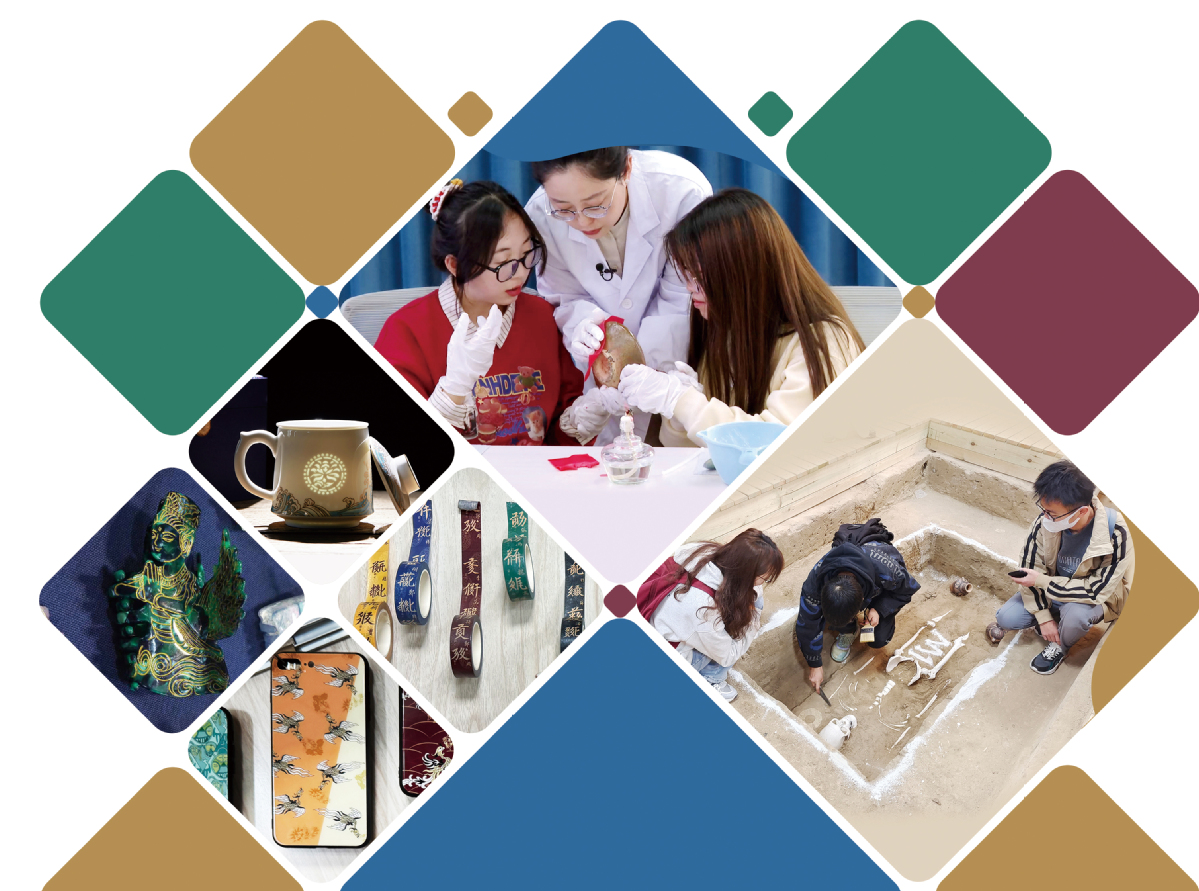
In 2018, while pursuing graduate studies at NXU, Miao joined the university's cultural innovation team, which develops products to promote Xixia heritage.
The team has launched over 30 product lines, featuring more than 400 items including magnets, scarves, hairpins, blind boxes, and bags. These products are sold at tourist sites in Ningxia, as well as in neighboring Gansu and Inner Mongolia.
They have also created digital characters — a Xixia prince and princess — who will star in immersive animated short films using virtual reality (VR) technology, designed to engage younger audiences with ancient culture.
"These creative products are not only rich in cultural significance but also practical. I hope they help bring Xixia culture into people's daily lives," Miao said.
Broadening reach
In recent years, many scholars like Miao have embraced digital platforms to share knowledge of Xixia with wider audiences.
For instance, Deng and his team launched a free online course on Xixia history in 2018, which was later featured on the Smart Education of China platform. They are currently developing an AI-powered English version to reach global learners.
At NXU, Deng offers an elective on Xixia culture, where students engage with relics through a digital museum and use VR to interact with artifacts. In addition, they can learn about Xixia through activities such as making ink rubbings of Tangut script or simulating archaeological excavations in recreated tombs.
"This course has attracted students from diverse majors, and the interdisciplinary approach sparks a lot of creative thinking," Deng said.
Deng's team is also developing a specialized large language model focused on the Xixia civilization.
"Much of the AI-generated content on Xixia is inaccurate or misleading," Deng noted. "Our goal is to build a reliable model that offers the public accurate historical knowledge and the latest research — free from myths."
Tian has also contributed to public understanding, participating in the writing of a book titled 80 Questions About Xixia.
The book addresses misconceptions held by some overseas scholars who mistakenly classify Xixia culture as Central Asian.
"The Xixia culture is an integral part of Chinese civilization — this is well supported by historical records," Tian emphasized.
He explained that Xixia was the first dynasty to honor Confucius as an emperor. It inherited and promoted traditional Chinese culture centered on Confucianism, spreading it across the vast expanse of Northwest China.
"The study of Xixia represents one facet of Chinese historical research, offering valuable materials and perspectives for understanding the formation of the Chinese national community from the 10th to the 13th centuries," Tian said.
Contact the writers at mengwenjie@i21st.cn


Today's Top News
- Chinese FM calls for resolving issues between Afghanistan and Pakistan through dialogue, consultation
- Security Council divided over sanctions
- Fighting persists in Middle East
- Promotion of satellite exports urged
- Asian firms eye technology partnerships
- China, US set for new round of trade talks





