


Unknown to many, Guyuan, a city in northwestern China's Ningxia Hui autonomous region, was a strategic stronghold and intersection of cultures.
The new exhibition The Spiraling Glory: Treasures from Guyuan, Ningxia at the Shanghai Museum brings the ancient city to the spotlight with more than 300 artifacts dating from the Western Zhou (c.11th century-771 BC) to the Sui (581-618) and Tang (618-907) dynasties.
The exhibition is taking place from July 9 to Nov 17 at the China Eastern Airlines Exhibition Gallery 2 in Shanghai Museum East.
Guyuan, sitting at the foothills of the Liupan Mountains south of Ningxia, was an intersection for agrarian and nomadic civilizations in ancient China and a vital hub along the ancient Silk Road.
The city is an excellent and rare sample of history: "Like slicing a carrot, we can see many aspects of its long development and communications with other cultures, reflecting the openness of Chinese civilization", says Wang Yue, the exhibition's curator and a researcher at the Shanghai Museum.
The exhibition is arranged in chronological order with three chapters, each featuring an important period in the history of Guyuan.
In the first chapter, visitors will view some of the most important objects excavated from the Yaoheyuan site, one of the Top 10 Archaeological Discoveries of China of 2017. Yaoheyuan is the site of the capital city of a vassal state on the northwestern tip of the Western Zhou kingdom, where the dynasty's ritual and musical systems were fully developed and practiced.
Two painted pots on display — one with characteristics of Majiayao culture, a Neolithic archaeological culture in the upper reaches of the Yellow River dating back 4,000 to 5,000 years, the other of Qijia culture (2200-1600 BC) — indicate that Guyuan was a beautiful place with a good, natural environment, Wang says. "That's why early humans chose to settle and survive there."
The second chapter tells of Guyuan during the Southern and Northern Dynasties (420-581), when it was a key metropolis along the northern route of the eastern section of the Silk Road, playing a vital role in trade and cultural exchanges.
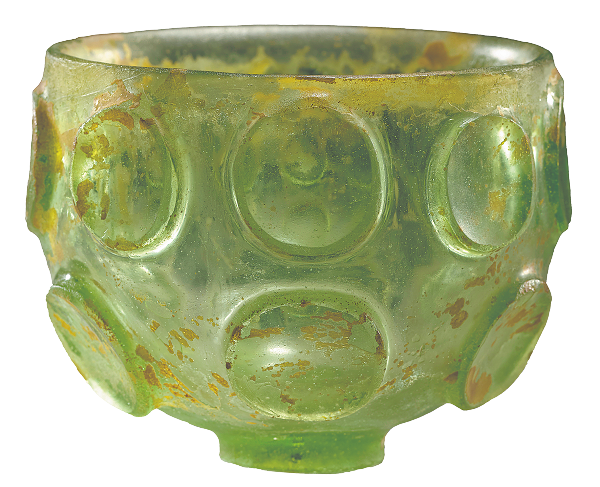
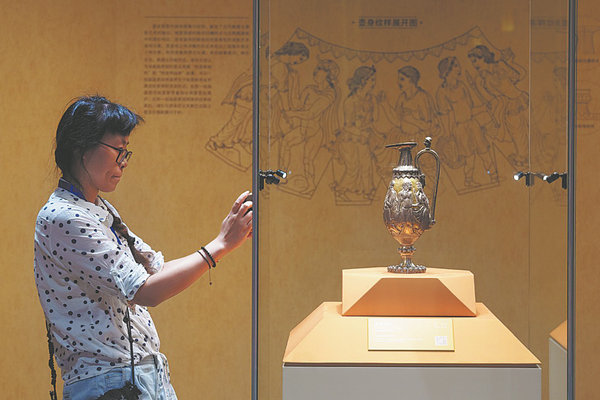
Among the highlighted artifacts are exotic treasures found in the tomb of Li Xian, an official of the Northern Zhou (557-581) period. While the inscriptions, murals and painted pottery figurines in the tomb represented the continuation of Han-style burial customs, objects such as the gilded silver ewer and the studded glass bowl are all rare imports from Central and Western Asia.
The coexistence of Han customs and exotic items witnessed the flourishing Silk Road trade during this era and reflected the convergence of diverse civilizations, Wang says.
A large number of commodities were found in Guyuan during this period, when the city was "like an interchange on a superhighway". "One of the most important imports was glassware", Wang says, by a cabinet displaying glass plates.
"It is interesting to see how ancient Chinese people favored glassware, while in Western Asia, people were fond of porcelain," he says.
He goes on to highlight the murals, noting that the techniques and the subject's facial features bear foreign influence. Murals are fragile artifacts that can rarely be transported. "This marks one of the earliest occasions that these artworks were taken out of Guyuan. In my opinion, these are among the most precious exhibits."
The third chapter shows Guyuan in the Sui and Tang dynasties, when a large group of Sogdians, a Central Asian people renowned for their commercial prowess, immigrated to the city. They adopted nine Chinese family names and actively engaged in political and economic activities, and gradually integrated into the broader Chinese nation.
The exhibition not only depicts the grand panorama of cultural integration in ancient Guyuan, but also provides substantial evidence of the strong appeal and remarkable inclusiveness of Chinese civilization, says Chu Xiaobo, director of the Shanghai Museum.








