



Trade changing western region future









When people think of China's western region, they generally picture rugged mountains, landlocked cities, vast rocky plains, green meadows, and the "last stop" on the globalization map.
But the New International Land-Sea Trade Corridor is fast changing that narrative. This ambitious transport artery connects the Silk Road Economic Belt in the north with the 21st Century Maritime Silk Road in the south. It's not just a line on paper, but a network abuzz with railways, ports and canals, moving everything from electric vehicles and batteries to coconuts at record speed.
Take the transportation of durians, for example. Yes, those spiky, divisive, fragrant to some but smelly to others, Southeast Asian delicacies — along with rice, mangosteens, frozen shrimp and other treats from Vietnam, Thailand, and Indonesia — have found their way to dinner tables in China thanks to the corridor.
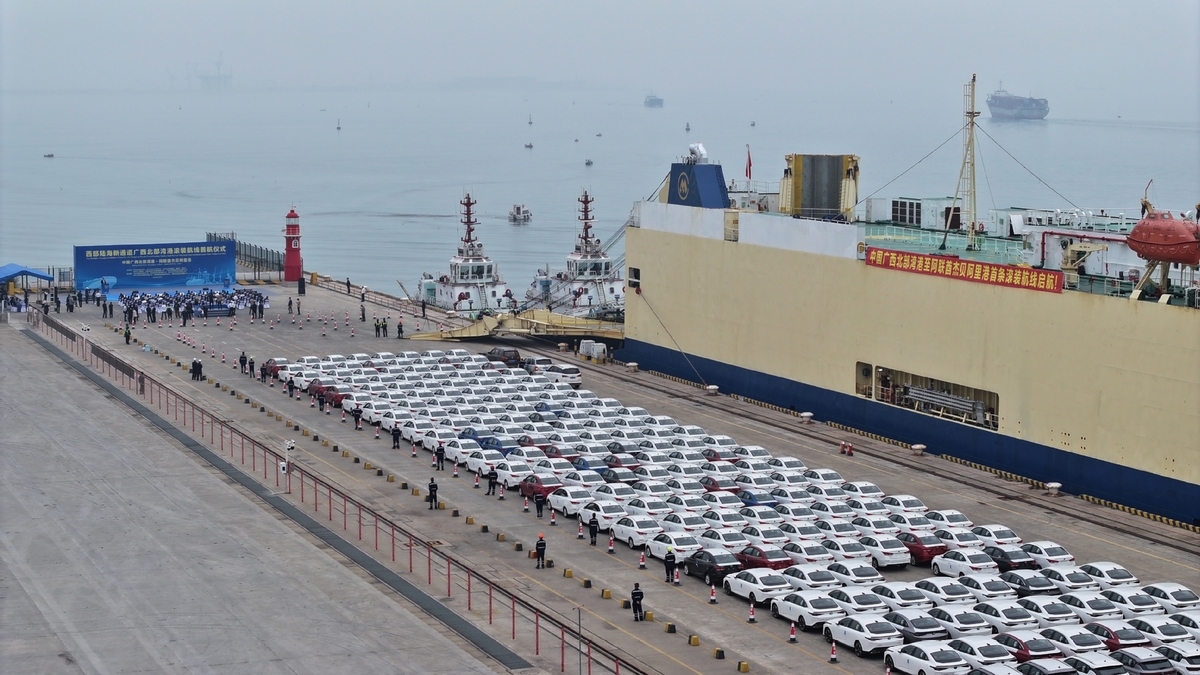
Also, Chongqing-made cars and Guizhou-built batteries are now cruising on brand-new rail lines to ports that handle the final leg of transportation.
This isn't an abstract policy vision anymore. Since the launch of the first Chongqing-Guangxi-Singapore International Transport Corridor in 2017, the corridor has grown from a pilot project to a sprawling transportation network. As of June 2025, it was transporting about 1,290 types of goods from across 160 stations in 74 cities of 18 provinces to 571 ports in 127 countries and regions. This makes the corridor a superhighway of trade.
The Beibu Gulf Port in the Guangxi Zhuang autonomous region was once a modest backwater, but today it's a vital gateway to global trade. More than 119 deep-water berths capable of handling ships of 10,000 dead-weight tonnage or above now welcome giant cargo vessels. Automated container terminals in Qinzhou, Guangxi, hum with activity. In 2024 alone, container throughput hit 9 million twenty-foot equivalent units (TEUs), marking eight consecutive years of double-digit growth.
Besides, the Pinglu Canal, under construction in Guangxi for three years, will soon link the Xijiang River with the Beibu Gulf Port and provide a river-sea shortcut for transportation of goods. Scheduled to be completed in 2026, it will shave more than 560 kilometers off shipping routes compared with the Guangzhou Port, and save businesses more than 5.2 billion yuan ($373.25 million) a year. And high-speed and heavy-haul railway projects, such as the Guiyang-Nanning line and the Chongqing-Huaihua second track, are stitching China's rugged southwest region together like a tailor with a high-tech sewing machine.
If there's one thing businesses love, it's eliminating the middlemen. The corridor is turning their dream into reality. The number of sea-rail intermodal trains via Beibu Gulf Port increased exponentially from 178 in 2017 to 10,000 in 2024. No longer a single, lonely route, it now has 22 scheduled lines, all linking with the China-Europe Railway Express.
All this means cheaper, faster shipping. Goods from Chengdu, for instance, can now reach Singapore via the corridor in as few as nine days — more than a week less than the traditional river-sea routes. And it is about 28 percent cheaper than the old-school segmented billing.
The corridor is not just a shiny new railroad. It is part of the new map of China's industrial structure. Take Chongqing's Seres Automotive, for instance. It is exporting automotive parts to Indonesia in just 18 days, instead of the 30 days in the past — and has slashed costs by half.
Moreover, SAIC-GM-Wuling is shipping knock-down kits from Liuzhou in Guangxi to Indonesia and Vietnam to be assembled locally, forging a "Liuzhou R&D-ASEAN manufacturing" supply chain. But trade is more than boxes and barcodes. In Nanning, Guangxi, the China-ASEAN Mercantile Exchange, a multicultural mall, showcases novelties like Vietnamese coffee, Indonesian chocolate, and Singaporean bak kut teh in themed pavilions.
Therefore, the corridor isn't only about moving goods; it's also about connecting people and industries. ASEAN neighbors like Laos, Thailand, Vietnam and Cambodia, along with China's partners from Africa and South America, are joining the "circle of friends" and reshaping trade flows and supply chains.
The China-ASEAN Free Trade Area negotiations on upgrading to 3.0 the China-Vietnam standard-gauge rail link have made some breakthroughs, and the China-Laos-Thailand railway is extending its reach. There's even a new "China-ASEAN-GCC" initiative in the works.
Furthermore, Chinese companies investing abroad are not only shipping goods; they're also creating jobs and nurturing talents, including skilled workers. Changan Automobile's plant in Thailand, for example, has created 3,000 direct jobs, and another 27,000 up and down the supply chain. The company is even sponsoring scholarships at Chulalongkorn University in Bangkok to train the next generation of EV engineers. Not to mention Vietnam now has 62 universities offering Chinese courses, for which more than 50,000 students have enrolled. After all, trade needs translators, and China's factories need workers who can say more than "hello" in Mandarin.
China's western region is no longer stuck at the end of the global trade map. The New International Land-Sea Trade Corridor is turning it into a launchpad for cooperation and shared growth.
The corridor reflects China's vision for open, shared development across borders. With the corridor's three main routes nearing completion, and projects like the Pinglu Canal and the China-Laos-Thailand Railway progressing well, China promises to further open up its economy, ensure security, and offer Chinese wisdom to address common challenges.

The views don't necessarily reflect those of China Daily.
If you have a specific expertise, or would like to share your thought about our stories, then send us your writings at opinion@chinadaily.com.cn, and comment@chinadaily.com.cn.





