



Black-necked cranes fly high thanks to conservation efforts









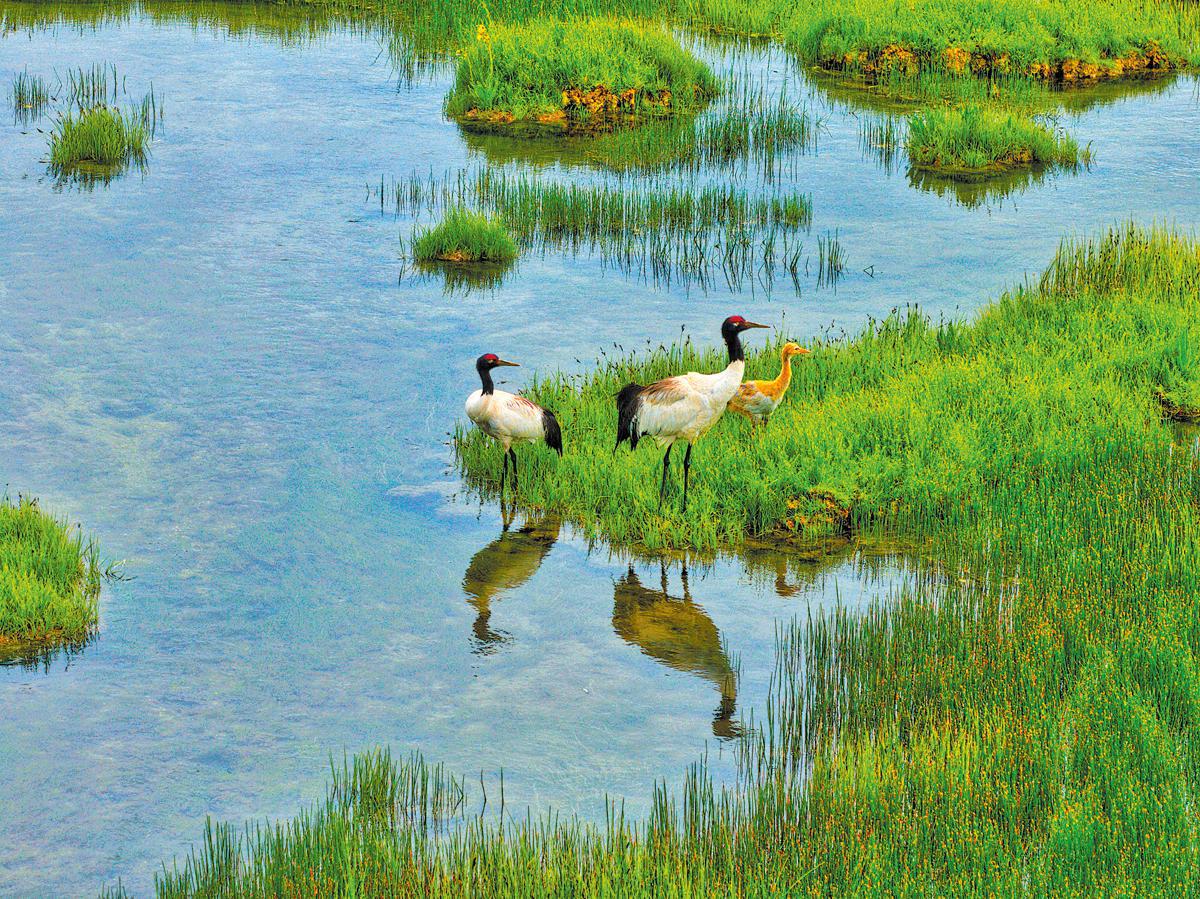
XINING — At Xining Wildlife Park in Northwest China's Qinghai province, animal keeper Li Xiaoqing walked past the crane enclosure while on a video call with her daughter.
"Mom, your black-necked crane is calling you again?" her daughter exclaimed through the screen, her voice filled with curiosity.
Since joining the park in 2013 after graduating with a degree in veterinary medicine, Li has cared for a diverse range of animals, including zebras, kangaroos and parrots. Three years ago, she took on the responsibility of caring for black-necked cranes.
"Black-necked cranes are different from other birds. They're proud and indifferent — when most people try to get their attention, they don't react," she said. "When they rest, they often stand on one leg with their heads tucked under their wings."
Her eyes lit up as she spoke, as if showing off her own children.
In recent years, Xining Wildlife Park has gained national attention for its charismatic wildlife, including snow leopards, Pallas' cats and Chinese desert cats. But less known is its long-running work in rescuing and breeding black-necked cranes.
In 2023, a crane named "Qianhe" was born at the park. Its mother had been rescued after an injury left her stranded in the wild.
To ensure Qianhe's healthy development, the park built a dedicated birdhouse and assigned two staff members to monitor its care around the clock.
Now fully grown, Qianhe stands as a symbol of the park's success in assisted breeding. With over a dozen black-necked cranes currently housed at the park, staff are preparing them for eventual release into the wild. Training programs to build survival skills are already underway.
Thanks to such efforts, the protection of black-necked cranes has made significant progress. In 2020, the International Union for Conservation of Nature downgraded its urgency status from vulnerable to near threatened.
"After spending so many years with them, I've developed a deep emotional bond," Li said. "To me, each crane is like a child — each one carries the hope of life."
Endemic to the Qinghai-Tibet Plateau, the black-necked crane is the world's only alpine crane species. Because of its rarity and striking black-and-white plumage, it is sometimes called the "giant panda among birds". The species is highly sensitive to changes in its wetland environment, making it a valuable indicator of ecosystem health.
For a time, their numbers dwindled due to habitat loss and water pollution. In Qinghai, authorities responded with sweeping ecological restoration measures — repairing wetland functions, banning industrial activity near key habitats, and launching rescue and breeding programs.
One such region lies at the southern foot of the Qilian Mountains, where a river basin fed by glacial melt and groundwater had suffered from illegal coal mining, damaging local pastures and wetlands.
"There was a time when livestock that drank the river water developed darkened organs," one resident recalled. "The black-necked cranes vanished. People saw them as symbols of good luck, so their disappearance worried everyone."
To reverse the damage, mining operations were halted, and in 2022, a large-scale restoration project for the river basin was launched. It included replanting native grasses, rehabilitating wetlands, and restoring the riverbanks. Officials say the efforts have already improved habitat conditions.
Today, the crane's return serves as the most compelling evidence of ecological restoration in the area.
Li Laixing, a 67-year-old associate researcher with the Northwest Institute of Plateau Biology under the Chinese Academy of Sciences, has spent decades tracking the cranes.
Based on habitat density estimates, Qinghai is now home to roughly 5,000 black-necked cranes. Monitoring data shows over 100 known distribution points across the province.
"Protected areas are seeing less human interference and more lush vegetation, which means more food sources for the cranes," Li Laixing added.
Beyond counting cranes, his recent research has focused on studying their migratory stopover points — "stepping stones" along their routes that serve as critical resting and feeding grounds.
"By mapping these sites, we can help refine conservation zones across provinces and ensure the birds are protected throughout their entire migration journey," he said.
The story of black-necked crane conservation in Qinghai reflects a broader national effort. In recent years, China has prioritized ecological protection as part of its ecological civilization strategy, with biodiversity conservation recognized as a key national goal.
According to data from the National Forestry and Grassland Administration, populations of rare and endangered wild species in China have shown steady growth, reflecting the country's significant progress in biodiversity conservation.
The total number of overwintering water birds recorded in China reached nearly 5.06 million last year, a record high since nationwide monitoring began.
"Black-necked cranes are an indicator species of ecological health on the plateau," Li Laixing said. "Their numbers are clearly rising, and their protection has become a model for biodiversity conservation in China."
Xinhua






- China unveils regulations on Party organization elections within armed forces
- Pick your own cherished flowers in downtown Shanghai
- Liangjiang New Area of Chongqing inaugurated
- 17 rescued Filipino crew members transferred
- Team of Chinese, US scientists identifies key tumor cell state driving cancer growth, drug resistance
- China conducts first metal 3D printing experiment in space














