



Talent exchanges can help improve relations between Beijing, Brussels









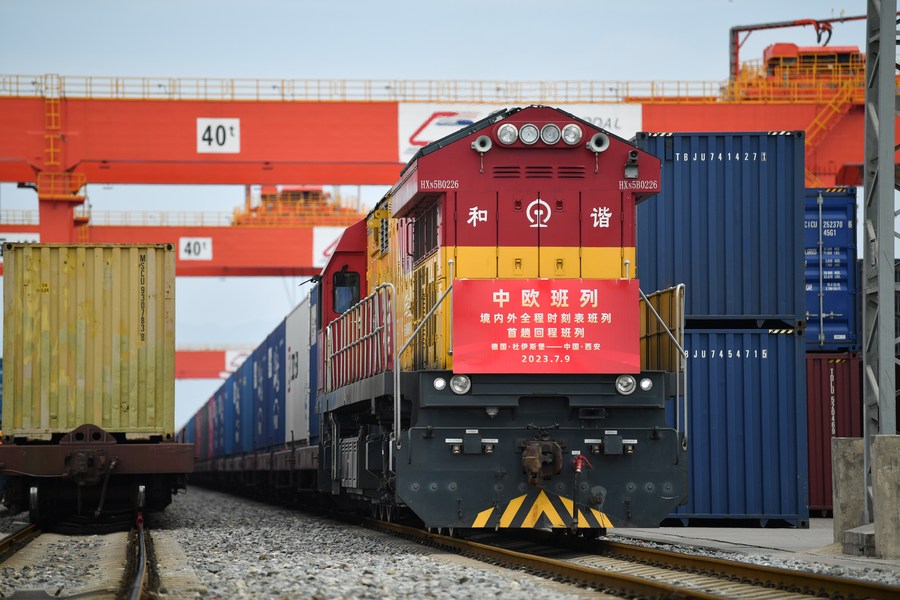
A China-Europe freight train departed from Duisburg of Germany arrives at Xi'an International Port in Xi'an, Northwest China's Shaanxi province, July 10, 2023. [Photo/Xinhua]
Chinese President Xi Jinping, European Council President António Costa and European Commission President Ursula von der Leyen are scheduled to attend the China-European Union Summit in Beijing on Thursday, marking 50 years of the establishment of diplomatic relations between Beijing and Brussels at a time when Sino-EU ties face uncertainties.
Geopolitical distrust on industrial subsidies, cybersecurity and the Russia-Ukraine conflict dominate official dialogue, while people-to-people exchanges are far from normal. In such a situation, the talks in Beijing are likely to focus on trade disputes and tariffs (particularly on Chinese-made electric vehicles), climate change, biodiversity, the Russia-Ukraine conflict, and ways to bolster multilateral cooperation.
The implementation of a "talent mobility action plan" could improve Sino-EU relations, especially because the issuance of new work permits on both sides has not yet returned to pre-COVID-19 pandemic levels, depriving companies, and research and educational institutions of the flow of talents. Re-establishing and increasing this flow is a secure and cost-effective way to stabilize Sino-EU relations and tackle some of the economic challenges domestically.
Demographic disparities between China and the EU are becoming more pronounced. The EU faces an aging population, and its labor markets are struggling to find high-skilled workers such as welders, electricians, nurses, software engineers and AI specialists. Consequently, the shortage of skilled workers is causing delays in orders, particularly among small and medium-sized enterprises involved in exports in Germany.
China, too, faces an aging population. But decades of higher education promotion has resulted in millions of high-skilled graduates, especially in engineering and computer science, not all of whom can find suitable jobs.
These labor-market mismatches, combined with a worsening trade situation, have further complicated issues. Last year, the EU's goods deficit with China exceeded €300 billion ($350.61 billion), as Chinese exports to Europe outpaced EU exports to China. And reports from the US suggest that supply chains, particularly of Chinese-made EVs, could become even more fragmented.
As such, Brussels and Beijing need to take constructive measures before trade becomes hostage to spiraling tariffs. Talent exchanges could help resolve some of these issues, by diversifying supply chains, mitigating innovation risks, and fostering knowledge and goodwill among trade partners.
Globally, austerity measures in higher education have tightened the post-doctoral job market. But since universities in both China and the EU continue to invest in cutting-edge science, a collaborative program for post-docs offering three-year contracts, renewable once, to young researchers holding Chinese or European citizenships could establish a solid academic base, with funding being equally shared and managed by the China Scholarship Council and the EU's Marie Sk?odowska-Curie Actions. Such an initiative would not only create an early success story but also foster professional networks and produce publishable results.
For multiyear postings, a bilateral "gold-card visa" could enhance existing programs like the EU Blue Card, while surpassing them in two key areas. One, holders could be allowed to move between EU member states without having to reapply for a visa, while China could do away with the current location-specific work permits for participating economic zones, allowing foreign specialists to transition between places like Suzhou and Shenzhen with equal ease.
And two, a unified set of salary and skill thresholds could be applied in both directions, benchmarked against each host country's average wage. Of course, critical defense industries and other security-sensitive sectors should remain off-limits. European policies are aligned with such an agenda.
Moreover, German Chancellor Friedrich Merz will likely visit Beijing with a business delegation later this year. Since Germany's updated "Skilled Immigration Act" has already eased the language and degree-recognition barriers, a "China-EU Gold Card" would complement this, enabling green-hydrogen start-ups in North Rhine-Westphalia or automotive suppliers in Baden-Württemberg to more swiftly recruit Chinese engineers.
For Chinese graduates, the reward would give access to one of the world's largest single markets and its AI ethics, battery chemistry and environmental regulation hubs. On the other hand, it would help Europe to collaborate with the internationally competitive Chinese research centers in universities and other institutions, advancing their careers.
While talent exchange may not address all the challenges the China-EU relationship faces, it can accomplish three practical objectives. First, it can clear bottlenecks by allowing Chinese graduates to meet the EU's demand for talents. Second, it can adjust the imbalanced trade ledger by transitioning a part of economic activity from goods to high-value services such as consulting and research.
And third, it can foster dialogue through personal connections: scientists, coders and project managers, for instance, who have worked on both sides and are less prone to misunderstanding the other side upon returning home.
Fifty years since the establishment of diplomatic relations, Beijing and Brussels have become adept at managing disagreements. And yet they risk neglecting the constructive potential of their relationship.
The concept of a "talent mobility action plan" presents a tangible solution: it can meet genuine labor market demands, alleviate economic concerns among the electorate, and be more cost-effective than granting subsidies or imposing tariffs. Should the summit initiate this process, the 50th anniversary of the establishment of Sino-EU diplomatic ties would be significantly more promising.
The author is a professor at the Free University of Berlin and the president of the Global Labor Organization, a Germany-based worldwide network of researchers investigating the path of globalization.
The views don't necessarily reflect those of China Daily.
If you have a specific expertise, or would like to share your thought about our stories, then send us your writings at opinion@chinadaily.com.cn, and comment@chinadaily.com.cn.





