



Challenges remain for Japan despite trade agreement









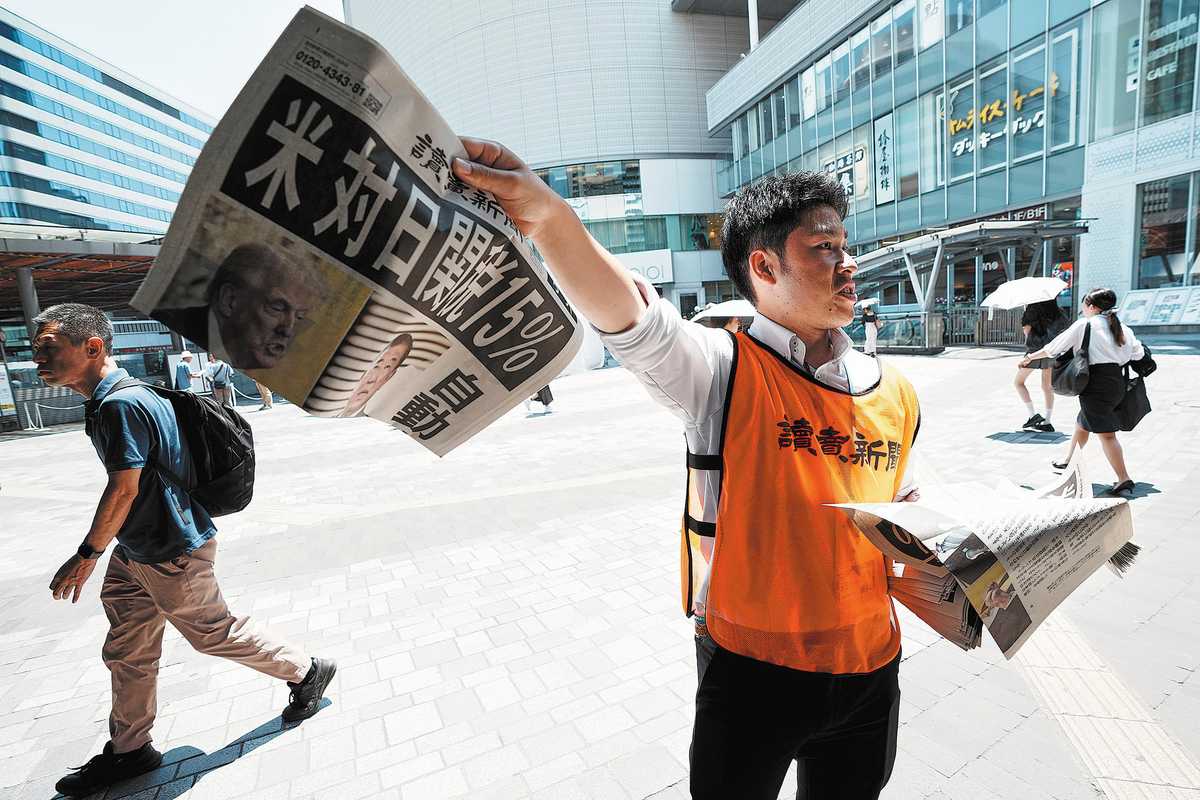
Despite the trade deal with the United States slashing the tariff rate for Japan to 15 percent, the so-called reciprocal trade agreement may pose challenges to the Japanese economy while favoring the US in exports and investment, according to analysts.
US President Donald Trump and Japanese Prime Minister Shigeru Ishiba announced that the two countries have reached a trade agreement to reduce the tariff rate from 25 percent to 15 percent.
In a post on Truth Social on Tuesday night, Trump wrote, "We just completed a massive deal with Japan, perhaps the largest deal ever made."
At a news conference on Wednesday morning, Ishiba said, "We have engaged in tough negotiations over automobiles and other products, with national interests at stake. This is the result of those efforts."
While some in Japan view this as a "negotiating achievement" following Japanese trade envoy Ryosei Akazawa's eighth visit to the US, experts have said it should not be simply regarded as "good news" for Japan as the deal will render the overall outlook for the Japanese economy bleak.
Citing estimates from a research institute, Ukeru Magosaki, director of the East Asian Community Institute and a former senior official at Japan's Ministry of Foreign Affairs, noted that a 15 percent tariff would reduce Japan's exports by approximately 2.2 trillion yen ($15 billion), directly lowering GDP by 0.36 percent.
He said exports accounted for about 18.8 percent of Japan's GDP, with exports to the US making up nearly 20 percent of total exports in 2014. "Including ripple effects, the overall impact could bring the GDP down by nearly 1 percent," he said.
Noriyuki Kawamura, an emeritus professor at Nagoya University of Foreign Studies, noted that the agreement includes opening the market to agricultural products such as rice. Depending on specifics, which are yet to be revealed, this could have a serious impact on Japanese agriculture.
"In the past US-Japan trade negotiations, agriculture was 'sacrificed', and if the same happens this time, the future of Japanese agriculture could be in jeopardy," he warned.
According to Trump, Japan would open its market to US goods, including rice and automobiles while investing billions of dollars in the US.
In reference to the tariff agreement, Ishiba said he will do his best "to make sure that people's livelihoods are protected". After meeting three former prime ministers — Taro Aso, Yoshihide Suga and Fumio Kishida — on Wednesday, he rejected local media reports that he would announce his resignation later, saying, "Nothing that has been reported is true."
Yangchoon Kwak, a senior professor at Rikkyo University's College of Economics in Japan, shared the same view, stating that the opening of the rice market would further increase the economic pressure on Japanese farmers.
He also added, "As for the manufacturing and automotive industries, it remains unclear whether they can continue to generate profits as they did in the past."
Experts said Japan's position during the trade negotiations was "not optimistic".
Kwak said, "Viewing the reduction of 'reciprocal tariffs' to 15 percent as an achievement plays right into the hands of the US. The 25 percent 'reciprocal tariff' itself is a violation of WTO rules."
He said that even though the tariff was reduced to 15 percent, the fact remains that Japan accepted high tariff conditions and reached an agreement. Given the current trend of yen appreciation, this is "by no means good news" for export-dependent industries.
"This mindset is exactly what is called the 'anchoring effect', where the initially proposed tariff rate influences subsequent judgments," Kwak stressed.
Still, the 10 percent difference in tariff is especially important for key industries like cars, said Kawamura.
However, since a 15 percent tariff will still apply to all exports to the US, Japanese industries will continue to be affected. "Companies will need to respond by reducing exports to the US and increasing exports to ASEAN and the EU," he said.
houjunjie@chinadaily.com.cn










