



US tariff talks termed 'one-sided'
Philippines, other nations in Asia forced to make concessions, experts say









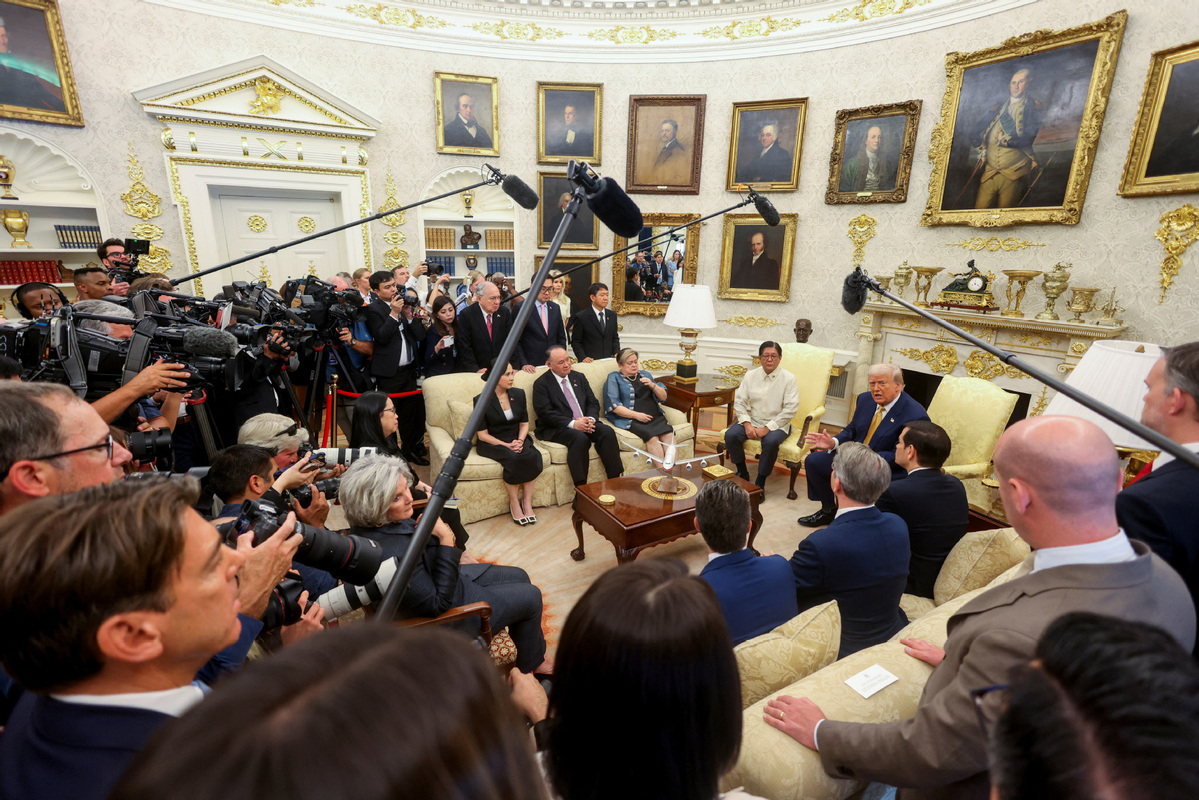
The trade tariff deals announced by US President Donald Trump have indicated that Asia-Pacific countries have been compelled to offer concessions on an unequal footing with the United States, only to get often "one-sided" results that are not in line with the international principle of reciprocity, analysts said.
Several Asian countries have even offered to purchase aircraft and energy in exchange for lower tariffs, but the US has demanded greater access for Asian markets with zero-rate tariffs from Vietnam, Indonesia and the Philippines.
Though Japan managed to reduce the tariff rate announced by Trump earlier from 25 percent to 15 percent, the new rate still poses challenges, while Japan has to further open its market to US goods.
Trump also met with Philippine President Ferdinand Marcos Jr at the White House on Tuesday. Trump later announced on Truth Social that the Philippines will open its market to the US and impose zero tariffs on US goods.
In return, the Philippines will face a 19 percent tariff — slightly lower than the 20 percent duty it was facing. Marcos said at a separate news briefing that the 1 percentage point reduction is a "significant achievement".
Yose Rizal Damuri, executive director of the Centre for Strategic and International Studies in Jakarta, said the ongoing bilateral negotiations on tariffs between the respective Asian countries and the US are "not real" negotiations.
"The negotiations with the US are mostly one-sided," Damuri told China Daily. While the US got "a lot of offers" such as commitment to buy US aircraft and opening local markets to US goods, Damuri noted the US still imposed high tariffs, though lower than those demanded earlier.
The US-Philippine deal is "neither fair nor strategic", according to Anna Rosario Malindog-Uy, vice-president of the Asian Century Philippines Strategic Studies Institute, a Manila-based think tank.
She said the outcome of the Philippine-US tariff deal "reflects geopolitical subservience, not partnership".
"Instead of negotiating as an equal ally, we acted like a client state, surrendering economic tools and sovereign rights for crumbs on the diplomatic table," Malindog-Uy said.
Defense allies
Japan and the Philippines are two of the US' closest defense allies in the Asia-Pacific region, and both countries have security agreements with Washington.
But as Lucio Blanco Pitlo III, a research fellow at the Manila-based Asia-Pacific Pathways to Progress Foundation, noted in an interview with China Daily, "being a longtime ally does not make much of a difference" for the Philippines.
Erica Tay, director of macro research at Maybank, Malaysia's biggest bank, said it is "very important to note" that a lot of countries usually offer to buy US aircraft and energy in their bilateral negotiations.
On July 15, Trump announced a tariff rate of 19 percent on imports from Indonesia. For its part, Indonesia agreed to import $15 billion in energy products, $4.5 billion in agricultural items and 50 Boeing jets from the US, and eliminate any duties on US goods. Vietnam was among the first to cut tariffs on US imports to zero.
"Why these two areas? Because these countries can only promise on behalf of government entities to make these purchases," Tay said.
Trump's "reciprocal tariffs", which he first announced on April 2, have sent ripples across developing Asia, which is export-dependent. The US, the world's biggest importer, is also the biggest market for most Asian countries.
The Asian Development Bank has cut this year's growth projections across emerging Asia-Pacific economies from 4.9 percent forecast in April to 4.7 percent.
In its flagship report published on July 23, the Manila-based lender attributed the downgrade to expectations of reduced exports amid higher US tariffs, global trade uncertainty and weaker domestic demand.
Malaysia, South Korea and Thailand are among others currently holding trade talks with the US.
prime@chinadailyapac.com










