The tariff war is not over yet









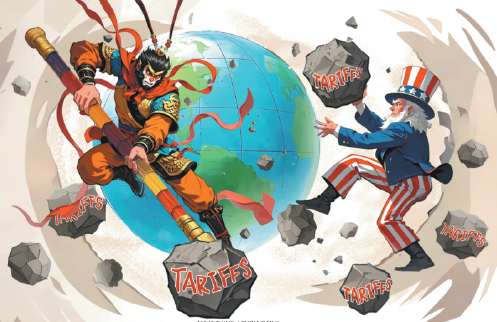
The global spotlight remains on the ongoing tariff war between China and the US. At the negotiation table, China has demonstrated both sincerity and unwavering principles. Yet off the table, fallacious narratives peddled by certain US political figures still demand rigorous refutation.
Did the US "win"?
Following recent China-US trade negotiations, some US politicians have claimed that tariffs have crippled China's economy and plunged its society into disarray.
This is nothing more than self-deception, concocted to hoodwink their electorate.
China is ready for a new wave of tariff pressures. Economic data underscores this resilience: in Q1 2025, China's GDP expanded by 5.4 percent year-on-year, with retail sales climbing 4.6 percent over the same period. Total goods trade surged 2.5 percent in the first five months of 2025, defying downward pressures.
By contrast, the US is confronting not only warning signals in its domestic economic indicators but also mounting tariff conflicts with other nations. The much-vaunted "maximum pressure" strategy, intended to coerce, has instead accelerated the erosion of America's global credibility. Domestically, under chaotic governance, polarization, social fragmentation, and racial tensions have reached new heights.
Who's to blame?
Certain American political figures have alleged that over the past 25 to 30 years, China has "monopolized" markets, distorted trade flows and caused trade imbalances detrimental to global interests.
Yet this ignores structural factors. The US controls 50.4 percent of the global semiconductor market and dominates 43 percent of arms exports (2020–2024). Its export restrictions on advanced technologies—from AI chips to industrial machinery—artificially constrain trade flows. For instance, the US has tightened controls on semiconductor design software and aviation equipment, disrupting global supply chains.
China's market openness contrasts sharply with US exclusion. TikTok, despite facing baseless "national security" claims, generated $1.6 billion in US tax revenue in 2024 while creating 200,000 jobs. Conversely, the US Inflation Reduction Act (IRA) explicitly bars Chinese EVs and batteries from subsidies. The trade deficit is less a product of Chinese policy than a reflection of US protectionism and declining industrial competitiveness.
Is China "flooding" production capacity?
The US' recently-invented "trade diversion" theory, which claims that Chinese goods will be dumped into Europe and other regions, is essentially the "China threat theory" in disguise. Trade fundamentally arises from comparative advantage. Put simply, Chinese goods gain access to markets based on demand and market logic—not political narratives.
Take Europe as a case in point. The decline in China's exports to the US has not triggered a systemic redirection toward Europe. A 2025 report by a Brussels-based think tank Bruegel highlights that China and the EU exhibit highly distinct comparative advantages, with minimal overlap in export product categories. Significantly, between 2018 and the first ten months of 2024, while China's export share to the US dropped by 4.6 percent, its share to Europe increased by a mere 0.4 percent.
Rather than fretting over the so-called "China's overcapacity", the world would be wiser to focus on the tangible opportunities arising from China's demand-side reforms. China's drive to boost consumption and expand domestic demand is set to open wider market access for higher-quality products and services worldwide.
Did China really trade unfairly?
Critics in the US often assert that China achieved its competitive advantage through state-backed "unfair" industrial policies. However, industrial policy is neither unique to China nor a novel concept.
Consider EVs: early-stage subsidies and tax incentives did play a role in kick-starting China's EV sector. Yet China also phased them out—beginning in 2016 and fully eliminating them by 2023. What is remarkable is that the industry did not falter; it thrived. In 2024, China sold approximately 12.87 million EVs—accounting for nearly two-thirds of global sales and ranking first worldwide.
China's technological ascent stems from decades of strategic investment, corporate innovation, and dedicated scientific research. In 2024 alone, China invested over ¥3.6 trillion in R&D—a near 40-fold increase since 2000. As former US Treasury Secretary Lawrence Summers observes, China's competitive edge derives from exceptional scientific talent and a societal commitment to educational excellence.
The tariff war is far from over; yet history will bear witness to which side opted for fair competition.
While US politicians peddle narratives, the responsible major country will steadfastly uphold facts and principles—advancing a fair and transparent global trading system that meets the urgent international imperative.
The author is a commentator on international affairs, writing regularly for Xinhua News, CGTN, Global Times, China Daily. The views don't necessarily represent those of China Daily.
If you have a specific expertise, or would like to share your thought about our stories, then send us your writings at opinion@chinadaily.com.cn, and comment@chinadaily.com.cn.