



Enduring legacy of anti-Japanese guerrilla base in Northeast China









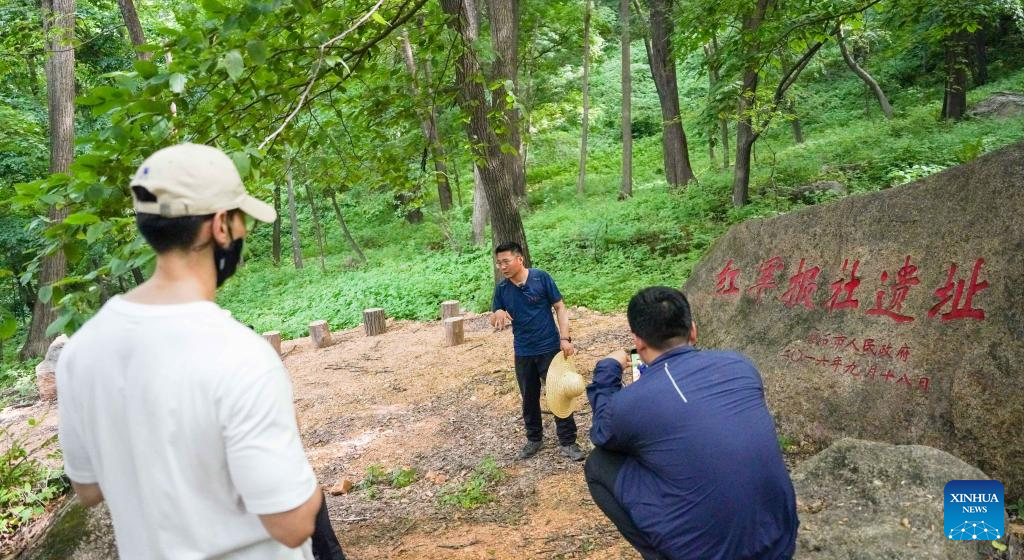
CHANGCHUN -- Winding through the ancient forests of Hongshilazi in Panshi city, Northeast China's Jilin province, wooden boardwalks overlook faint semi-subterranean house foundations, the remnants of a secret network once housing a field hospital, arsenal and command post for the Northeast Anti-Japanese United Army.
In the autumn of 1932, 27-year-old Communist Party of China (CPC) member Ma Shangde, under the alias Zhang Guanyi, arrived in the dense forests of Hongshilazi, which means "red rocks." His mission was urgent and perilous: to unite scattered anti-Japanese militias into a single front against the formidable invaders. He carried a rallying cry that echoed through the trees, clear, simple and powerful: "Chinese don't fight Chinese; save the bullets for the enemies."
He reorganized Panshi's anti-Japanese volunteer forces into the South Manchuria Guerrilla Force of the CPC-led Red Army, achieving several victories against enemy encirclement and suppression campaigns. As one of the founders and key leaders of the Northeast Anti-Japanese United Army, Ma would later be immortalized by history under his heroic name: General Yang Jingyu.
These mountains, once the frontlines of guerrilla resistance, now tell a different story. As the CPC's first anti-Japanese base in northeast China, Hongshilazi and the wider Panshi region have transformed from battlegrounds into a thriving hub of "red tourism," where history lives on through footsteps and stories rather than ruins.
For decades, the heroic struggle of the Northeast Anti-Japanese United Army existed mostly in scattered documents and fading memories, a legacy historians often called "recorded in text, but absent on the ground." That began to change with the arrival of archaeologists, as their work has uncovered the long-lost physical traces missing from the historical record.
"Telling the story of the Northeast Anti-Japanese United Army inevitably leads you to Hongshilazi," said Wang Zhongshi, deputy director of the Hongshilazi Site protection center.
The earliest archaeological survey of the Hongshilazi Site began in 1958, carried out jointly by the history department of Jilin University and the Jilin provincial cultural relics management committee. In 2019, the site was designated as a major national cultural heritage unit under protection.
Launched in 2021, a five-year archaeological initiative -- the first systematic excavation of a nationally protected site linked to the Northeast Anti-Japanese United Army -- has yielded remarkable results.
By the end of 2024, archaeologists had identified more than 3,300 ruins scattered across the mountainous terrain and unearthed 938 artifacts tied to the guerrilla force, including locally-made Jingal muskets, single swords used by the youth battalion, and even a Japanese-made iron box containing gun repair tools.
"No one really knew what the Northeast Anti-Japanese United Army's sites looked like or what their hidden camps were like until now," said Meng Qingxu from the Jilin provincial institute of cultural relics and archaeology, who is leading the Hongshilazi Site excavation team.
"These five years of work have resolved a long-standing issue: a history well recorded in writing but lacking physical evidence," he said. Today, Hongshilazi stands as the largest, best-preserved, richest in content, and most fully functional complex of Northeast Anti-Japanese United Army sites in China.
Preservation efforts at Hongshilazi extend far beyond excavation. A comprehensive master plan spanning 6,115 hectares divides the area into core protection zones, construction control zones and environmental buffer zones. While experimental backfilling protection is implemented in certain excavated areas, 2,400 meters of gravel paths and 600 meters of elevated wooden boardwalks now guide visitors through the terrain, offering access without disturbing the fragile ruins.
To bring history to life, five key structures, including sentry posts and a clothing factory, have been rebuilt. Surrounding them, nine themed squares and 13 interpretive signs bring to life the arduous years of struggle endured by the Northeast Anti-Japanese United Army.
According to Meng, the next phase of site preservation faces significant hurdles, foremost among them the harsh climate of the forested region, marked by relentless freeze-thaw cycles that threaten the integrity of exposed remains.
"We're working with Jilin University to run long-term monitoring experiments, tracking surface temperature, humidity, pressure and watching how these variables shift across all four seasons," Meng said. "Only with that data in hand can we develop future protection strategies."
The smoke of battle has long since cleared, yet the spirit of the Northeast Anti-Japanese United Army, rooted in the forests of Hongshilazi, lives on in Panshi.
Dozens of kilometers to the east, in Guanma New Village, tourists are arriving in growing numbers. In recent years, the village has embraced red tourism as a pillar of its rural revitalization, with the spirit of the Northeast Anti-Japanese United Army becoming a driving force for local development. A themed education exhibition hall now stands at the heart of the village, alongside a newly opened bookstore and cinema, transforming history into both a living classroom and a magnet for visitors.
Once a primarily agricultural mountain village, Guanma is now charting a new path of diversified development, with red tourism and history education at its core, according to Zhang Hongqiu, director of the Panshi municipal bureau of culture, radio, television and tourism. In 2024, Panshi welcomed 1.7 million tourists, generating 850 million yuan (about $118.9 million) in tourism revenue, with more than 70 percent of visitors drawn by red tourism.
Panshi's red heritage now threads through diverse sectors, from dining and homestays to local specialty agricultural products, enriching both the local economy and cultural landscape.
As cultural tourism flourishes, Panshi's agricultural development is keeping pace. On the hillsides above Beiguokui village in Baoshan township, 300 hectares of Jinxiu crabapple orchards burst into full bloom.
Village Party secretary Luan Rensheng noted that the village's unique blend of water and mountainous terrain is ideal for fruit tree cultivation. After years of varietal refinement, Jinxiu crabapples have emerged as the premier choice for large-scale planting, now cultivated as a premium product.
Not far from the village, in a bustling factory, young entrepreneur Yang Shangbin is gearing up to add two new production lines. Since returning home in 2016, he has set up cold chain facilities, invested in cutting-edge equipment, and driven research and development, all with strong support from the local government. His company's products, like crabapple wine, dried crabapples and crabapple tea, have quickly gained traction, with strong market demand.
"We're about to double our crabapple procurement this year," Yang said. "There's immense potential here at home. Starting a business brings promising opportunities."
Ma Chengming, Yang Jingyu's great-grandson, now in his late 20s, chose to work in Panshi after graduating from university. "In my senior year, Panshi was the first stop on my journey retracing the Northeast Anti-Japanese United Army's route. Along the way, elders shared stories about their sacrifices," he recalled.
While working at the grassroots level in rural Panshi, Ma actively led initiatives to boost local prosperity. Beyond his primary responsibilities, he regularly gave talks on the red spirit in schools and communities, and volunteered as a docent at the village history museum. In sharing Panshi's story, Ma speaks not only as a local resident but also as the great-grandson of a national hero who once fought there.
Once, deep within the forests of Hongshilazi, fighters of the Northeast Anti-Japanese United Army laid down their lives to defend this land. Today, across the wide stretches of Panshi, a new generation is shaping its future with wisdom and hard work.
"The spirit of my great-grandfather has long been woven into this land," Ma said.


- Beijing-Pyongyang passenger rail service to resume Thursday
- Shanghai and Jiangsu integration boosts sports-tourism development
- China Eastern Airlines restores direct flights between Shanghai and Stockholm
- RedNote targets AI-run accounts with new governance rules
- China's draft law on ethnic unity aims to serve as global model, political adviser
- Spring blossoms complement the Honghe Hani Rice Terraces in Yunnan





