World Heritage sites bear new fruit
Nation's treasures improve global understanding, local livelihoods









As the largest existing ancient Chinese venue for imperial sacrificial ceremonies of agriculture, the Altar of the God of Agriculture often seemed to be neglected by bustling visitors who poured into the nearby Temple of Heaven just across Beijing's Central Axis.
But when the Central Axis was inscribed on the World Heritage List in July last year, with the words "Beijing Central Axis: A Building Ensemble Exhibiting the Ideal Order of the Chinese Capital", things changed dramatically.
Now the sacrificial altar, as a component of the axis — an ensemble of palaces, ceremonial and public buildings, roads and other aspects governing the overall layout of the old city area of the Chinese capital — is embracing a new scenario. It has received more than 1.2 million visits between July 2024 and last month, a tenfold year-on-year increase, according to the administration of the Beijing Ancient Architecture Museum, which oversees the altar site.
"The altar was once merely a relaxation area for residents of local communities. But when people know it provides a good angle to view the northern section of Beijing's Central Axis, tourists rush to the place now," said Lyu Zhou, director of the National Heritage Center at Tsinghua University, who participated in the axis application process. "This is the charm and influence of a World Heritage site."
China has 60 UNESCO World Heritage sites, the second most among all countries. President Xi Jinping's continuous guidance in applications for World Heritage sites has helped to better unveil their outstanding universal value to the world and boost international communication.
Following the inscription of the Central Axis on the list, Xi, who is also general secretary of the Communist Party of China Central Committee, called for further efforts to preserve the country's cultural and natural treasures and renew their glamour in the new era. He also noted that such inclusions on the list have added new luster to world civilizations.
Since the 18th National Congress of the CPC in 2012, Xi has toured a number of World Heritage sites and made many instructions related to their significance and protection.
In 2016, after receiving a letter from four archaeologists about seeking World Heritage status for the archaeological ruins of Liangzhu city in Hangzhou, the capital of East China's Zhejiang province, Xi proposed the "three-benefits "principle guiding such applications. He said the projects should be beneficial to highlighting the historical and cultural value of Chinese civilization, to demonstrating the spiritual pursuits of the Chinese nation, and to showcasing for the world a comprehensive and authentic ancient and modern China.
In 2003, when Xi was the Party secretary of Zhejiang, he visited the Liangzhu site, a hub for a rice-cultivating and jade-worshiping culture dating back 4,300 to 5,300 years. He called for better protection of the site, which was then facing huge pressure, as it was being disturbed by nearby quarries. Lasting comprehensive protection and studies finally brought World Heritage status in 2019 to the "Archaeological Ruins of Liangzhu City".
"The 'three-benefits' principle proposed by President Xi is fundamental for our application work," said Zheng Jun, a researcher at the China Academy of Cultural Heritage, who is also a World Heritage consultant for the International Council on Monuments and Sites. "It gets rid of the old narrative of history that often centered on the West."
For locals who live around the World Heritage sites, the legacies left by their ancestors bear new fruit. Last year, Xi called for efforts to take UNESCO inclusion as an opportunity to further strengthen the comprehensive and systematic protection of cultural and natural heritage and make good use of the sites to better meet the people's needs.
"The application is essentially a process of enhancing protection of the heritage, as each site needs to be improved in legal protection, heritage management and monitoring, and its value must be explained to prepare for the application," said Zheng, adding that "World Heritage sites are key tourist brands".
For example, "The Cultural Landscape of Old Tea Forests of the Jingmai Mountain in Pu'er", in Yunnan province, was listed in 2023. This mountainous area has become a haven for an ancient planting technique, in which tea trees are cultivated under forest canopies. The method is known as the "understory" growing technique, by which sunshine is filtered and moisture ensured.
"It represents a format of sustainable development," Zheng said. "Gaining World Heritage status helps to protect the local ecosystem and cultural tradition. It also greatly improves the value of local tea and thus the economy booms."
Another example can be found in Fujian province, where tulou are traditional multifamily, communal living structures of mainly the Hakka people that are built in a circular or square pattern designed for defense purposes. In the past, many young people who lived in tulou migrated to other places to earn a living.
In 2000, when Xi was governor of the province, he coordinated the application work and suggested using the term "Fujian Tulou" in the application process.
Fujian Tulou became a World Heritage site in 2008. After that, local people who had moved away found that they could earn more from local tourism, so they returned home.
"This not only increased their income, but also solved social problems like left-behind children, showing the remarkable influence of the sites in tourism," Zheng said.
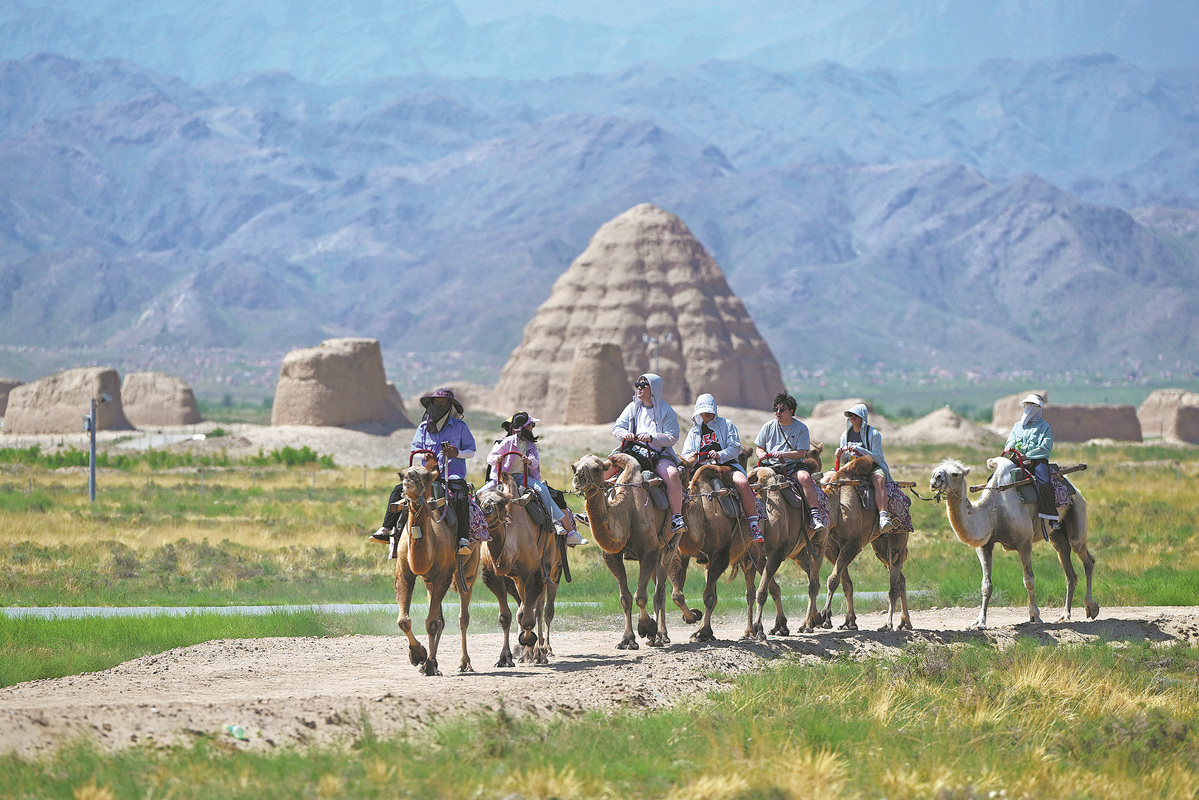
In July, the Xixia Imperial Tombs in Yinchuan, the capital of Northwest China's Ningxia Hui autonomous region — currently the most intact archaeological site of the Xixia Dynasty (1038-1227) — became China's newest entry on the World Heritage List, signifying the nation's continued efforts in applying for World Heritage status for its numerous legacies of various ethnic groups.
Cultural dialogue
Through decades of practice, Chinese professionals have explored effective ways to prepare materials for seeking World Heritage status, enabling the value of China's sites to be understood by experts from other cultural backgrounds, according to Chen Tongbin, honorary director of the Institute of Architectural History affiliated with the China Architecture Design and Research Group.
Chen has participated in World Heritage application for more than two decades. She said that each inscribed site represents an aspect of Chinese civilization, and by piecing them together, the world can gradually get a comprehensive view of China.
"The key point is to view the sites from the perspective of human civilization instead of China's own, extracting the most fundamental elements of them and letting the facts speak," said Chen, who also was the main drafter of documents when seeking World Heritage status for the Xixia Imperial Tombs.
"When viewing the Xixia Imperial Tombs from the global perspective, for instance, you will find that none of the existing sites on the World Heritage List had a relation to the Xixia Dynasty or the Tangut people who established it," she said, so the Xixia tombs site "fills in a blank".
In a congratulatory message to the 44th Session of the World Heritage Committee, held in Fuzhou, Fujian, in 2021, President Xi said that China stands ready to work with all countries and UNESCO to strengthen exchanges, boost cooperation and enhance mutual learning to jointly preserve the cultural and natural treasures of the whole of mankind.
Zheng, the researcher from the China Academy of Cultural Heritage, said, "The World Heritage system is a good platform for international communication and equal dialogue among various civilizations."
A remarkable example of such communication was the successful application for inscription on the World Heritage List of "Silk Roads: the Routes Network of Chang'an-Tianshan Corridor" in 2014 by China and its Central Asian neighbors Kazakhstan and Kyrgyzstan.
"The ancient Silk Road spanning across Asia, Africa and Europe is one of the world's largest heritage sites, woven together by a vast network of corridors and routes. It's impossible to apply for it all at once", so the applications are instead segmented, said Zheng.
During the application process, the three countries had frequent conferences to work out details in application strategies, selection of constituting elements, extraction of value, establishment of a multinational joint management system, and preparation of documents in the bid for World Heritage status.
The project proved to be a model for other sections of the Silk Road in applying for World Heritage status. Following the Chang'an-Tianshan Corridor's application success, "Silk Roads: Zarafshan-Karakum Corridor", involving Tajikistan, Turkmenistan and Uzbekistan, was inscribed on the list in 2023. Chinese experts including Lyu also contributed their ideas during the application process for that corridor.
"These sites depict the scenes of communication, dialogue and growth of human civilization throughout history," Lyu said. "For today's people, they also create a space for development through cooperation."
Contact the writers at wangru1@chinadaily.com.cn


- 5 dead, 24 injured in suspension bridge accident in Xinjiang
- Mainland warns Lai over pro-independence remarks
- Shanghai Book Fair unveils new initiatives ahead of official opening
- China allocates 100m yuan for post-disaster recovery in flood-hit Guangdong
- Notice calling for a halt to minors participating in food delivery services sparks debate
- 1st anniversary of Badain Jaran World Heritage status celebrated