Xi set stage for rise of cultural powerhouse
Zhejiang stands out for its development of heritage preservation, film industry









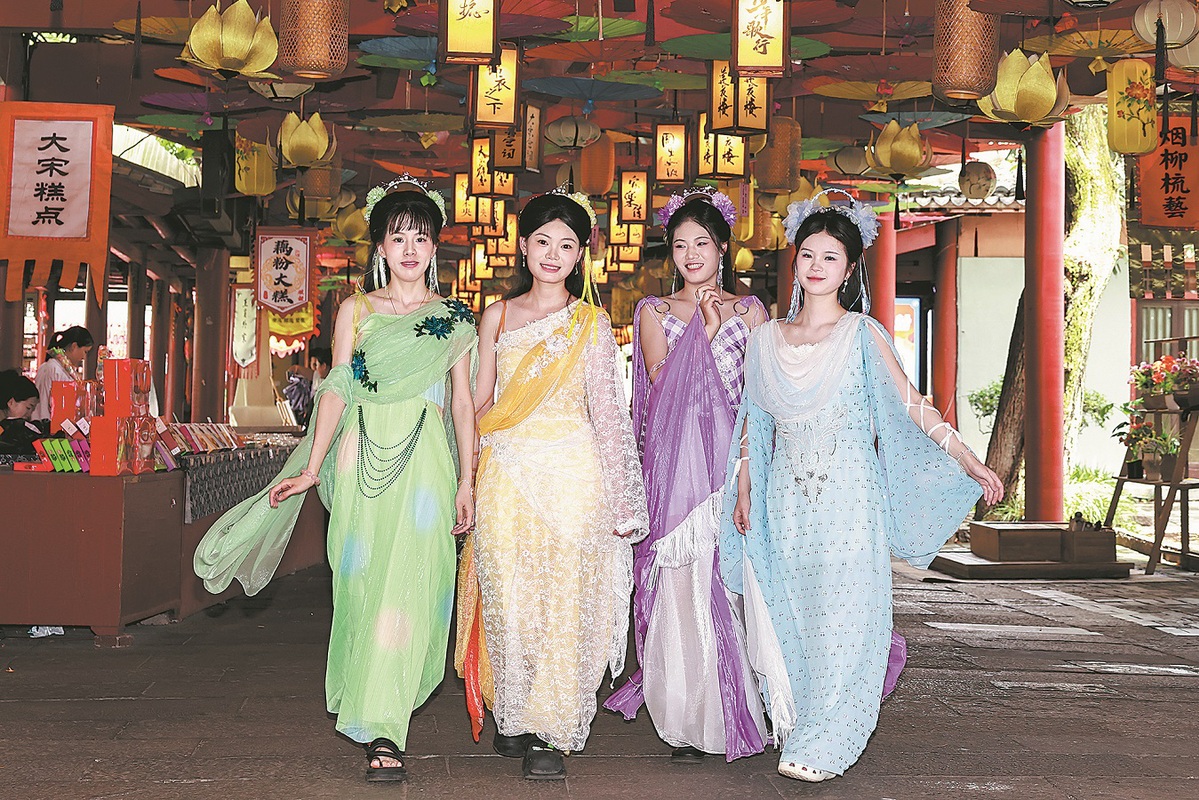
Every year, hundreds of films are produced in Hengdian, a once-obscure township in Zhejiang province that is now often referred to as "China's Hollywood".
Few people realize, however, that the ascent of Hengdian — and the broader transformation of Zhejiang as a cultural powerhouse — was shaped earlier when Xi Jinping served as the province's Party secretary.
In 2003, months after becoming secretary of the Communist Party of China Zhejiang Provincial Committee, Xi visited Hengdian at a moment when its sprawling film sets were growing rapidly, but the industry lacked support for deeper integration across the production value chain.
Private capital was still restricted from entering critical areas such as film production and distribution.
"He encouraged us to explore boldly and vigorously develop the film and cultural industry," recalled Xu Tianfu, vice-president of Hengdian Group.
Soon after Xi's visit, Zhejiang authorities launched a provincial task force to study reforms, which led to the creation of China's first national-level film industry pilot zone in Hengdian in 2004.
The move marked a turning point in widening investment opportunities for the cultural sector and laid the groundwork for what is now one of the world's busiest film production hubs.
In 2005, the provincial Party committee, under Xi's leadership, adopted "eight projects" to build Zhejiang into a province with strong culture.
The projects span eight areas — civic quality, cultural excellence, cultural research, cultural preservation, cultural industry promotion, cultural infrastructure, cultural communication and cultural talent development.
As China pushes to build itself into a nation strong in culture, the projects have provided key references and are a critical component of Xi Jinping Thought on Culture, analysts said.
The thought, first put forward at a two-day national meeting on the work of public communication and culture in October 2023, highlighted the need to meet the people's increasingly diverse, multitiered and multifaceted spiritual and cultural needs, and enhance the supply of services and products, in order to strengthen people's sense of cultural fulfillment and happiness.
Chen Ye, former vice-president of the Zhejiang Academy of Social Sciences, said the eight projects reflected Xi's belief that cultural development is central to modernization.
"His strategic vision, forward-looking ideas, political courage and pragmatic approach laid a solid foundation for preserving cultural heritage and promoting contemporary cultural development," she said.
In Zhejiang, the results have been more than palpable. More than 5,000 film and television companies operate across the province. Since 2003, the added value of Zhejiang's cultural industries has risen from 44.2 billion yuan ($6.15 billion) to over 615 billion yuan. Their share of the province's GDP has more than doubled, to over 7 percent.
The province is now home to three UNESCO World Heritage sites, five national archaeological parks, 281 nationally protected heritage sites and 926 registered village museums.
One of the most notable preservation efforts has focused on the archaeological ruins of Liangzhu City, a Neolithic site on the outskirts of Hangzhou.
Preserving heritage
During a 2003 visit, Xi was briefed on the status of the preservation of the site — a hub for a rice-cultivating and jade-worshiping culture dating back 4,300 to 5,300 years.
"The Liangzhu archaeological site is a sacred testament to China's 5,000-year civilization and a rare, invaluable treasure. We must ensure its preservation with the utmost care," Xi said during the visit.
He ordered the expansion of the preservation zone, halted nearby quarrying and called for the site to be prepared for nomination as a UNESCO World Heritage Site. Over the next decade, archaeological work accelerated alongside policy, legal and ecological support, and in 2019, Liangzhu was inscribed on the World Heritage List.
Preservation of intangible heritage was also elevated under Xi's tenure in Zhejiang.
In 2005, when he visited a Kunqu Opera troupe in Yongjia county, the troupe had been struggling to survive since losing public funding in the 1980s.
After watching the performance and speaking with veteran actress Lin Meimei, Xi initiated a provincial-level plan to rescue the centuries-old Kunqu Opera.
The troupe was granted heritage status and allocated funding of 1 million yuan per year. Today, it stages more than 200 shows annually and has worked with a vocational college to train new performers.
"We are full of gratitude," Lin said. Now recognized as a national inheritor of Kunqu Opera, she added: "The flame of Kunqu Opera in Yongjia has not gone out. We've lived up to the legacy entrusted to us by our forebears."
Innovation matters
Xi's emphasis on cultural innovation also extended to the animation and gaming sectors.
In 2005, he visited the China Academy of Art, where he highlighted the broad potential of the animation sector and the strength for Hangzhou to build a "city of animation".
That same day, he toured Zhejiang Zhongnan Animation Co, now one of the largest original animation companies in China.
"Animation should not be measured purely in financial terms," Xi told Wu Jianrong, chairman of Zhongnan Group, of which Zhongnan Animation is a subsidiary.
"It provides young people with healthy spiritual nourishment. Chinese civilization has over 5,000 years of history — you can create animated works featuring our national heroes," Xi said.
Encouraged by Xi's remarks, Zhongnan produced a series of animations and began exporting them.
That year, Hangzhou hosted the inaugural China International Cartoon & Animation Festival, generating over 10 million yuan in on-site sales and 3 billion yuan in potential deals.
Xi later wrote to national regulators to help secure Hangzhou as the event's permanent home and supported the creation of a dedicated organizing office.
Hangzhou is now home to more than 270 animation and gaming companies, employing over 12,000 people. The city is the birthplace of the hit video game Black Myth: Wukong, and 227 internet-based animated series produced in the city were licensed in 2024, accounting for 34.45 percent of the national total.
Across Zhejiang, there are more than 300,000 private cultural enterprises — up from fewer than 45,000 in 2003.
Chen, the former vice-president of Zhejiang Academy of Social Sciences, said that Xi's cultural initiatives during his tenure in Zhejiang and the landmark achievements in the new era highlighted the importance of sustained efforts to deliver cultural development outcomes that truly benefit the people.
"It also indicated that the implementation and evaluation of cultural initiatives should prioritize the production of more high-quality outcomes to meet the cultural rights and interests of the broadest segments of the population."
Zhejiang Daily contributed to this story.

- Mainland says DPP's so-called trade deal with US sells out Taiwan's interests
- A bar with no bar
- Disaster relief efforts underway after 5.1-magnitude quake hits China's Yunnan
- China's commercial space sector logged 50 launches in 2025
- Scientists discover single-walled carbon nanotubes, graphitic carbon in Chang'e 6 lunar samples
- Commercial, reusable Chinese rocket PALLAS-2 completes engine system test