


A key breakthrough has been achieved after archaeologists uncovered a ritual complex, in Henan province, that was recorded in history that had never, until now, been located. The discovery marks a huge advancement in the studies of emperors' mausoleums in China.
In their excavations at the Eastern Han Dynasty (25-220) emperors' mausoleums in Luoyang, archaeologists from the Luoyang City Cultural Relics and Archaeology Research Institute found special foundations last year in one of the mausoleums' courtyards. These were markedly different from normal foundations for buildings and they are probably relics of the zhongju complex recorded in history.
According to literature, zhongju originally meant the racks used to hang musical instruments, but during the Eastern Han era, the facility was upgraded into an architectural complex and placed in emperors' mausoleum courtyards.
Archaeologists found in the zhongju site, which covers about 1,400 square meters, two long-strip rammed earth foundations on which there are many column base pits in an organized layout and a house foundation situated to the east of them.
In their earlier studies, archaeologists have known there are often five major components in an Eastern Han emperor's mausoleum besides the earth mound, which covers a stone hall probably for sacrifice, a hall storing the dead's attire, a residence for concubines and palace maids, a place for the administrative staff and zhongju. Although the other four had been identified, zhongju remained a mystery.
"Located by the stone hall, zhongju was very small in size compared to other four components. We used to believe rows of rammed earth mounds to the south of the major earth mound were remains of zhongju, but after excavating the new site we changed our minds," says Li Jipeng, an associate researcher at the Luoyang City Cultural Relics and Archaeology Research Institute.
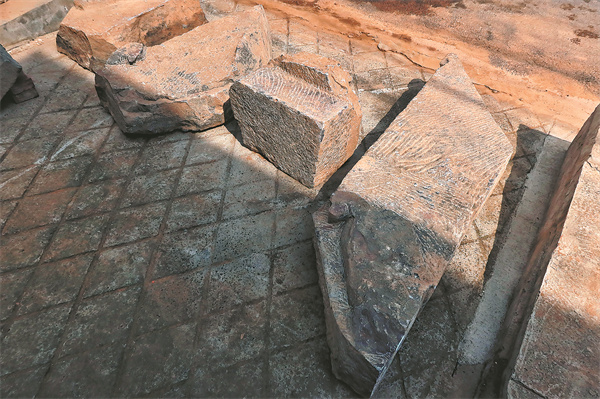
Another important discovery is the inscriptions on some cornerstones found from the zhongju site. These recorded information included the time when the stone materials were made: "the second year of Yuanjia era" (AD 152).
According to Wang Xianqiu, a colleague of Li, as the stones were made before constructing the mausoleum, the zhongju complex was built after 152. This helps archaeologists to point to Liu Zhi, better known as Emperor Huan of the Han Dynasty, who lived from 132 to 168, and was buried in this mausoleum.
Besides this mausoleum, all other Eastern Han emperors have the zhongju complex, Li says.
In ancient China, people followed the rituals and music system, which means differentiating social status by different rituals and music to uphold social order. Therefore, music played a big role in the life of aristocracy, especially for the royalty.
Historical literature records during the Qin Dynasty (221-206 BC), Emperor Qinshihuang collected weapons and cast them into zhongju. In the Western Han Dynasty (206 BC-AD 24), there were also zhongju in front of major palaces for ritual use.
Eastern Han Dynasty seems to take the lead turning zhongju from a facility into architecture, and that is a direct result of the elevating status of mausoleums in rituals.
Emperor Ming, the second emperor of the Eastern Han Dynasty, once cried when he woke up and said he dreamed of his late parents. The next day, he led officials to hold a ceremony in his father's mausoleum, and standardized the rituals since then.








