



Balancing competition and cooperation
Only by transcending ideological divides and adopting a respectful approach can China-EU relations develop healthily









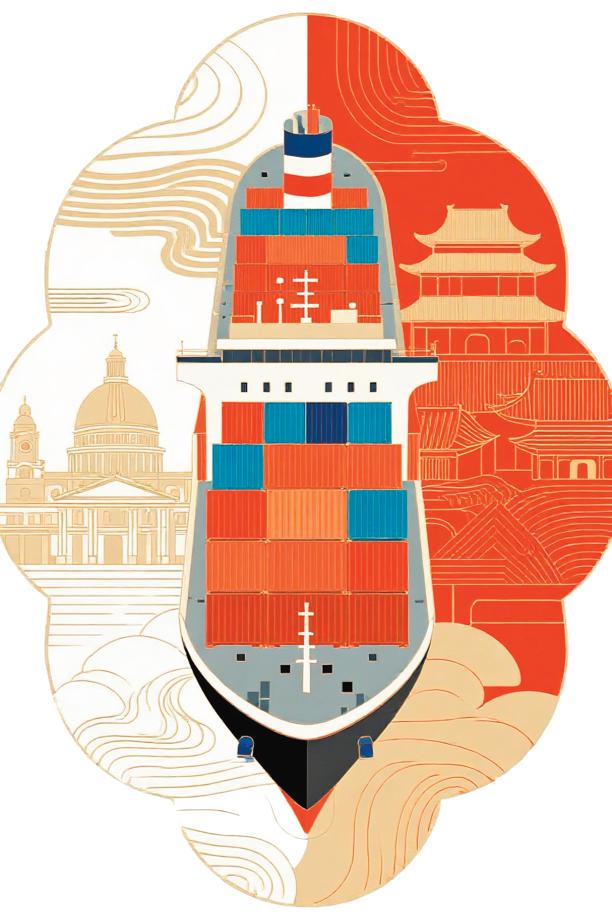
For half a century, through trials and tribulations, China and the European Union have forged ahead with unwavering commitment to cooperation and mutual development. As the two sides embark on the next 50 years, the world confronts unprecedented complexity — resurgent geopolitics, rising protectionism and unilateral coercion threaten the multilateral order.
The China-EU Summit, which concluded in Beijing in late July, came at a critical juncture, when both sides should not merely reflect on past achievements, but also strategically blueprint their shared future. Guided by profound strategic alignment, a tradition of frank dialogue, and pragmatic cooperation, China and the EU have sent an unequivocal signal to the world — their steadfast commitment to multilateralism and collective solutions to global challenges.
Against the backdrop of profound global transformation, China-EU ties stand as one of the world's most pivotal bilateral partnerships — now at a critical juncture. Mutual strategic trust constitutes the foundation for all cooperation between China and the EU. Their 50-year journey of engagement demonstrates that this bedrock of trust has consistently allowed both sides to rise above differences and move forward in partnership. However, facing escalating geopolitical tensions, the greatest challenge for China-EU relations is navigating through the current complexities to restore and strengthen this trust.
In recent years, the EU, buffeted by successive crises, has developed a deepening sense of strategic unease. This has precipitated a fundamental shift in its outlook-from a paradigm of mutual benefit to one increasingly framed in terms of geopolitical rivalry, exacerbating the divergence between China and the EU.
Paradoxically, while China and the EU maintain clear strategic convergence on critical global challenges — from safeguarding regional stability to championing multilateralism and combating climate change, the EU's growing tendency to assess bilateral relations through a geopolitical prism has created new tensions. By linking China-EU dynamics to third-party actors such as Russia and the US, the EU has inadvertently heightened strategic wariness.
Most alarmingly, at a time when unilateral actions and protectionist policies are eroding the very foundations of international governance, China and the EU — as twin pillars of global stability — bear shared responsibilities to transcend outdated zero-sum mentalities. Both parties are obligated to transform strategic common ground into aligned initiatives, solidifying their position as an anchor of stability for global peace and development.
The economic cooperation stands as a testament to the power of mutually reinforcing development. During China's reform and opening-up, European investments and technologies played a pivotal role in facilitating the nation's economic transformation. On the other hand, China's dynamic market and sustained development have become an indispensable driving force of the EU's prosperity, generating growth and employment across the continent. This symbiotic relationship has cultivated an exceptionally interdependent economic ecosystem.
While the EU's "de-risking" narrative has introduced some policy uncertainties, the fundamental resilience and structural complementarity of China-EU economic cooperation remain unchanged, as demonstrated by the enduring reciprocal status as principal trading partners, with each consistently serving as the other's second-largest market.
We must recognize that China-EU economic relations are undergoing a profound transformation, necessitating an evolution beyond the traditional cooperation frameworks. The conventional model of vertical integration — defined by vertical specialization along industrial and value chains — is rapidly giving way to a more complex dynamic of horizontal competition and collaboration.
This structural shift manifests most visibly in the increasing symmetry of their trade profiles, particularly in frontier industries such as renewable energy and digital infrastructure, where the innovative prowess and competitive edge are regarded as "challenges" for certain European industries.
This will test the statesmanship and strategic vision of both sides. The path forward lies in pursuing high-quality development through renewed mutual benefit and win-win framework.
This necessitates a closer economic partnership through multilayered coordination — reciprocal market access, aligned industrial policies, interoperable technical standards, safeguarding intellectual property and equitable competition frameworks — all converging to provide businesses with a stable, transparent and predictable governance ecosystem. Through such institutionalized collaboration, China and the EU can advance the bilateral economic dynamic to an optimized state where structured competition and collaborative engagement become mutually reinforcing.
China and the EU's distinct historical cultures, social systems and development paths do not predetermine conflict and confrontation between the two sides, nor should the EU seek to justify labeling China as a "systemic rival".
Every nation's institutional choice is deeply rooted in its unique history and status quo. It is precisely this diversity that makes the world vibrant and multifaceted.
The very process of European integration stands as a living testament to the principle of "unity in diversity" — its essence lying in accommodation and compromise, with its core mechanism being the careful balancing of pluralistic interests among member states. This fundamental logic holds equal validity in managing relations with the external world. As 50 years of China-EU relations have compellingly demonstrated, only by transcending ideological divides and adopting an objective, respectful approach toward each other's institutional differences can bilateral relations develop healthily without disruptive interference.
The world today is witnessing an increasingly diverse growth landscape, with every country actively exploring a path suited to their own national conditions. China and the EU should uphold the fundamental principle of mutual respect, adhere to the approach of seeking common ground while reserving differences, and work together to build a world of mutual benefit and pluralistic openness.
Looking ahead, China-EU bonds are entering an "age of maturity" and setting sail on fresh endeavors. Anchored by strategic consensus, steered by mutual trust, and propelled by win-win cooperation, the two sides must jointly advance the evolution of the international order toward greater fairness, equity and justice. This represents not only the common mandate of the times, but also the true course for the great vessel of China-EU relations to navigate the tides of history.
The author is director and a senior research fellow at the Department for Global Governance at the China Institute of International Studies. The author contributed this article to China Watch, a think tank powered by China Daily. The views do not necessarily reflect those of China Daily.
Contact the editor at editor@chinawatch.cn.





