



Japan must face up to its wartime past









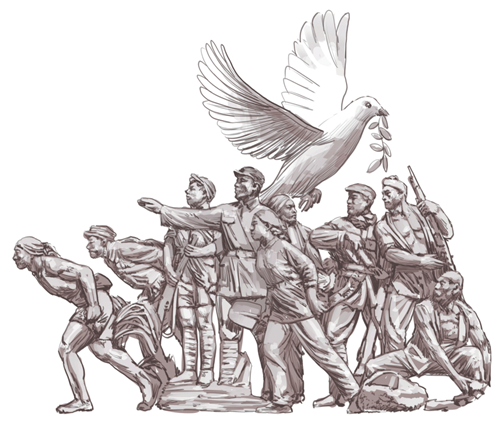
JIN DING/CHINA DAILY
Editor's note: This year marks the 80th anniversary of the victory in the Chinese People's War of Resistance Against Japanese Aggression (1931-45) and the World Anti-Fascist War. Japan should learn from its past and desist from rebuilding its military. In an interview with Li Huixian for Dialogues with Thinkers, China Daily's high-end interview program, Fang Ke, a Japanese affairs expert at the National Defense University of the Chinese People's Liberation Army, said Japan should face up to its history, and stressed that Japanese right-wing forces should not distort history and mislead ordinary Japanese people, especially the younger generation. Excerpts follow:
Question: Aug 15 marks the 80th anniversary of Japan's unconditional surrender in World War II. How should Japan behave now?
Answer: Japanese invaders in China and other Asian countries killed and wounded millions of people, leaving a trail of destruction across much of East and Southeast Asia. For Japan, adopting a right view of history is imperative. Only by facing up to history can Japan truly atone for its atrocities before and during World War II. Facing up to history is a litmus test of its political sincerity.
Also, Japan must adhere, both in letter and spirit, to the four political documents it has signed with China. It is equally crucial for Japan to enhance communication with China to build strategic mutual trust and better understand each other's legitimate concerns.
Amid growing economic turbulence fueled by the United States' tariff war, China and Japan, as the Asia-Pacific's leading economies, have every reason to deepen economic cooperation, because it would not only mitigate economic risks but also bolster regional stability. Effective crisis management is critical, too, for Japan to improve relations with China and other countries in the region. So it should respect Beijing's core interests. Rather than exacerbating tensions, it should adopt a constructive approach to fostering regional stability, particularly bilateral relations with China.
Q: To what extent will the far-right forces in Japan continue to influence the country's policies?
A: Ever since the Meiji Restoration, militarists and far-right forces have been influencing, to various degrees, Japan's policies, even dragging it into the abyss of war. After World War II, the international community's oversight and the US-engineered democratization reforms temporarily marginalized these elements, even stripped them of political power.
However, the outbreak of the Korean War in 1950 prompted a US policy reversal. By remolding Japan into an anti-communist linchpin in East Asia, the US helped rehabilitate convicted war criminals and dismissed wartime officials, some of whom became part of Japan's power structure.
Consequently, Japan has never truly atoned for its wartime crimes nor has it fully abandoned its militarist views. Although these elements' capacity to fundamentally alter Japan's domestic or foreign policy is constrained, they can still shape public views, especially influence young minds.
Q: What sort of impact did the Chinese people's humanitarian act of adopting Japanese war orphans after the end of World War II have on the development of Sino-Japanese relations?
A: The sort of treatment Japanese orphans got from kindhearted Chinese people has long been a testament to the friendship between China and Japan. After Japan's defeat in World War II, an estimated 4,000 to 5,000 war orphans were left behind in China. The older generation of Chinese leaders, including Chairman Mao Zedong and Zhou Enlai, treated them with kindness, as did ordinary Chinese people in Northeast China.
This shows that China distinguishes between Japan's militarist clique and the Japanese people. By launching the war, the militarists not only dragged all the Japanese people into World War II but also made them victims of the war.
After returning to Japan, those orphans acted as a bridge between China and Japan. Many of them formed organizations, revisited their adoptive families in China, and fostered goodwill between the two countries. Their story shows that a genuine people-to-people bond rooted in compassion and mutual understanding is irreplaceable.
Q: Will Japan's labeling of China as the "greatest strategic challenge" in its recent defense white papers harm bilateral relations?
A: Postwar Japan has oscillated between pursuing strategic autonomy to enhance its defense capabilities and relying on the US for national security. Yet by calling China the "greatest strategic challenge", Japan is fabricating stories to justify its militarization and rally domestic public support for it. Japan plans to increase its defense spending beyond 2 percent of GDP by 2027.
The Japanese government argues that its "low defense spending" is inadequate to sustain its status as a major power or counter what it calls "diversified threats", whether from China or other sources. To this end, it seeks to increase defense budgets, expand offensive weapons capabilities, and procure advanced military hardware — all of which require securing public support to ensure smooth approval in both houses of the Diet when these policies are formally proposed.
On the other hand, with the US advancing its "Indo-Pacific" strategy, Japan is concerned about its diminishing role in the alliance due to the US' growing diversified partners. For decades, Tokyo has followed Washington's lead, but it has been working to exercise greater influence and autonomy within the alliance.
By calling China as such a "threat", both countries gain justification to deepen alliance integration, enabling Tokyo to harness US strategic weight for expanded regional influence and leadership. Japan also believes this will make it an indispensable ally of the US in the Asia-Pacific. But Japan should realize that in today's world, national security cannot be safeguarded by hyping up nonexistent threats. And clinging to the beggar-thy-neighbor approach will not help Japan win the support of its neighbors or the wider international community either.
Q: Is Japan's strategy of boosting security and the economy sustainable?
A: At the end of 2024, Japan was China's fifth-largest trading partner, third largest among individual countries, while China was Japan's largest trading partner and primary source of imports. Sino-Japanese trade has been mutually beneficial for decades. It is the US that has been trying to destabilize the global economic order by launching the tariff war.
It is essential for China, Japan and the Republic of Korea, as major economies in the Asia-Pacific, to deepen cooperation, especially in fields such as cutting-edge technologies and infrastructure development, to ensure the region's continued development.
Japan's approach to China is inherently contradictory. Despite continuing to align with the US in matters of security and defense, Japan has been enjoying the economic gains from Sino-Japanese trade.
Q: How should we respond to certain US and Japanese politicians' frequent hyping of the Taiwan question?
A: This is a matter of serious concern. We should continue to make efforts to achieve the reunification of Taiwan with the motherland, and avoid making the mistake of "strategic overreach".
Ineffective crisis management could turn a friction into conflict, potentially dragging other countries into it. To prevent this, China and Japan have established effective multi-tier, multi-channel crisis management mechanisms, including hotlines at the defense minister level.
In recent years, through a series of military exercises and demonstrations of advanced weapons systems, China has showcased the modernization of its defense forces, as well as its resolve to safeguard its sovereignty and territorial integrity, and achieve national reunification.
It will again do so at an opportune moment and location to demonstrate its military capabilities to deter hostile forces, and prevent them from exploiting sensitive issues.
The views don't necessarily represent those of China Daily.
If you have a specific expertise, or would like to share your thought about our stories, then send us your writings at opinion@chinadaily.com.cn, and comment@chinadaily.com.cn.





