China Focus: Study finds moon's Apollo Basin formed 4.16 billion years ago









GUANGZHOU -- Based on a recent study of lunar samples collected as part of the Chang'e 6 mission last year, Chinese and international researchers have dated the formation of the Apollo Basin — a major impact basin on the far side of the moon — to 4.16 billion years ago.
This discovery provides key information that could help explain the apparent early impact flux during the Late Heavy Bombardment (LHB) period of the moon and the solar system. The study was published in Nature Astronomy on Wednesday.
The giant impact basins scattered across the lunar surface are largely remnants of intensive bombardments by asteroids from the solar system during the early formation stage of the moon, which is known as the LHB.
Due to a lack of precise, sample-backed age data on the moon's key impact basins, scientists have long debated whether the LHB impact flux declined gradually or saw a sudden intensity peak approximately 3.8 billion to 4 billion years ago.
Last year, the Chang'e-6 probe landed and collected samples in the Apollo Basin, which is located within the South Pole-Aitken Basin and is the largest secondary-impact structure in the region. Scientists believe that the Apollo Basin likely formed concurrent with the onset of the LHB, making the determination of its formation date key to unraveling this mystery.
A team from the Chinese Academy of Sciences' Guangzhou Institute of Geochemistry, led by CAS academician Xu Yigang, worked with other Chinese and international researchers to examine three unusual clasts measuring 150 to 350 micrometers in size, which were among the lunar samples retrieved by the Chang'e 6 mission. The three samples are impact-melt fragments that formed during the formation of the Apollo Basin, meaning they can act as a geological clock for the impact event.
The research team accurately determined the age of the fragments and, by integrating multiple information sources, including remote sensing images and geochemical data, determined that the Apollo Basin formed approximately 4.16 billion years ago.
These findings push back the date at which the LHB began on the moon by at least 100 million years. The study has also revealed that the LHB impact flux followed a trend of gradual decay — a fact which does not support the hypothesis of a sudden surge between 3.8 billion and 4 billion years ago.
Xu told Xinhua that this research on the Chang'e 6 samples will continue to drive humanity's developing understanding of the evolution of the Earth-moon system.
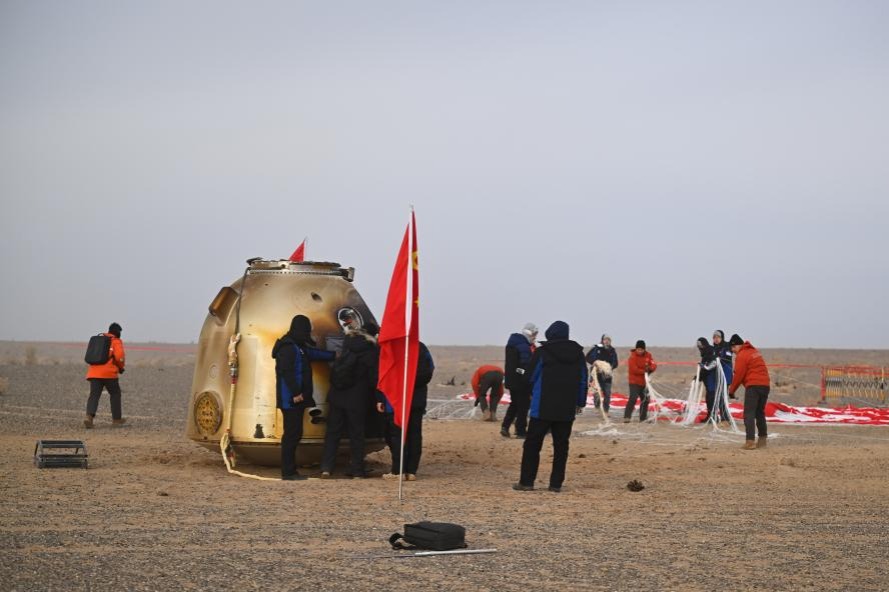
The Chang'e 6 probe was launched from China on May 3, 2024. On June 25, 2024, its returner landed in north China, bringing back over 1.93 kilograms of samples from the far side of the moon.
A separate study that Chinese scientists carried out on the Chang'e 6 samples was published in March of this year, confirming that the South Pole-Aitken Basin formed some 4.25 billion years ago, and providing critical insights for the understanding of the early evolution of the moon and the solar system.
In July, China also unveiled a series of other research findings from studies of the Chang'e 6 samples, covering categories such as the volcanic activity, ancient magnetic field, water content and geochemical characteristics of the lunar mantle.





- Shenzhen leads China's megacities in commuting efficiency
- Shenzhen forms micro-drama industry association
- Former security official expelled from Party for serious violations
- One Chongqing Marathon participant dies due to sudden illness
- Jiangsu schools delay start times to improve student well-being
- Death toll rises to 9 after steel plant blast in China's Inner Mongolia