Access to child care services made easier
Guideline aims to increase number of nursery facilities to encourage births









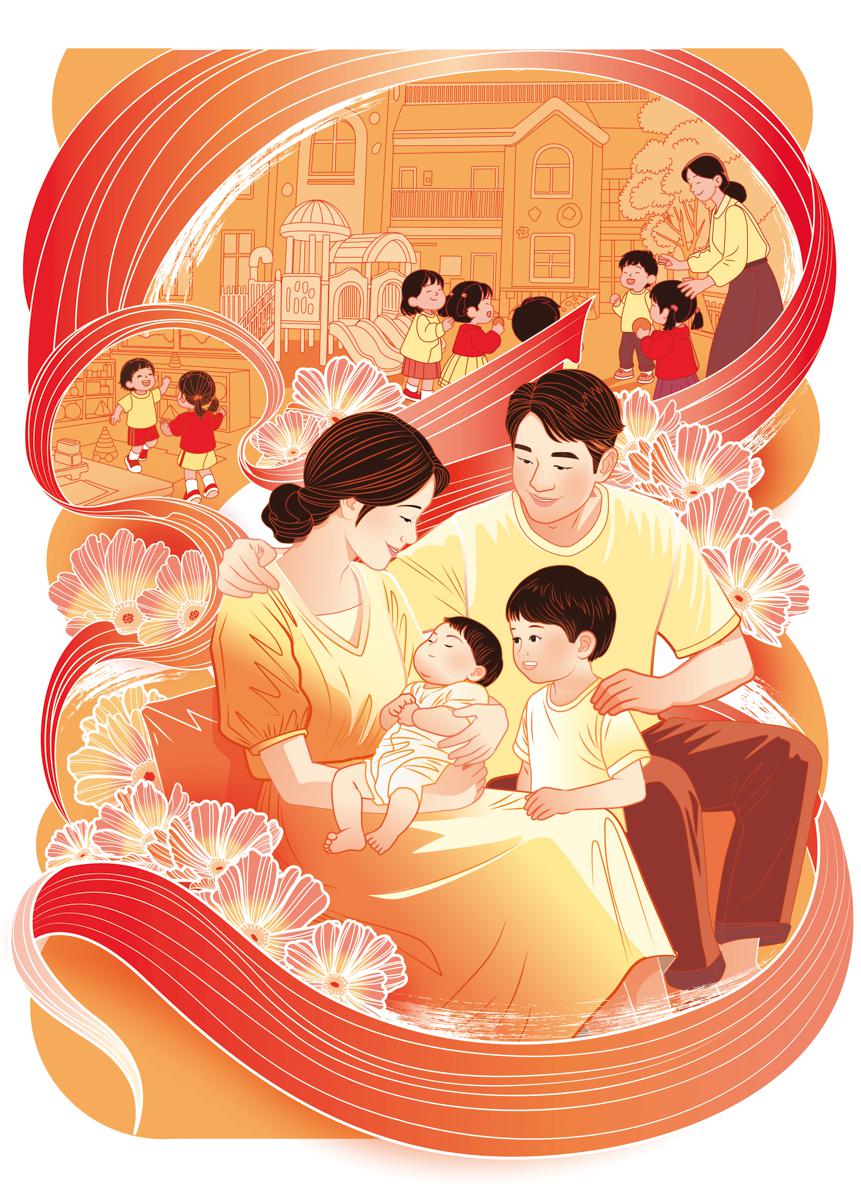
China plans to add 660,000 affordable nursery care slots, increasing the number of places per 1,000 people to 4.5 by the end of this year, as part of efforts to ease the child care burden on families and build a more fertility-friendly society.
By 2030, the nation's affordable nursery care system will be basically established with supporting policies in place, according to a guideline released by the National Health Commission and six other government departments in July.
The number of public nursery care slots should increase significantly, and the capacity and quality of related services should also improve markedly. "Nursery care costs shouldered by families will be effectively lowered and the public's demand for affordable child care services will be largely met," the guideline said.
Expanding accessible and affordable nursery care services is seen as a critical measure to alleviate family financial burdens and encourage childbirth to address China's persistently declining birth rates in recent years.
By the end of last year, the number of nursery care places per 1,000 people had reached 4.08, compared with 2.5 by the end of 2022 and 3.38 by 2023, according to official data.
However, many parents still report difficulties finding suitable nursery care facilities, even as a considerable number of existing slots remain underutilized.
Research results released by the commission show that about a third of families with a baby aged under 3 are in need of nursery care services, but the actual enrollment rate is only 7.86 percent.
In 2023, private nursery care made up 89.5 percent of all facilities nationwide, with the average monthly cost standing at 1,978 yuan ($275) per child. In first-tier cities, fees exceeded 5,500 yuan per month.
The pricing has outstripped most families' budgets and expectations, while inconsistent service quality has further deterred parents. In 2023, the national utilization rate of nursery care slots was just 46.7 percent, according to the commission.
Under the latest guideline, the nation's nursery care system should comprise comprehensive service centers and a variety of child care service providers, such as regular nursery care units, home-based or community facilities, kindergartens offering child care services, as well as facilities funded and managed by employers.
Comprehensive nursery care service centers will not only provide care slots but also offer caregiver training, family child-rearing guidance, innovative child care product development and oversight on industry safety. Central finance has so far invested in establishing 347 such centers across the nation, the commission said.
Local authorities are urged to leverage free or low-cost public spaces in neighborhoods to expand community-based services — such as full-day, half-day, temporary, or hourly care — closer to residential areas.
The guideline also encourages kindergartens, which typically serve children aged 3 to 6, to admit those aged 2 to 3 who can adapt to group settings.
In 2023, about 337,000 toddlers aged 2 to 3 were enrolled in kindergartens, accounting for 15 percent of all enrolled infants and toddlers, data from the Ministry of Education showed.
"Toddlers aged 2 to 3 can exhibit distinct differences in physical and cognitive characteristics compared to older preschoolers and require unique care and education methods. So kindergartens seeking to offer nursery programs should avoid directly applying education approaches designed for older children to this younger group," said the commission.
It is also important to align the environment, facilities and the ratio between caregivers and children, with the developmental needs of the younger age group, who tend to have weaker self-care abilities and thus require more attentive nurturing and higher safety standards.
Employers will be supported to build nursery care facilities, and private nursery care companies will be encouraged to participate in operating publicly funded facilities.
Medical institutions are required to offer infant health management and traditional Chinese medicine services regularly to nearby child care institutions. They are also expected to organize health lectures and consultations on topics such as scientific parenting, growth and development, and the prevention and treatment of common infant and toddler illnesses.
Wang Menglu, a 35-year-old mother of two in Nantong, Jiangsu province, said that she sends her 6-year-old son and 2-and-a-half-year-old daughter to the same kindergarten that's about a 20-minute walk away from home.
"We can drop them off and pick them up together, saving us a lot of trouble and time," she said. "It's reassuring that the kindergarten has also established a long-term partnership with the community healthcare center so that when my children feel uncomfortable, they can access professional medical services promptly."
To lower the operational costs of nursery care services, the guideline calls on local authorities to grant subsidies and allow them to be charged at residential utility rates for their water, electricity, gas and heating. Favorable tax policies are also proposed for community nursery care services.
Guo Yang, deputy director-general at the department of social security of the Ministry of Finance, said that central finance has invested 3 billion yuan into fostering the development of nursery care services since 2023.
"Through employment subsidies, we have also supported local governments in rolling out vocational training for nursery workers, child care specialists and other care service providers," he said.
"Additionally, tax incentives for income tax, value-added tax and deed tax have been granted to employees raising infants, their employers and community-based child care service institutions," he added.
Song Jian, a professor from Renmin University of China's School of Population and Health, said it is important to monitor demographic trends, including annual birth rates, so as to determine adequate amounts of care service supplies and to prevent an excess.
wangxiaoyu@chinadaily.com.cn




- Most parts of country were warmer than usual in 2025
- Poverty relief transitions to governance
- 'Micro sports areas' boost students' fitness, fun
- China tips scales toward healthier living trends
- Anti-corruption efforts focus more on work conduct issues
- Deeper reflections on 'cave-dwelling conversation'