China and India can be civilizational partners









Indian Prime Minister Narendra Modi will soon travel to Tianjin for the Shanghai Cooperation Organization summit — his first visit to China since 2018. The symbolism will be closely watched.
The two sides have taken some steps to improve bilateral ties.
India said it resumed issuing tourist visas to Chinese citizens starting on July 24 this year, the first time in five years, and China said that it has been in close communication with India to promote the early resumption of direct flights between the two countries.
Individually, these may appear as small steps. But collectively, they signal something more meaningful: a tentative shift from guarded distance toward cautious reengagement. And if we take the long view, this reengagement is not simply political — it is profoundly civilizational.
Too often, the India-China relationship is framed narrowly — in terms of border disputes, trade deficits, or strategic rivalry. Yet, long before any modern boundary was drawn, the two civilizations were bound together by the exchange of ideas, philosophies and spiritual traditions.
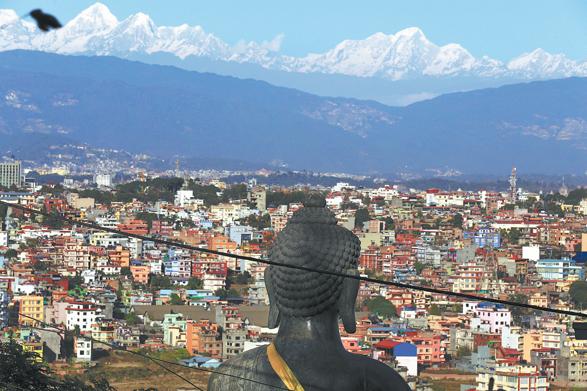
Foremost among these was Buddhism — an Indian gift that took deep root in Chinese soil and grew into one of the major sources of traditional Chinese thoughts.
According to ancient tradition, Emperor Ming, the second emperor of the Eastern Han Dynasty (25-220), dreamt of a golden figure in the clouds. Believing it to be the Buddha, he dispatched envoys westward to seek its origin.
The envoys returned with sacred texts, relics and two monks from India, Kasyapa Matanga and Dharmaratna. The White Horse Temple in Luoyang in Henan province-China's first Buddhist monastery was born of that journey.
Over the centuries, scholars such as Kumarajiva, Xuanzang and Faxian undertook arduous journeys across mountains and deserts to translate, interpret and transmit vast collections of Buddhist texts. Their work enriched China's intellectual and spiritual life and, in turn, brought Chinese interpretations of Buddhism back to India and beyond. Even today, in the frescoes of Dunhuang, the carvings of Longmen, or the serene halls of Chinese temples, the Indian imprint remains — not as a faint historical footnote, but as an enduring testament to a partnership of the mind and spirit.
With different political systems and modern history, China and India share deep-rooted values: respect for family and tradition, a belief in education as a path to self-cultivation, and a philosophical search for balance and harmony.
Buddhism resonated so strongly in China precisely because it found common ground with Confucian ethics and Taoist principles. Concepts such as compassion, nonattachment, and the Middle Way harmonized with the Chinese ethos of moderation, moral conduct and societal harmony. The familiar chant "Namo Amituofo" in Chinese temples is a living bridge to India's ancient spiritual heritage.
Seen through this lens, the two countries are not simply geographic neighbors — they are civilizational cousins whose shared heritage could form the bedrock for a more stable and cooperative future.
In today's turbulent world, such cooperation is not merely desirable; it is essential. The international order is undergoing profound shifts — from rising protectionism in some Western countries to fragility in global supply chains and increasing geopolitical uncertainty. Both China and India, as major emerging economies and ancient civilizations, face similar external pressures, including attempts to contain their development.
Recent trade moves by the United States have made this even clearer. Washington has announced a 50 percent tariff on Indian goods, and the US administration has also imposed significant tariffs on Chinese exports, although they have been engaging in prolonged negotiations.
While these actions may appear as setbacks, they could in fact be a fortune in disguise for Beijing and New Delhi. Both nations can turn this moment into an opportunity by deepening economic cooperation, expanding bilateral trade, and jointly developing supply chains that reduce reliance on unpredictable Western markets.
History suggests that when Asia's two great civilizations stand apart, external forces tend to dominate the region's narrative. When they engage constructively, they can anchor stability not just for themselves, but for the broader Global South.
Beyond geopolitics
Diplomatic breakthroughs often begin not in conference rooms but in cultural exchanges. The deep reservoir of shared history between China and India offers a unique form of "cultural statecraft" that can complement traditional diplomacy.
One concrete step could be the creation of a jointly funded China-India Centre for Buddhist and Confucian Studies, with twin campuses in Luoyang and Nalanda. Such an institution could serve as a hub for scholarly exchanges, student fellowships and collaborative research on ancient texts, logic, ethics and comparative philosophy.
Similarly, a China-India Youth Forum could facilitate exchanges in language learning — Sanskrit and Pali for Chinese students, Chinese classics for Indian students — as well as joint training in arts, crafts and traditional medicine. Annual cultural summits could focus on philosophy, meditation and the ethics of sustainable development, rather than contentious geopolitical issues.
Culture does not erase differences. But it can soften their sharpest edges, building mutual trust in ways that purely transactional diplomacy cannot.
While cultural dialogue provides a strong foundation, economic cooperation can give it practical momentum.
China is India's largest trading partner, and despite recent challenges, there is scope to expand collaboration in green technology, renewable energy, infrastructure development and digital innovation.
Joint ventures in clean energy could address shared concerns about climate change while generating employment and advancing technological capacity. Initiatives in health cooperation — from traditional medicine to modern pharmaceuticals — could deepen people-to-people trust.
The author is a Sinologist at the University of Bath in the United Kingdom, and the first deputy mayor of Asian heritage in the historic city of Bath.
The views do not necessarily reflect those of China Daily.