


Ancient bronze casting art decoded









A team of researchers in Xi'an, Shaanxi province, has decoded the casting technique used by Bronze Age artisans 3,000 years ago to create a complex buffalo-shaped vessel. Their work has helped solve some of the mysteries surrounding primitive foundry technologies.
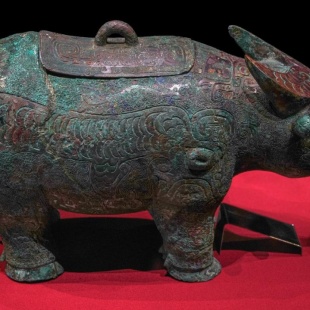
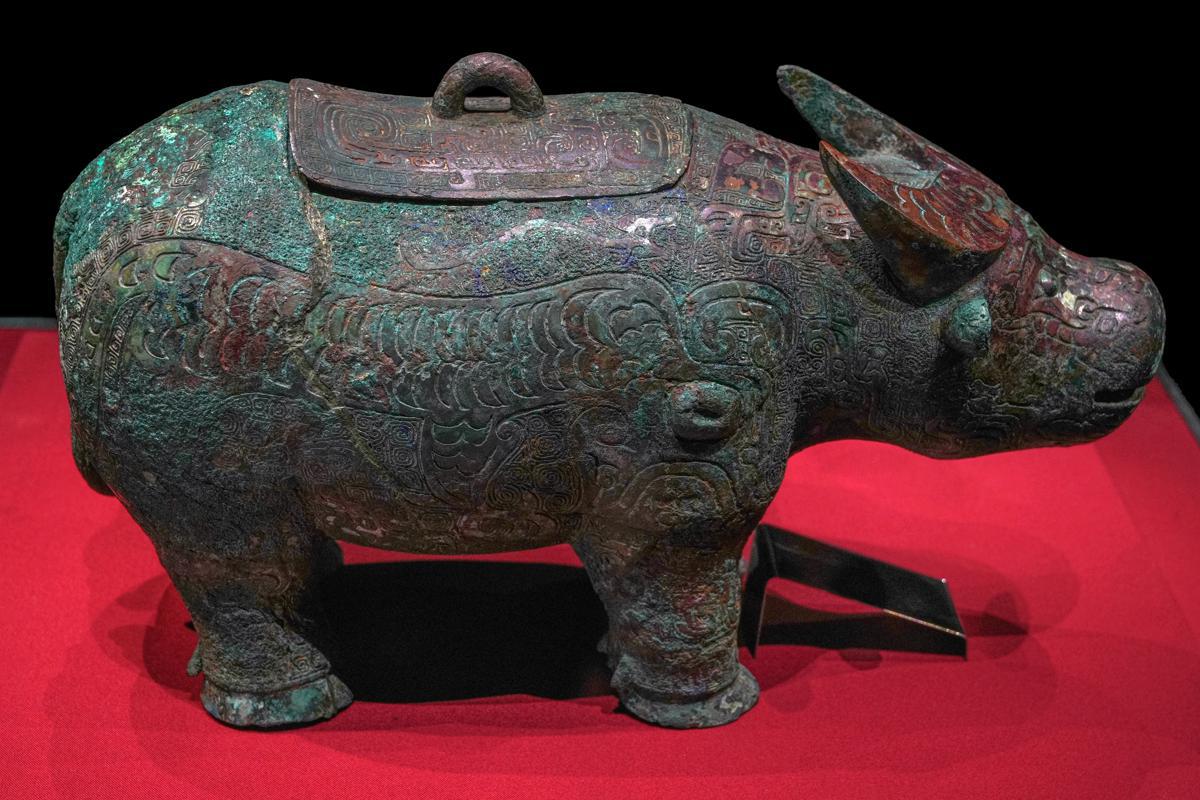
The vessel, which was unearthed at the Yinxu Ruins in Anyang, Henan province, features a bovine head with a slightly open mouth, distinct horns, a bulky body and short, thick legs resembling those of a buffalo. It is 40 centimeters long and 22.5 cm tall, including the lid, and weighs 7.1 kilograms. Its surface is decorated with patterns of tigers, dragons, birds and fish.
Excavated from the tomb of a high-ranking military general and tribal leader, Ya Zhang, whose name is cast on the buffalo's neck and the inner wall of the lid, the bronze vessel is believed to have been used as a ritual wine container during the late Shang Dynasty (c.16th century-11th century BC).
Casting such complex figures poses far greater challenges than making simple geometric shapes, and how ancient artisans achieved the flawless designs with limited tools and materials had long been a mystery.
Members of the research team, led by Yang Huan, an associate professor at Northwestern Polytechnical University's Institute of Culture and Heritage in Xi'an, applied their knowledge of materials science in computer simulations to duplicate the bronze pouring and solidification process.
Using 3D scanning to capture millimeter-level details and reverse modeling technology to build a virtual casting workshop, the researchers re-created the ancient process with unprecedented detail.
"It's like performing a holographic scan on the artifact," said Fang Minghui, a PhD candidate and member of the team. "For the first time, we have dynamically duplicated the entire process to understand how molten bronze flowed and solidified inside the pottery mold."
The team tested two pouring gates — one at the right hind leg and another at the left front leg — to observe the differences in solidification time and the distribution of defects. Their findings confirmed that the ancient craftsmen used the right hind leg to pour molten metal when they cast the buffalo-shaped vessel.
"The precision with which Shang Dynasty artisans controlled the gate location fully aligns with modern materials science principles," associate professor Yang said, pointing to the simulated flow path of molten bronze in a dynamic video demonstration.
Equally remarkable is the thickness of the vessel's wall, which was maintained at about 3 millimeters throughout, a standard that matches modern casting criteria, she added.
The buffalo — an animal revered in the Shang Dynasty as a sacred medium between heaven and earth — gave the vessel exceptional status at Yinxu. It is the only known bovine-shaped bronze vessel to be unearthed at the site.
"Even when examined through a modern lens, the technical skills of the artisans can only be described as extraordinary," Yang said.
Casting such a vessel would have required a fully customized pouring system, akin to what would be needed for a precision engineering project in modern times, she said.
"The artisans had thoroughly mastered the tempering of tin bronze," Yang said. "In an era without instruments, they relied on their accumulated experience to precisely control alloy ratios and achieve flawless casting within margins of millimeters."
Chinese bronze craftsmanship, which began to emerge in the late Neolithic period, or New Stone Age, reached its zenith in the late Shang Dynasty.
Yang's team plans to apply the same high-tech methods to study other bronze artifacts and further explore ancient manufacturing techniques, materials and purposes.
The casting technique used at Yinxu demonstrates the creativity and persistence of ancient artisans, Yang said.
"In an era when technology was less developed, they made beautiful things — perhaps after numerous trials and errors. That spirit is really inspiring," she added.