



Wasted opportunity
European leadership has fumbled a historic trade moment, missing the chance for joint action with China









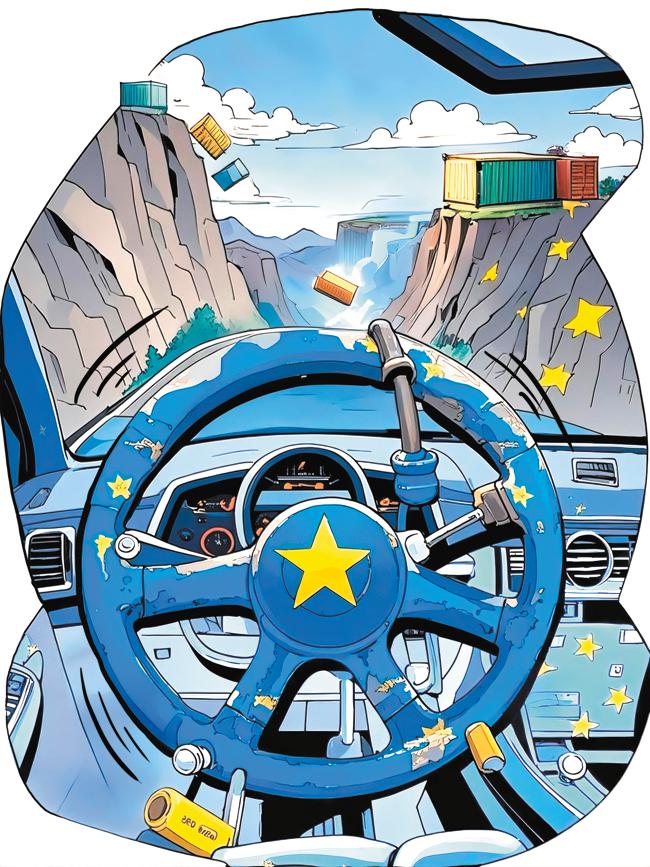
At the end of July, the European Commission, the main executive body of the European Union, and the United States administration reached a trade agreement after months of negotiations. The US president threatened the EU and many other economies, with unilateral tariffs. This common threat could have prompted joint action, especially between China and the EU. However, the European Commission failed to take advantage of the situation. Instead, it made a questionable deal with the US that has already faced strong opposition.
But let's start at the beginning and see how the European Commission maneuvered itself into this awkward situation. When President Donald Trump tweeted in 2018 that "trade wars are good and easy to win", he referred to what is known as "escalation dominance" or "capability". It stands for the capability of one economy to make things worse for another, while the other economy cannot do the same to the first economy. He believes that the US has this capability and that is the way he can win the trade wars he started. He is wrong when it comes to China, but he might be right regarding the EU.
Why has China fared better? What's the difference? It is mainly because of China's diverse and broad export structure and the successful steps China has taken in recent years to diversify its trade portfolio. The Association of Southeast Asian Nations has become China's largest trading partner. The US accounted for 19.2 percent of China's exports in 2018, but this ratio decreased to 14.7 percent in 2024.
Both China and the EU have more exports to the US than imports. In 2024, the US had a trade deficit with the EU, totaling $161 billion. In the same year, China continued to run a trade surplus with the US, which was much higher than Europe's.
The EU is responsible for almost 20 percent of the US' trade deficit, which is behind only that of China and Mexico. To put it simply, the US still has a huge trade deficit with the EU. This means that US dependency hasn't increased, which goes against the US explanation for why high tariffs are needed in this relationship.
The European leadership failed to take advantage of the chance to expand its options in foreign policy and trade, ignoring the hand China extended to it. The agreement with the US raises overall tariffs to 15 percent, which is lower than the threatened 30 percent, but still a significant increase.
It is doubtful whether the European leadership can keep its promise of investing $600 billion in the US by the end of Trump's second term as president since the investors are private players not the member states or the European Commission. Another problem is the obligation of the EU to buy energy worth $750 billion by the end of Trump's second term. Even in this case, the European Commission cannot legally bind the bloc to purchase energy from the US. In this context, it is worth noting that neither the buyer nor the supplier is the US or the EU, but private companies.
The White House published a fact sheet which states "the European Union agreed to purchase significant amounts of US military equipment", while EU officials deny this statement.
The details of the deal are not only opaque, but the agreement has received strong criticism from many sides. French Prime Minister Fran?ois Bayrou said it was a "dark day" for Europe. Arnaud Bertrand, a French entrepreneur, summarized it in a more elegant way on social media X: "This does not even remotely resemble the type of agreements made by two equal sovereign powers. It rather looks like the type of unequal treaties that colonial powers used to impose in the 19th century — except this time, Europe is on the receiving end." While German Chancellor Friedrich Merz and Italian Prime Minister Giorgia Meloni welcomed the deal, representatives of the industry and agriculture in these countries were less happy. Cristiano Fini, president of the Italian Confederation of Farmers, said the US-EU trade agreement was more like "a surrender" than an agreement, while the German industry lobby said it is a "fatal sign" regarding the future of trade relations.
The weakness of the European Commission under President Ursula von der Leyen has many signs, not only the trade agreement. Although she survived a no-confidence vote in the European Parliament in early July, she is politically weakened. Not only the fact that she did not withstand US pressure in this case, but more importantly she rejected China's invitation to join hands for the continuation of globalization. Something that is also in Europe's interests.
While it would have been a significant development to enhance Europe's strategic autonomy with China's support and establish a global environment where free trade and the movement of people and capital are the norm rather than the exception, the EU did not pursue this course of action.
The most logical step would be to establish a partnership with China, which does not pose a military threat to the EU and which is committed to preserving a free global economy. Nevertheless, the EU chose to enter into a trade deal with the US that appears to be disadvantageous. This deal will be renegotiated repeatedly, as the US has the ability to escalate the trade conflict in ways that will be disadvantageous or costly to the EU, while Europe cannot do the same in return.
While the EU could benefit from increased engagement with China in its trade and globalization efforts, this is unlikely to occur in the near future. What are the reasons for this? The primary issue lies with the European Commission and its leadership. They have demonstrated an inability to revise EU strategies that would enhance European autonomy. This is largely due to their inability to overcome ideological differences and their apparent adherence to concepts that falsely uphold the dominance of the European model.
The author is head of the School of International Relations at Mathias Corvinus Collegium, Budapest, and corresponding researcher at the China-CEE Institute. The author contributed this article to China Watch, a think tank powered by China Daily. The views do not necessarily reflect those of China Daily.
Contact the editor at editor@chinawatch.cn.





