



Reform helps raise life expectancy in Xizang









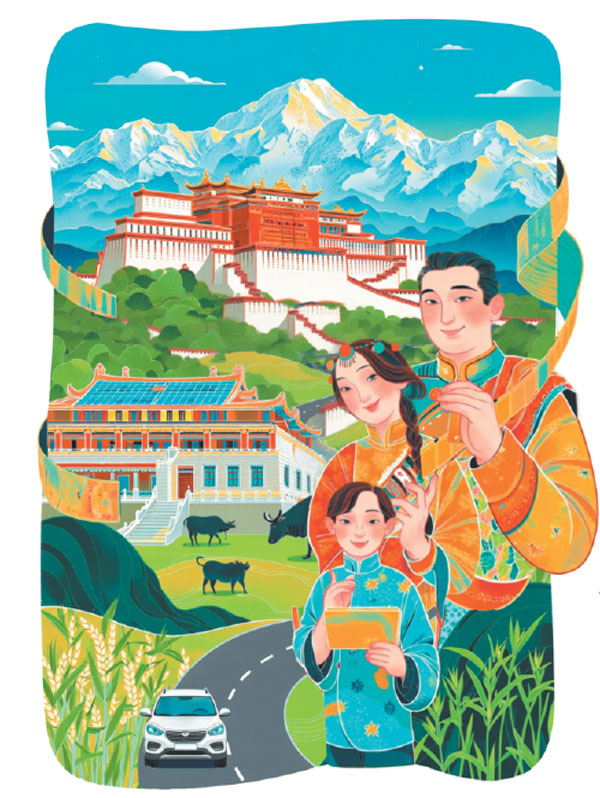
In the six decades since the establishment of the Xizang autonomous region, the increase in life expectancy from 35.5 years to 72.5 years stands out as a powerful testament to the progress the region has made. The increase in life expectancy represents more than just a number; it is a miracle made possible by the development on the Qinghai-Tibet Plateau through political reform and huge investments in social security, education, healthcare and infrastructure.
The democratic reform implemented under the leadership of the Communist Party of China abolished the oppressive system in Xizang, and ensured millions of former serfs became masters of their own destiny. In the new era, "whole-process people's democracy" continues to drive high-quality development under an institutional framework that prioritizes public health and well-being of the people.
Xizang's GDP reached 276 billion yuan ($38.7 billion) in 2024, 155 times that of 1965 and per capita disposable income of urban residents and farmers increased by about 121 and 199 times, respectively. Equally important, the rise in per capita disposable income translated into better nutrition for the people and greater access to essential healthcare services. The economic boom has not only improved people's living standards, but also helped 88.7 percent of farming and pastoral households shift from earthen structures to spacious and modern houses with clean drinking water and sanitary facilities, dramatically reducing the spread of diseases.
Nutrition is a critical micro-determinant of life expectancy, the foundation upon which long-term health is built. The Party and the central government have also been making consistent efforts to improve the nutritional intake of the local people, with their traditional diet of tsampa and butter tea diversifying to include vegetables, fruits, eggs, and dairy and meat products.
While the average daily protein intake has met the recommended protein intake standards, the central government has instructed agricultural and nutritional experts to make efforts to increase the nutrient content in local staples such as highland barley and yak products.
Moreover, a quiet revolution in education, particularly women's education, has been a powerful driver of health gains in Xizang. Before the democratic reform, the illiteracy rate in Xizang was more than 95 percent, but today women average over nine years of schooling, basically on par with men, with an increasing number of young women pursuing university education.
This progress has had a profound impact on child health. Research shows that each additional year of education for a woman reduces infant mortality by 7-9 percent. The vaccination rate for children of women with secondary or higher education is 30 percent higher, and child malnutrition in families where the mother has a junior high school or higher education degree is 25 percent lower.
Also, educated women pay greater attention to prenatal care, with the medical check-up rate increasing largely. Accordingly, a growing number of women in Xizang, empowered with modern health knowledge, now ensure their family's well-being.
Sixty years ago, Xizang suffered from an extreme shortage of medical resources, having only three medical institutions. Farmers and herders, once they fell ill, often had to rely on traditional medicines or travel long distances for treatment. This lack of access to medical services allowed infectious and endemic diseases to spread unchecked.
Today, Xizang boasts a five-level medical and health service network in both urban and rural areas. While the number of medical institutions increased from 193 in 1965 to 7,231 in 2024, the number of hospital beds increased to 17,000. And the improved disease prevention and control system reduced the incidence of infectious diseases.
With the increase in medical subsidy for farmers and herders, the deductible threshold for critical illness insurance has reduced from 60,000 yuan to 5,000 yuan, and 98.5 percent of the impoverished population enjoys the convenience of "treatment first, payment later". Besides, modern infrastructure has been a game-changer for healthcare access. With a highway network of nearly 125,000 kilometers, every township and village in Xizang is now well-connected to healthcare facilities, and the Lhasa-Nyingchi Railway has brought train services to southeastern Xizang, ensuring convenient travel for people and smooth flow of goods.
With the continuous improvement of energy and communication infrastructure, the main power grid now covers all counties and districts, and optical fiber and 4G networks have reached all administrative villages. In fact, herders in even remote pastoral areas can now access diagnostic services online.
The ultimate goal of Xizang's development is to ensure the local people enjoy a high quality of life and confidently march into the new era to realize the rejuvenation of the Chinese nation.
The author is a professor at the Institute of Ethnology and Anthropology, Chinese Academy of Social Sciences, and director of the Research Center for Consolidating the Sense of Community for the Chinese Nation in Xizang.
The views don't necessarily represent those of China Daily.
If you have a specific expertise, or would like to share your thought about our stories, then send us your writings at opinion@chinadaily.com.cn, and comment@chinadaily.com.cn.





