Patriotic scientist who turned illness into inspiration









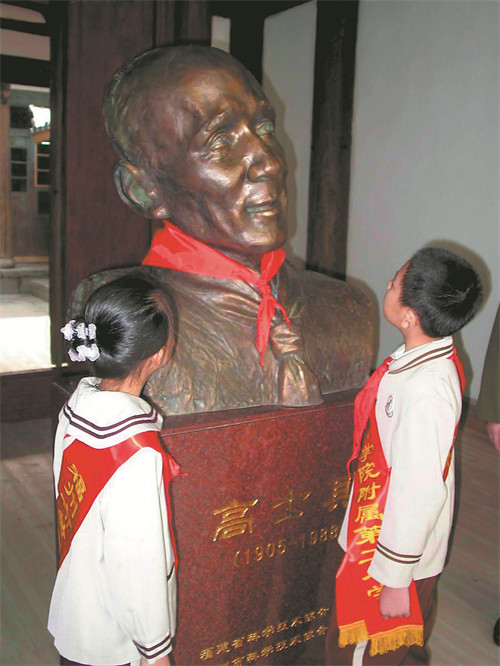
At Beijing's China Scientists Museum, visitor Miao Qing paused before a striking black-and-white portrait — an elderly man seated with his head gently tilted, pen poised in hand. She photographed it for her 9-year-old son's summer essay on a patriotic scientist from the Chinese People's War of Resistance Against Japanese Aggression (1931-45). The man was Gao Shiqi, and this year marks the 120th anniversary of his birth.
Academia on front line
Trembling hands, halting speech and unsteady steps marked his days. It was 1935, the seventh year of Gao's battle with encephalitis, an inflammation of the brain. In Shanghai, he eked out a living translating foreign articles, pressing on through illness as the nation itself was battered, with Japanese forces occupying the northeast and the war advancing south.
Once a medical student in the United States, Gao wrote that year: "For Chinese people today, struggling desperately is the only path forward."
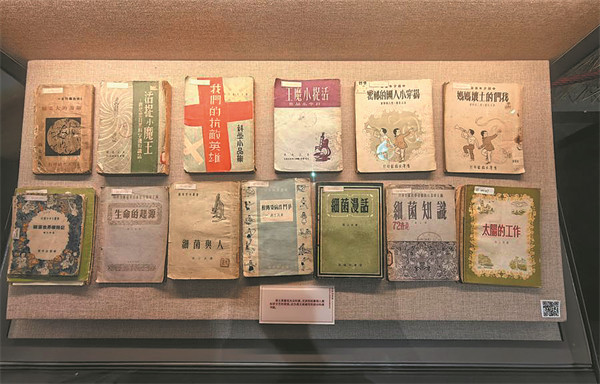
Gao turned to science writing as his weapon. With encouragement from educator Tao Xingzhi, a champion of the "science for the people "movement, he began crafting essays that explained bacteria, pests and childhood diseases in accessible language. Between 1935 and 1937, despite the illness that left him struggling even to hold a pen, Gao produced nearly 100 essays for popular magazines.
In his writings, bacteria became invading enemies and white blood cells heroic soldiers. He urged readers to resist both disease and foreign aggression. "The survival of the Chinese nation is like that of a cell threatened by its environment. By uniting and relying on ourselves, China will not perish," he wrote.
Writing also became his way of confronting destiny.
Born in 1905 in Fuzhou, Fujian province, Gao entered Tsinghua's preparatory school at 13 for studies in the United States. He excelled, but in 1928, while pursuing a medical doctorate at the University of Chicago, a laboratory accident exposed him to the encephalitis virus. The infection left him permanently disabled. Yet, he completed his dissertation.
Returning to China, he briefly worked in a Nanjing hospital but resigned, disillusioned by corruption. In Shanghai, he survived as a freelance translator before dedicating himself to science writing. Though weakened, he found fulfillment and respect in it.
"He never wanted to lose touch with the world around him," recalls his stepson, Gao Zhiqi, now 76.
When Japanese forces launched their full-scale invasion in 1937, Gao Shiqi refused evacuation. Instead, he traveled to Yan'an, the Communist Party's revolutionary base. Leaders including Mao Zedong and Zhou Enlai welcomed him as the first US-trained scientist to arrive there.
Yan'an's conditions were austere, yet Gao Shiqi received care, including a nurse and a secretary to help with writing. He immersed himself in Marxist theory, joined the Party in 1939, and later traveled for medical treatment before returning to Beijing after the war.
At Yan'an, patriotic scientists advanced agriculture, refined copper for weapons, improved salt production, and even produced paper from local grass. Gao Shiqi contributed essays advocating for a national defense science society to boost agriculture, improve medical supplies and educate the public.
Behind the hero
Chen Xiaohong, a scholar at a Shandong-based science think tank who has studied Gao Shiqi's work for more than a decade, says that these ideas represent the early foundations of his vision after 1949 that science should serve the people.
Gao Shiqi believed that efforts to popularize science should keep up with the times, meet people's needs, and support economic development.
His ideas have inspired and guided many Chinese people toward the path of science. Among them was the late renowned Chinese sci-fi writer Ye Yonglie, who regarded Gao Shiqi as his mentor. Ye was also the author of the book, China's Hawking: The Biography of Gao Shiqi, which was published in 2012.
The founding of the People's Republic of China brought Gao Shiqi long-sought stability. He became a deputy of China's top legislature and was invited to attend various academic conferences. He continued to write, from science essays and poems to sci-fi articles.
In a 1959 article, Gao Shiqi envisioned the 21st century with cities on the moon equipped with abundant air, water, and fuel, as well as the invention of driverless planes, cars, and ships. Many of these visions have since been realized or are on the verge of becoming reality.
To the public, Gao Shiqi was a social activist, but privately, his life was a daily struggle. By that time, he was nearly completely paralyzed by the disease, confined to a wheelchair, and often troubled by lingering effects, such as uncontrollable eye movements. Simple tasks like eating, walking, or even turning in bed required constant assistance. His wife, Jin Aidi, once a singer in Shanghai and later a factory worker, cared for him tirelessly for 27 years until her own health declined. She passed away from cancer in 1989, exactly one year after Gao Shiqi.
"My mom was a truly kind, gentle and patient woman," says Gao Zhiqi. "She once told me that when she first met my stepfather, she was not scared away by the man's disability. Instead, she saw a bright, inspiring spirit."
Jin married Gao in 1961, when her son was just 12 years old. Although the father and son had little communication in daily life, Gao Zhiqi took good care of his stepfather by helping him to the bathroom, giving him massages and organizing his manuscripts.
What Gao Zhiqi admired most about his stepfather was that he remained optimistic about life, continued to write and strove to improve himself.
After Gao Shiqi's passing, he was honored by the CPC as a national hero.
Today, his popular science works are recommended reading in textbooks for pupils. The China Association for Science and Technology plans to publish a collection of his selected works in September, the country's first National Science Popularization Month. Chinese leadership has described scientific innovation and popularization as "the wings for the realization of innovation-driven development".
Gao Zhiqi says that a series of commemorative events will be held later this year in cities such as Beijing, Fuzhou and Suzhou, Jiangsu province, where Gao Shiqi had lived.
His family bookshelf still holds the letters and gifts presented to him by school students from across the country decades ago, along with a certificate for an asteroid named in honor of Gao Shiqi by the International Astronomical Union's Minor Planet Center in 1999.