Resistance songs score a resounding victory









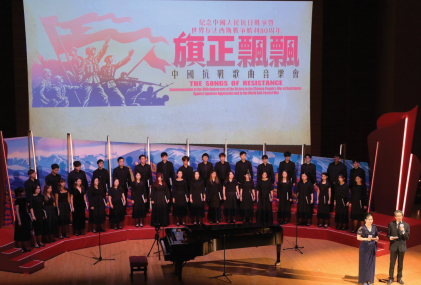
The Songs of Resistance concert at the Hong Kong Academy for Performing Arts on Aug 30 was a celebration. It marked the 80th anniversary of China's victory in the Chinese People's War of Resistance against Japanese Aggression (1931-45). Produced by Radio Television Hong Kong Radio 4, the show featured a selection of resistance songs composed between 1931 and 1945. These range from rousing paeans to the Chinese soldiers' unbreakable spirit in the face of fierce battles to poignant songs describing wartime hardships endured by civilians.
Although the songs are products of unfortunate circumstances, the concert provided an elevated listening experience, blending history with musical excellence. Each song was introduced by the concert hosts — the Education University of Hong Kong academic Jim Chang and Eunice Chow — who provided valuable historical context to help set the scene. The songs were thoughtfully arranged in chronological order, tracing the evolution of the resistance movement.
The concert opened with what is considered the first song of protest against the Japanese invasion of China — Song of Resistance Against the Enemy, written by Wei Han-tseung and composed by Huang Tzu in 1931. The Educators' Singers ensemble beautifully conveyed the song's uplifting spirit, with a powerful-yet-restrained rendition of the song. Its companion piece, The Flag is Fluttering, followed. Being relatively somber, the song offered an intriguing contrast to the opening piece.
The Educators' Singers continued with selections from Song of Everlasting Sorrow, the first Chinese cantata, composed in 1932. Its 10 movements cover the political history of the time, including a reference to protests against the Kuomintang government's policy of nonresistance to the Japanese invasion. Five movements were chosen for the concert, showcasing the work's musicality and emotional range, moving from joy to sorrow to a reflective mood, as expressed through patriotic lyrics.
The sizeable audience sat in a semicircle around a relatively small stage with a grand piano and a visually striking backdrop. Spectators were able to watch the performers from up close in this intimate setting. The well-designed lighting and vivid watercolorlike projections in the background perfectly complemented the mood and emotion of each song.
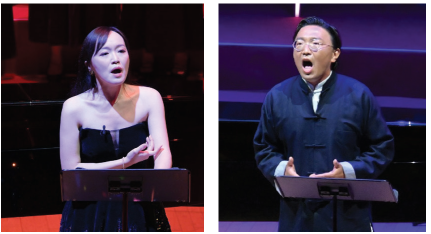
Performances by two opera singers added one more layer of sophistication to the evening that had already surpassed expectations. Tenor Chen Chen and pianist Huang Naiwei marked their entry with a rendition of Along the Songhua River, written and composed by Zhang Hanhui. Chen's reiteration of the words "September 18" powerfully underscored the pain and significance of that historic date in 1931, when the Imperial Japanese Army launched its invasion of China — marking the beginning of the 14-year Sino-Japanese war. Louise Kwong, a soprano, sang Clouds Over My Hometown, composed by Lin Sheng-shih and written by Wei Hantseung, and Flowers in May, written and set to music by poet Guang Weiran. Her elegant yet powerful voice projected the moving lyrics about displacement and longing for home with elan, effortlessly capturing the audience's attention.
As the Sino-Japanese war intensified, resistance songs evolved from solo pieces to large-scale, multimovement choral works — The Yellow River Cantata, which marked the evening's finale, for example. Inspired by a long, patriotic poem by Guang, Xian Xinghai composed the piece in eight movements in 1939. The Educators' Singers performed four of these, culminating in the stirring final movement — The Roaring Yellow River. The resounding cries of "Defend our homeland! Defend the Yellow River! Defend North China! Defend all of China!" echoed throughout the amphitheater, bringing the concert to a triumphant close and earning a well-deserved ovation from the audience.



- A new lease of life: Providing dialysis access in rural China
- China's grain output hits new high in 2025
- Xinjiang ensures vegetable, fruit supply amid cold wave
- Chinese scientists develop self-powered device to speed up muscle repair
- Taiwan's leader Lai absent from first legislative review meeting of his impeachment
- New plant species with lemon fragrance discovered in China's Guizhou